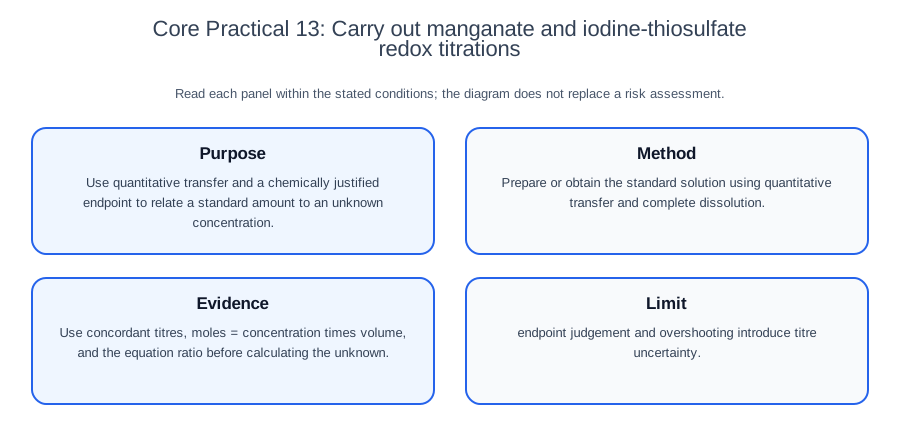
This outline compares acidified manganate(VII), also called permanganate, and separately specified iodine-thiosulfate analysis. It is not a complete authorised procedure or confirmation of current Pearson analytes, reagents or assessed scope. Select the actual reaction, standardisation, acid medium, indicator timing, endpoint and waste controls through the approved practical plan and current course documents. Do not transfer one endpoint rule or analyte-to-titrant ratio to every redox system.
Aim and scientific principle
Relate a standardised reacting amount to the specified analyte through balanced, sufficiently complete and selective reactions. Distinguish the observed endpoint from the stoichiometric equivalence condition and a repeatable titre from an accurate result. State whether thiosulfate measures iodine initially present, iodine generated from an analyte, or iodine remaining after a separate reaction; those calculations have different links to the original sample.
Begin by translating the title into a testable question. Identify what is deliberately changed, what is measured directly, what is calculated and what must remain controlled. Predict a relationship only after naming the mechanism. A prediction without a reason is weak; a reason without measurable variables cannot guide a practical design.
Apparatus and setup
Use the approved quantitative-transfer and volume-measurement equipment, reaction vessels, standardised titrant, specified acid/iodide system and indicator where required. Establish titrant concentration for the actual use rather than assuming a weighed mass or preparation label alone is sufficient. Use the method-specific burette reading convention and endpoint observation; strongly coloured solutions may require a different meniscus convention from clear solutions. Consider measuring range, resolution, uncertainty, calibration and suitability for the sample, not the instrument name alone. Draw a labelled scientific setup that shows the working geometry and exactly where readings are taken. Include a control or blank when it distinguishes the target effect from drift, contamination or background response.
Before collecting results, check zero readings, calibration, leaks, alignment or sterility as relevant. Record the instrument resolution beside the first raw-data table. If a digital device displays more digits than its underlying accuracy supports, do not treat every digit as equally certain.
Method
Identify the analyte, oxidation states, reaction sequence and direction of titration. Establish titrant concentration, sample preparation and any dilution/aliquot factors. Choose the approved acid medium, iodine-generation or residual-iodine stage, blank and endpoint rule before measuring.
Check this topic from memory
Attempt the matching topic bank before reopening the notes. Use each missed idea to decide what to review next.
Prepare and transfer the relevant portions quantitatively using the approved method. Condition volumetric apparatus appropriately, check the burette and its filled tip for delivery faults, remove unintended bubbles/funnel and record raw initial readings. Keep sample identity and all volume factors traceable.
Follow the prescribed mixing, addition, timing and endpoint criteria. For acidified manganate(VII) used as titrant, the specified persistent faint excess-titrant colour is a method-defined endpoint, not proof of exact equivalence. When thiosulfate consumes an initially iodine-rich solution, the approved method normally delays starch until most iodine has reacted and uses disappearance of its blue colour. Direct iodine-as-titrant methods can use colour appearance and different indicator timing; do not interchange these rules.
Retain final readings and individual titres, distinguish a rough trial, inspect repeats against the stated concordance criterion and justify exclusions. Calculate reacting amounts with the correct balanced sequence, blank correction and aliquot/dilution factors. Concordance supports repeatability, not accuracy or selectivity; investigate a shared bias rather than averaging it away.
Plan the analysis before starting. This reveals whether an additional measurement is needed for a derived quantity and prevents a completed experiment from lacking a mass, length, concentration, background or calibration value. A method should be detailed enough for another trained student to reproduce, while avoiding decorative steps that do not affect validity.
Variables and controls
Independent variable: delivered titrant volume.
Dependent variable: defined endpoint response used to determine the reacting volume.
Important controls: sample preparation and aliquot, titrant concentration and stability, acid/reagent conditions, indicator amount/timing, mixing, reaction/waiting time, iodine retention, blank and endpoint rule. Relevant conditions differ between the two reaction systems; they are not interchangeable controls.
Explain how each relevant condition is maintained or checked. This is usually an amount determination, not a requirement for an arbitrary independent-variable range or fitted trend. Delivered titrant volume is varied to locate the endpoint; repeat titrations estimate repeatability. A separate concentration-dependence investigation needs its own justified design. Changing acid, time or indicator can change the chemical result, not merely the ease of observing it.
What is distinctive about this practical
For the specified acidic reduction of manganate(VII) to manganese(II), an iron(II) example is MnOX4X−+5FeX2++8HX+MnX2++5FeX3++4HX2O. Thus n(FeX2+)=5n(MnOX4X−) applies to that complete reaction, not every reductant. Use the actual balanced equation and acid medium; a different manganese product, interference or incomplete reaction invalidates an assumed ratio. Iron(II) analysis is not automatically total iron analysis across oxidation states.
For the usual iodine-to-iodide/thiosulfate-to-tetrathionate step, IX2+2SX2OX3X2−2IX−+SX4OX6X2−, so n(IX2)=21n(SX2OX3X2−). Iodine may be present as triiodide in iodide-rich solution; use the corresponding balanced form consistently. If iodine was first generated from an oxidant, add that reaction ratio; if residual iodine is measured after reacting with a reductant, use the initial-minus-remaining balance. The thiosulfate ratio alone does not determine an arbitrary original analyte.
Use n=cV with consistent concentration and volume units, a valid standardised concentration and any justified blank correction. The visual endpoint is an operational detection condition with possible error relative to equivalence. In an iodine-rich solution titrated with thiosulfate, late starch addition avoids the endpoint difficulty associated with a large iodine-starch response; it is not a universal timing rule for every iodine method. Iodine loss, incomplete iodine generation, other redox-active species and titrant instability can bias a chemically neat calculation. A reverse arithmetic check verifies bookkeeping, not quantitative recovery or selectivity.
Recording and processing results
Record raw initial/final burette readings, individual titres, titrant concentration and standardisation, aliquot/sample preparation, acid/reagent and indicator conditions, blank, timing and actual endpoint observations. State the concordance rule and which runs enter a mean; retain rough trials and anomalies separately. Show the full reaction chain from titrant to measured species to the requested original-sample quantity, including dilution and any initial-minus-remaining calculation. Keep units and precision consistent without treating repeated agreement as proof of accuracy.
For routine amount determination, use the volume/amount record and balanced stoichiometry rather than an unnecessary independent-variable graph. A titration curve or instrumental endpoint can be useful only with a justified response and endpoint criterion. An instrumental signal does not automatically remove reaction interference, iodine loss or standardisation error. Check the calculation direction before assigning a final concentration-error sign.
Safety, ethics and responsible practice
Follow the approved substance-specific risk assessment for the actual acid, oxidant, iodide/iodine, thiosulfate, indicator and sample, including suitable eye/skin protection, ventilation and waste segregation. Use only the authorised medium, addition order and temperature. Do not improvise stronger acid, heat, iodide mixtures or replacement oxidants to sharpen an endpoint. This outline approves no reagent concentration, volume recipe or hands-on procedure.
Worked application: from raw evidence to a defensible conclusion
Consider a constructed direct iodine determination, not experimental data or an approved mixture. A standardised thiosulfate concentration of 0.0100molL−1 and valid blank-corrected titre of 20.00mL give n(SX2OX3X2−)=0.000200mol. The stated iodine-thiosulfate reaction gives n(IX2)=0.000100mol. If this is all the iodine in an aliquot of 25.00mL, its concentration is 0.00400molL−1, conditional on quantitative retention and the stated method. Any earlier sample dilution must still be accounted for.
Loss of iodine before this direct measurement would reduce the titre and underestimate the original iodine amount if no loss correction were justified. In a different back-titration model, losing iodine remaining after reaction can make calculated analyte consumption too large. These are different bookkeeping cases, not one universal iodine-loss error direction. Likewise, an overshoot with standard titrant normally raises the inferred fixed-aliquot amount, whereas standardising an unknown titrant against a fixed known amount puts volume in the denominator. State the actual calculation before predicting the bias; concordant biased titres remain biased.
Evaluation: limitation, effect and improvement
Limitation: endpoint judgement/overshoot, titrant concentration drift, iodine loss or incomplete generation, unsuitable medium, interference and transfer errors can affect the result.
Likely effect: inconsistent endpoints add spread, while a consistent overshoot makes delivered titre too large. The final amount/concentration direction depends on what is unknown and on the reaction chain. Iodine loss can bias direct and residual-iodine determinations differently. A correct-looking colour change or concordance does not diagnose interference or establish complete recovery.
Targeted improvement: validate standardisation, quantitative transfer, actual medium/reaction timing, iodine retention and the method-specific endpoint/indicator rule. Use an approved rough trial, viewing arrangement and controlled near-endpoint addition where appropriate. Add a justified instrumental endpoint only if it addresses the demonstrated limitation; more repeats do not repair shared chemical bias.
Separate random variation, systematic bias and model limitation. Repeats help reveal random variation but do not remove a zero error. Calibration establishes the relation between reference values and indications; appropriate adjustment or correction can address an identified offset. It does not make biased sampling representative. Finer resolution and greater repeatability are distinct properties, and finer resolution may improve an estimate only when the reading is a material source of uncertainty.
Common misconceptions and corrections
Repeats automatically make a result accurate. Repeats estimate random variation; they do not correct a biased method or calibration error.
A control variable is just a list item. Explain the apparatus or procedure that keeps it stable.
The line must pass through every point. Use the overall pattern and a best-fit relationship, then investigate justified anomalies.
Percentage error and percentage uncertainty are interchangeable. Error compares a measured value with a suitable reference. Uncertainty characterises dispersion of values attributed to the measurand; it may be expressed as a standard uncertainty or an interval with stated coverage, and includes more than resolution alone. State the reference, denominator and uncertainty convention used.
A successful endpoint proves the theory. The observation supports a conclusion only within the method, range and assumptions tested.
More sophisticated apparatus is always better. The improvement must address the dominant limitation and be practical in the stated context.
Assessment guidance
Pearson states that IAL practical skills are assessed mainly in Unit 3 and Unit 6, with related theory also assessable in the other unit papers. Planning answers need an operational independent variable, a measured dependent variable, a justified range, controls, repeats, safety and a stated analysis. Data answers need units, consistent precision, sensible significant figures and transparent calculations. Graph answers need labelled axes, a scale using the grid well and line treatment appropriate to the data and question. Evaluation answers should use a limitation-effect-improvement chain specific to the apparatus. Do not claim that a memorised core-practical recipe is the only acceptable method when the question supplies a different valid context.
Retrieval practice
Extend or adapt this practical to answer a related question. Where the design uses a continuous variable, justify its planned values. List apparatus with range and resolution where relevant, control methods, a raw record layout, the expected analysis and one hazard-control pair. Then identify one random uncertainty, one systematic bias and one model limitation. Explain which can be reduced by repeats, which needs calibration followed by appropriate correction or adjustment, or a redesign, and how your conclusion would change if the anomaly were confirmed.