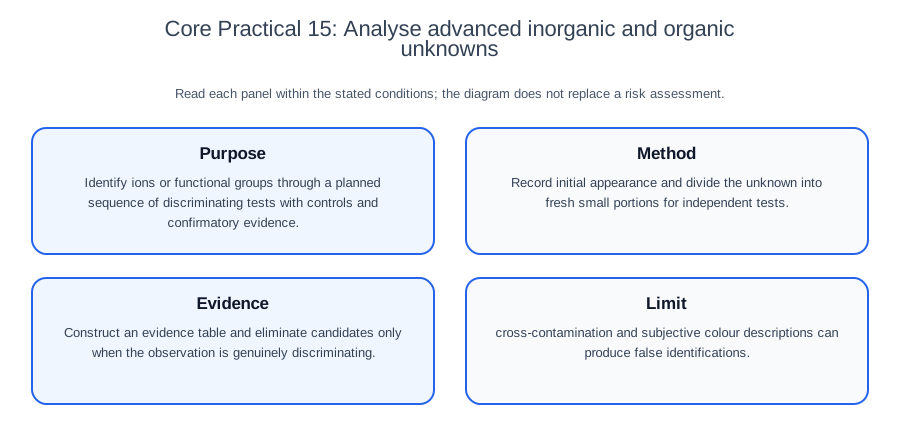
This outline develops evidence-based identification by combining approved wet tests and supplied or authorised spectral or synthesis evidence within a stated candidate set. It is not a complete authorised test scheme or confirmation of current Pearson advanced-test, spectral or assessed scope. Select the actual tests, quantities, conditions, controls and waste route through the approved practical plan and current course documents. An unknown sample must still have sufficient hazard information for its approved handling.
Aim and scientific principle
Narrow an explicitly stated candidate set using tests whose discrimination and operating conditions are understood. Record observations before inference, and distinguish evidence for an ion or functional group from unique identification of an entire compound, purity or composition. One positive colour or precipitate is not automatically specific.
Begin by translating the title into a testable question. Identify what is deliberately changed, what is measured directly, what is calculated and what must remain controlled. Predict a relationship only after naming the mechanism. A prediction without a reason is weak; a reason without measurable variables cannot guide a practical design.
Apparatus and setup
Use the approved vessels, clean dedicated transfer tools, reagents, reference/control materials and any required temperature or analytical equipment. Equipment choice follows the test and sample hazards; neither small volume nor an unknown label establishes safety. Keep source samples separate from reacted portions and record sample/reagent identities without cross-contamination. Consider measuring range, resolution, uncertainty, calibration and suitability for the sample, not the instrument name alone. Draw a labelled scientific setup that shows the working geometry and exactly where readings are taken. Include a control or blank when it distinguishes the target effect from drift, contamination or background response.
Before collecting results, check zero readings, calibration, leaks, alignment or sterility as relevant. Record the instrument resolution beside the first raw-data table. If a digital device displays more digits than its underlying accuracy supports, do not treat every digit as equally certain.
Method
Establish the allowed candidate set, sample context and approved test decision scheme. Record initial appearance without smelling, tasting or improvised exposure. Label and divide fresh portions for separate tests as the method requires; do not return reacted material to the source.
Choose tests that distinguish the remaining candidates under the actual concentration, matrix and conditions. Run appropriate reagent/procedure blanks and known positive controls, and a negative reference where needed to assess discrimination. Define valid observations and control acceptance before interpreting the unknown.
Check this topic from memory
Attempt the matching topic bank before reopening the notes. Use each missed idea to decide what to review next.
Apply the specified addition, excess-reagent or heating conditions only where the method calls for them. Record reagent, amount, order, time, conditions and the actual colour, phase, gas or other response separately from the inferred identity. Do not add excess indiscriminately or perform an improvised gas test.
Reconcile compatible positive, negative and ambiguous results with controls and possible interference. Choose an additional discriminating test when needed; one extra test is not a universal guarantee of confirmation. If controls fail or evidence conflicts, retain an unresolved candidate set and investigate rather than forcing one identity.
Plan the analysis before starting. This reveals whether an additional measurement is needed for a derived quantity and prevents a completed experiment from lacking a mass, length, concentration, background or calibration value. A method should be detailed enough for another trained student to reproduce, while avoiding decorative steps that do not affect validity.
Variables and controls
Independent variable: test reagent or condition applied to separate aliquots.
Dependent variable: colour, precipitate, gas, pH or other analytical observation.
Important controls: fresh labelled portions, reagent identity/condition and specified amount, addition order, time/temperature, clean transfer tools, matrix and control/reference responses. Different tests deliberately use different reagents; do not describe their chemistry as identical controls. Record how each relevant condition is established.
For each relevant condition, explain how it is maintained or checked. In qualitative identification, the coverage of plausible candidates and interferents matters more than an arbitrary number of evenly spaced values. Choose test conditions and reference materials for the actual decision. A concentration or temperature range is appropriate only where the investigation genuinely measures a quantitative dependence.
What is distinctive about this practical
For inorganic evidence, distinguish the original sample from the species produced after adding reagents. A transition-metal colour or precipitate depends on the specified chemical conditions; do not treat it as a unique label for a complete salt, oxidation state or coordination structure without the required evidence. Fresh portions reduce deliberate test-to-test transformation and clean tools reduce carry-over, but neither establishes analytical specificity.
For organic evidence, separate a functional-group indication from a complete structural assignment. IR patterns can support functional groups and comparison with an appropriate reference; one selected band is not a complete molecular structure. Interpret supplied NMR observations for the stated nucleus and method, using the relevant chemical environments and other justified constraints rather than equating every visible line with a separate atom. Record what each observation excludes and what it leaves unresolved. A supplied synthesis route is a constraint to assess, not automatic proof of an isolated product.
Reconcile all evidence with sample identity, preparation, actual measurement conditions and the candidate model. A blank addresses background/contamination only within its covered stages. A positive control tests response under its own conditions, not every unknown matrix; useful negative evidence additionally requires adequate detection and valid sample conditions. Tests or spectral assignments sharing the same disputed assumption are not automatically independent confirmation. If valid results conflict, preserve the conflict; consider misassignment, sample mismatch, interference, mixture or an incomplete candidate set without declaring any one cause proved.
Recording and processing results
Construct an evidence table with test conditions, raw observation, blank/positive/negative control results, validity decision, compatible candidates and the next discriminating step. Keep absent, weak, ambiguous and invalid responses distinct. Record units and resolution for any quantitative readings and retain anomalies. Do not turn failed-control observations into negative chemical evidence or omit conflicting results to obtain a desired identification.
Use a decision table or justified decision scheme for categorical observations. Assigning arbitrary numbers to colours or candidate names does not make a fitted trend meaningful. If an approved quantitative method is used, explain its calibration, range and decision criterion and interpret any graph accordingly. A spectrum or instrument label is another evidence source with its own reference, mixture and detection limits; it does not automatically resolve ambiguity.
Safety, ethics and responsible practice
Follow the approved substance-specific risk assessment for the possible sample hazards and actual reagents, including ventilation, eye/skin protection, addition/heating and waste segregation. Use only the authorised sample scale and gas-identification method. Never taste or deliberately smell an unknown, combine arbitrary test reagents or heat a sealed improvised system. A small amount is not a general safety approval; this outline does not approve a reagent recipe or hands-on scheme.
Worked application: from raw evidence to a defensible conclusion
Consider a constructed single-substance decision model with candidates A, B and C, not actual chemical or spectral profiles. Suppose valid evidence constraint P is compatible with A and B, while valid complementary constraint Q is compatible with B and C. Their intersection leaves B within the stated complete candidate model. Reading the same feature twice or assigning it two labels is not a new independent constraint.
Suppose a further approved test R is expected positive for B but is negative for the unknown. If R and its relevant controls and sample conditions are valid, no listed single candidate fits all three constraints: report the conflict rather than ignoring R. If the positive control for R fails, the negative unknown result cannot validly exclude B, but B remains provisional rather than confirmed. Mixture, misassignment, sample mismatch, interference or an omitted candidate require further evidence; the pattern alone does not diagnose which explanation is correct.
Evaluation: limitation, effect and improvement
Limitation: carry-over, background, weak/subjective responses, interference, failed controls and an incomplete candidate model can produce false or over-specific conclusions.
Likely effect: contamination can create a false positive, while suppression or inadequate response can create a false negative. Ambiguous observation language can change classification between observers. A positive control does not automatically detect all contamination, and repeated tests do not repair a shared interference or omitted candidate.
Targeted improvement: use clean dedicated tools, fresh portions and controls matched to the suspected failure. Define observations, check relevant interferents and choose a test that distinguishes the remaining alternatives. Add instrumental evidence only with appropriate references and interpretation; report an unresolved result when discrimination is insufficient.
Separate random variation, systematic bias and model limitation. Repeats help reveal random variation but do not remove a zero error. Calibration establishes the relation between reference values and indications; appropriate adjustment or correction can address an identified offset. It does not make biased sampling representative. Finer resolution and greater repeatability are distinct properties, and finer resolution may improve an estimate only when the reading is a material source of uncertainty.
Common misconceptions and corrections
Repeats automatically make a result accurate. Repeats estimate random variation; they do not correct a biased method or calibration error.
A control variable is just a list item. Explain the apparatus or procedure that keeps it stable.
The line must pass through every point. Use the overall pattern and a best-fit relationship, then investigate justified anomalies.
Percentage error and percentage uncertainty are interchangeable. Error compares a measured value with a suitable reference. Uncertainty characterises dispersion of values attributed to the measurand; it may be expressed as a standard uncertainty or an interval with stated coverage, and includes more than resolution alone. State the reference, denominator and uncertainty convention used.
A successful endpoint proves the theory. The observation supports a conclusion only within the method, range and assumptions tested.
More sophisticated apparatus is always better. The improvement must address the dominant limitation and be practical in the stated context.
Assessment guidance
Pearson states that IAL practical skills are assessed mainly in Unit 3 and Unit 6, with related theory also assessable in the other unit papers. Planning answers need an operational independent variable, a measured dependent variable, a justified range, controls, repeats, safety and a stated analysis. Data answers need units, consistent precision, sensible significant figures and transparent calculations. Graph answers need labelled axes, a scale using the grid well and line treatment appropriate to the data and question. Evaluation answers should use a limitation-effect-improvement chain specific to the apparatus. Do not claim that a memorised core-practical recipe is the only acceptable method when the question supplies a different valid context.
Retrieval practice
Extend or adapt this practical to answer a related question. Where the design uses a continuous variable, justify its planned values. List apparatus with range and resolution where relevant, control methods, a raw record layout, the expected analysis and one hazard-control pair. Then identify one random uncertainty, one systematic bias and one model limitation. Explain which can be reduced by repeats, which needs calibration followed by appropriate correction or adjustment, or a redesign, and how your conclusion would change if the anomaly were confirmed.