Pearson International A Level Chemistry Core Practical 16: Prepare and purify aspirin
Pearson International A Level Chemistry Core Practical 16: Prepare and purify aspirin
Study guide//Updated 16 Oct 2026
Pearson IAL Chemistry aspirin preparation: overall yield versus purification recovery, method-specific isolation and drying, and limits of melting-range evidence.
This outline develops the evidence needed to prepare and assess aspirin, or acetylsalicylic acid, under an approved method. It is not a complete authorised synthesis or confirmation of current Pearson reagents or assessed scope. Select the actual reaction, work-up, purification, drying, characterisation and waste controls through the approved practical plan and current course documents. Separate the amount recovered from the evidence that it is the intended sufficiently pure product.
Aim and scientific principle
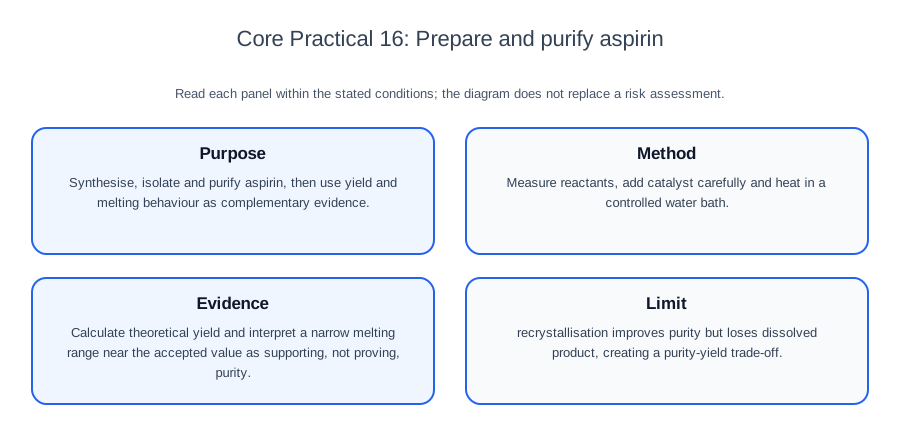
Prepare and isolate the intended aspirin product, then assess recovered mass, overall isolated yield and evidence for identity and purity as separate outcomes. Calculate theoretical product from the approved reaction stoichiometry and actual limiting reagent. Distinguish yield relative to that theoretical amount from mass recovery through a purification step; neither percentage alone measures chemical purity.
Begin by translating the title into a testable question. Identify what is deliberately changed, what is measured directly, what is calculated and what must remain controlled. Predict a relationship only after naming the mechanism. A prediction without a reason is weak; a reason without measurable variables cannot guide a practical design.
Apparatus and setup
Use the approved reactants, catalyst where specified, controlled heating, suitable collection and purification equipment, compatible solvent, balance and characterisation facilities. Record actual reagent form, purity or concentration and relevant quantities. Salicylic acid and ethanoic anhydride are one specified synthesis route, not permission to substitute an arbitrary acylating reagent or catalyst. Choose the apparatus and solvent for the authorised method. Consider measuring range, resolution, uncertainty, calibration and suitability for the sample, not the instrument name alone. Draw a labelled scientific setup that shows the working geometry and exactly where readings are taken. Include a control or blank when it distinguishes the target effect from drift, contamination or background response.
Before collecting results, check zero readings, calibration, leaks, alignment or sterility as relevant. Record the instrument resolution beside the first raw-data table. If a digital device displays more digits than its underlying accuracy supports, do not treat every digit as equally certain.
Method
Identify the approved reaction, product form, actual reactant quantities and limiting reagent. Record relevant purity or concentration and distinguish reagents, catalyst and solvent roles. Use only the specified addition, mixing, temperature and reaction-time conditions.
Check this topic from memory
Attempt the matching topic bank before reopening the notes. Use each missed idea to decide what to review next.
Follow the authorised work-up, including quenching and crystallisation where specified. Keep crude material and purification input traceable to the original batch or stated fraction. A visible precipitate alone does not establish aspirin identity or complete reaction.
Collect, wash and purify using the prescribed solvent system and conditions. Control dissolution, exposure time, cooling and transfer losses as the method requires; unnecessary solvent can increase dissolved-product loss, while unsuitable conditions may change the chemical product. Dry and weigh by the approved criterion without improvising stronger heating.
Record recovered masses, any fractions removed and the actual melting-range measurement conditions and observations. Calculate overall yield and purification mass recovery with their different denominators. Use suitable reference and complementary characterisation evidence; retain uncertainty about composition rather than treating all weighed solid as pure aspirin.
Plan the analysis before starting. This reveals whether an additional measurement is needed for a derived quantity and prevents a completed experiment from lacking a mass, length, concentration, background or calibration value. A method should be detailed enough for another trained student to reproduce, while avoiding decorative steps that do not affect validity.
Variables and controls
Independent variable: a deliberately varied reaction or purification condition only in a separately planned comparison. A single preparation does not require an invented continuous-variable series.
Dependent variable: recovered mass, calculated overall yield, purification mass recovery and observed melting range or other specified characterisation. These outcomes are related but not interchangeable purity measurements.
Important controls: actual reagent quantities and quality, specified catalyst and reaction conditions, batch/fraction accounting, solvent system and amount, heating/cooling and exposure time, collection, drying/weighing conditions, and melting-range instrument and sample preparation. Separate intended changes from controls.
For each relevant condition, explain how it is maintained or checked. A single synthesis needs traceable quantities, observations and analysis rather than an arbitrary minimum of evenly spaced values. A comparison needs justified conditions, appropriate repeat preparations and defined outcomes. Reweighing one sample is not an independent repeat synthesis, and changing product composition is not merely a change in recovery.
What is distinctive about this practical
Synthesis, isolation and purification address different questions. Overall isolated yield compares recovered intended aspirin with the stoichiometric theoretical amount from the starting reaction. Purification mass recovery compares the collected material with the amount actually entering that purification step, accounting for any fraction used. Crude and purified masses can have different compositions; a mass-recovery percentage is not an assay of aspirin purity or automatically the recovery of chemically pure aspirin.
A melting range is an observed interval under stated measurement conditions. Record the onset and completion criteria, instrument/reference check, sample preparation and heating conditions. A narrow interval near an appropriate reference supports the assessment but does not uniquely identify aspirin or supply a purity percentage. Impurities can lower or broaden a range, but heating/thermal lag, preparation and chemical change also affect the observation; some mixtures can melt sharply. A changed range alone does not diagnose one cause.
Purification depends on compatible solvent behaviour and product stability, not just cooling as far as possible or heating for longer. Aspirin can undergo chemical change under unsuitable aqueous, alkaline or heating conditions, so follow the authorised exposure and drying method. Distinguish removal of retained solvent from product loss or decomposition. A stable mass is a weighing criterion, not proof of identity or purity. Use the specified complementary evidence with its own limitations, rather than assuming that recrystallisation necessarily succeeds.
Recording and processing results
Record reagent quantities and relevant quality, limiting-reagent calculation, batch or fraction used, crude mass, purification input and output masses, tare and drying conditions, and characterisation observations. Calculate theoretical and recovered intended-product amounts in consistent units. Label overall yield and purification mass recovery separately, with explicit denominators and any justified composition correction. Preserve raw observations and reasons for excluding data; an apparently excessive yield requires investigation of retained material, tare, quantities and composition.
A single preparation needs mass and stoichiometric records plus characterisation evidence, not an unrelated best-fit graph. For an actual varied-condition comparison, define the outcome and keep batch/fraction accounting consistent. Report the measured melting interval and reference conditions rather than converting width into a purity percentage without a validated method. Lower recovered mass does not distinguish incomplete reaction, dissolution, handling loss or chemical change by itself.
Safety, ethics and responsible practice
Follow the approved substance-specific risk assessment for the actual acylating reagent, catalyst, solvents, work-up and products, including appropriate protection, ventilation, controlled heating, additions and waste segregation. Use only the authorised quench, solvent and drying conditions. This outline approves no reagent recipe, concentration, hands-on procedure or use of the prepared material as medicine.
Worked application: from raw evidence to a defensible conclusion
Consider a constructed complete-batch mass-accounting example, not experimental data or a synthesis recipe. Suppose the approved reaction and limiting reagent predict 2.00g of aspirin. A crude mass of 1.60g is all taken into purification, and the final weighed material is 1.20g. The apparent overall mass-based yield is sixty per cent, while purification mass recovery is seventy-five per cent. The latter is not seventy-five per cent purity, nor proof that only a quarter of the aspirin was lost, because the crude and final compositions may differ.
If independent evidence establishes that the final weighed material is the intended pure aspirin form, its isolated yield in this model is sixty per cent. If it contains retained solvent, an impurity or altered product, the mass alone does not establish that chemical yield. A narrower melting interval after purification can add evidence under matched measurement conditions, but does not by itself quantify purity, prove identity or identify why mass decreased. These arithmetic cases test denominators and interpretation, not an actual synthesis, assay or purification performance.
Evaluation: limitation, effect and improvement
Limitation: dissolved-product and handling losses, retained material, chemical change and imperfect melting-range measurement can affect mass and purity interpretation; purification is not guaranteed to improve every sample.
Likely effect: aspirin left in solution or lost in transfer lowers recovered intended-product yield. Retained material can inflate apparent mass; changed composition or melting measurement conditions can alter the interval. A mass loss or broad range alone does not isolate the cause, and stable mass does not establish purity.
Targeted improvement: investigate the observed loss or composition/measurement problem, then apply the authorised solvent, dissolution, cooling, washing and drying conditions. Check batch/fraction accounting, tare, relevant references and suitable characterisation. Reducing solvent, stronger heating or extra recrystallisation is not a universal correction; each must be compatible with the actual method and demonstrated limitation.
Separate random variation, systematic bias and model limitation. Repeats help reveal random variation but do not remove a zero error. Calibration establishes the relation between reference values and indications; appropriate adjustment or correction can address an identified offset. It does not make biased sampling representative. Finer resolution and greater repeatability are distinct properties, and finer resolution may improve an estimate only when the reading is a material source of uncertainty.
Common misconceptions and corrections
Repeats automatically make a result accurate. Repeats estimate random variation; they do not correct a biased method or calibration error.
A control variable is just a list item. Explain the apparatus or procedure that keeps it stable.
The line must pass through every point. Use the overall pattern and a best-fit relationship, then investigate justified anomalies.
Percentage error and percentage uncertainty are interchangeable. Error compares a measured value with a suitable reference. Uncertainty characterises dispersion of values attributed to the measurand; it may be expressed as a standard uncertainty or an interval with stated coverage, and includes more than resolution alone. State the reference, denominator and uncertainty convention used.
A successful endpoint proves the theory. The observation supports a conclusion only within the method, range and assumptions tested.
More sophisticated apparatus is always better. The improvement must address the dominant limitation and be practical in the stated context.
Assessment guidance
Pearson states that IAL practical skills are assessed mainly in Unit 3 and Unit 6, with related theory also assessable in the other unit papers. Planning answers need an operational independent variable, a measured dependent variable, a justified range, controls, repeats, safety and a stated analysis. Data answers need units, consistent precision, sensible significant figures and transparent calculations. Graph answers need labelled axes, a scale using the grid well and line treatment appropriate to the data and question. Evaluation answers should use a limitation-effect-improvement chain specific to the apparatus. Do not claim that a memorised core-practical recipe is the only acceptable method when the question supplies a different valid context.
Retrieval practice
Extend or adapt this practical to answer a related question. Where the design uses a continuous variable, justify its planned values. List apparatus with range and resolution where relevant, control methods, a raw record layout, the expected analysis and one hazard-control pair. Then identify one random uncertainty, one systematic bias and one model limitation. Explain which can be reduced by repeats, which needs calibration followed by appropriate correction or adjustment, or a redesign, and how your conclusion would change if the anomaly were confirmed.