

Pearson International A Level Physics Unit 2: Waves and Electricity
Pearson IAL Physics notes on waves, particle nature of light and electric circuits.
Pearson Edexcel International A Level Physics Unit 2 is an externally assessed written unit. This note follows the official specification content and keeps theory ownership separate from the dedicated practical-skills hub. Experimental evidence can appear inside theory questions, but Units 3 and 6 remain the written practical-skills papers. Pearson's 2025 addendum also requires confident conversion between giga, mega, kilo, centi, milli, micro and nano prefixes.
Official unit scope
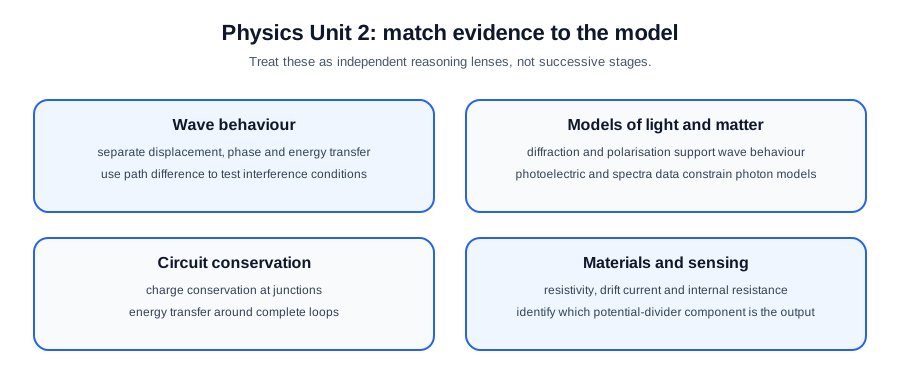
- Wave description and superposition. Use wave graphs, phase and path difference, stationary-wave nodes and antinodes, string-wave speed, intensity, refraction and total internal reflection.
- Diffraction and quantum evidence. Apply diffraction-grating and de Broglie relationships, explain polarisation and Huygens' construction, and distinguish the wave evidence from photoelectric and line-spectrum evidence for photons and discrete energy levels.
- Circuit quantities and conservation. Define current, potential difference, resistance and electromotive force, derive series and parallel resistance results from charge and energy conservation, and interpret current-potential difference characteristics.
- Materials and sensing circuits. Use resistivity and drift-current relationships, analyse potential dividers, and distinguish electromotive force from terminal potential difference when a source has internal resistance.
The content is assessed through unfamiliar contexts as well as direct recall. Build explanations from first principles: identify the system, name the relevant quantities or structures, state the mechanism, connect cause to observation and limit the conclusion to the evidence supplied. A list of keywords is not a causal explanation.
Core reasoning and methods
- Use phase and path difference explicitly when explaining interference.
- Apply charge conservation at junctions and energy conservation around complete loops with a consistent sign convention.
- For a potential divider, identify which component output is measured across before predicting the response.
Quantitative work should begin with the governing relationship, followed by unit conversion, substitution, calculation and a reasonableness check. Keep additional significant figures during working and round at the end. Qualitative work needs the same discipline: compare like with like, identify a control or baseline, and distinguish an observed result from an inferred mechanism.
Graphs and tables are arguments in compressed form. Read axes, units, uncertainty indicators and scales before describing a trend. A valid conclusion identifies the relevant interval, direction and evidence. If data scatter or overlap weakens the claim, say so. Extrapolation beyond the measured range requires justification.
Check this topic from memory
Attempt the matching topic bank before reopening the notes. Use each missed idea to decide what to review next.
Start the topic quiz