

Pearson International A Level Physics Unit 4: Further Mechanics, Fields and Particles
Pearson IAL Physics notes on further mechanics, electric and magnetic fields, nuclear and particle physics.
Pearson Edexcel International A Level Physics Unit 4 is an externally assessed written unit. This note follows the official specification content and keeps theory ownership separate from the dedicated practical-skills hub. Experimental evidence can appear inside theory questions, but Units 3 and 6 remain the written practical-skills papers. Pearson's 2025 addendum also requires confident conversion between giga, mega, kilo, centi, milli, micro and nano prefixes.
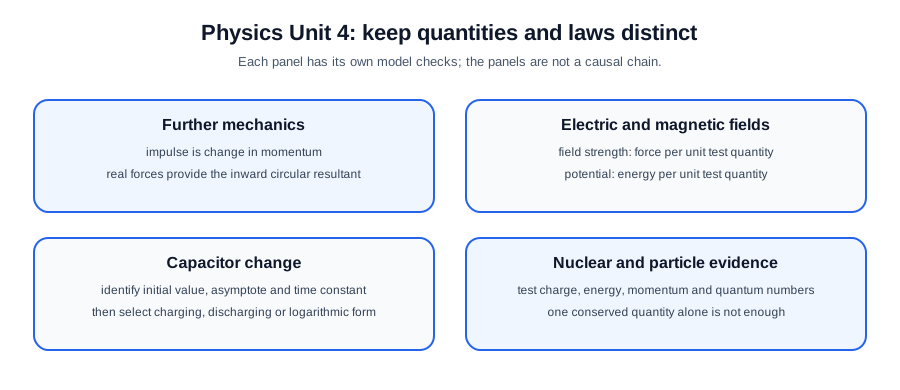
Official unit scope
- Further mechanics. Connect impulse with change in momentum, analyse two-dimensional collisions, distinguish elastic from inelastic collisions, and use radian measure, angular velocity and centripetal acceleration without inventing an additional centripetal force.
- Electric and magnetic fields. Use field strength, potential, field lines and equipotentials; apply Coulomb's law, parallel-plate relationships, capacitance and capacitor energy; and analyse forces on charges, currents and moving particles in magnetic fields.
- Capacitors and exponential change. Interpret charge, current and potential difference during charging and discharging, use the time constant , and connect exponential graphs and logarithmic forms to experimental evidence.
- Nuclear and particle physics. Use scattering evidence, accelerators, mass-energy conversion and particle lifetimes, then test particle reactions through conservation of charge, energy, momentum, baryon number and lepton number.
The content is assessed through unfamiliar contexts as well as direct recall. Build explanations from first principles: identify the system, name the relevant quantities or structures, state the mechanism, connect cause to observation and limit the conclusion to the evidence supplied. A list of keywords is not a causal explanation.
Core reasoning and methods
- Treat electric field strength as electric force per unit positive test charge, and electric potential as electric potential energy per unit charge. Magnetic flux density is a different quantity: the magnetic force on a moving charge also depends on its velocity and its direction relative to the field.
Check this topic from memory
Attempt the matching topic bank before reopening the notes. Use each missed idea to decide what to review next.
Start the topic quiz