

Pearson International A Level Physics Unit 5: Thermodynamics, Radiation, Oscillations and Cosmology
Pearson IAL Physics notes on thermodynamics, nuclear decay, oscillations, astrophysics and cosmology.
Pearson Edexcel International A Level Physics Unit 5 is an externally assessed written unit. This note follows the official specification content and keeps theory ownership separate from the dedicated practical-skills hub. Experimental evidence can appear inside theory questions, but Units 3 and 6 remain the written practical-skills papers. Pearson's 2025 addendum also requires confident conversion between giga, mega, kilo, centi, milli, micro and nano prefixes.
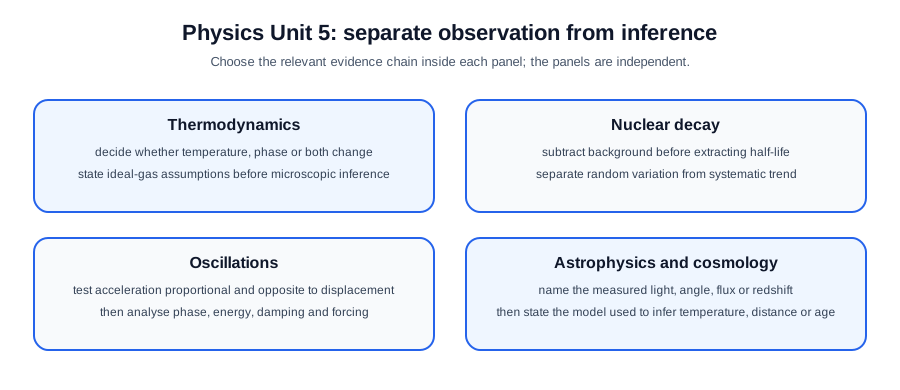
Official unit scope
- Thermodynamics. Distinguish heating within a phase from a phase change, connect internal energy and absolute temperature to microscopic behaviour, and use both the ideal-gas equation and the molecular kinetic-energy relationship under ideal-gas assumptions.
- Nuclear decay. Use mass defect and binding energy, compare fission and fusion, account for background radiation, relate ionising ability to penetration, and analyse random decay with half-life and exponential relationships.
- Oscillations. Apply the defining acceleration or force condition for simple harmonic motion, interpret displacement, velocity and energy, and distinguish free, forced, resonant, damped and undamped behaviour.
- Astrophysics and cosmology. Use gravitational fields and orbital motion, black-body laws, luminosity, intensity, parallax and standard candles; interpret Hertzsprung-Russell diagrams, stellar evolution, Doppler shift, Hubble's law and evidence relevant to the universe's age and possible fate.
The content is assessed through unfamiliar contexts as well as direct recall. Build explanations from first principles: identify the system, name the relevant quantities or structures, state the mechanism, connect cause to observation and limit the conclusion to the evidence supplied. A list of keywords is not a causal explanation.
Core reasoning and methods
- Separate temperature change from phase change before selecting specific heat or latent heat equations.
- For oscillations, identify amplitude, phase, energy transfers and the effect of damping or forcing.
- In cosmology, distinguish direct observations from model-dependent inference.
Quantitative work should begin with the governing relationship, followed by unit conversion, substitution, calculation and a reasonableness check. Keep additional significant figures during working and round at the end. Qualitative work needs the same discipline: compare like with like, identify a control or baseline, and distinguish an observed result from an inferred mechanism.
Check this topic from memory
Attempt the matching topic bank before reopening the notes. Use each missed idea to decide what to review next.
Start the topic quiz