

Pearson International A Level Physics Core Practical 1: Determine free-fall acceleration
Pearson IAL Physics practical notes on determine free-fall acceleration.
This guide practises measuring free-fall acceleration using an explicit motion model. The outline is a starting point for a locally approved method and risk assessment, not a complete validated procedure. Check the current Pearson specification and practical guide for course-specific requirements.
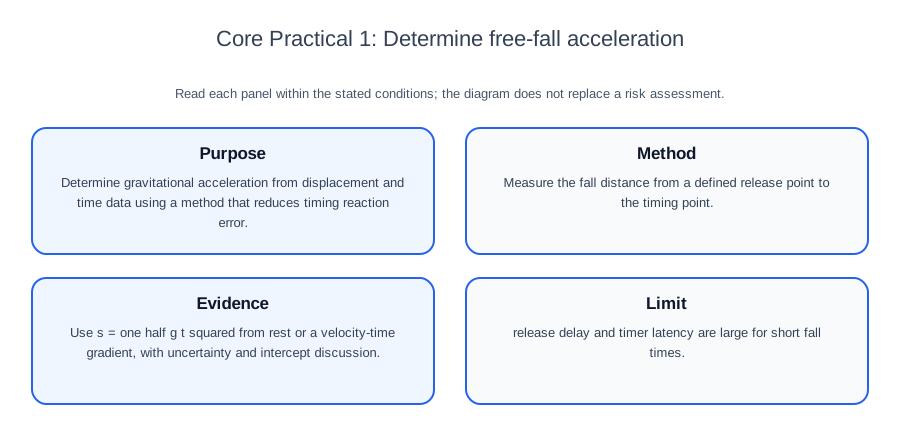
Aim and scientific principle
Determine gravitational acceleration from displacement-time or velocity-time data, using electronic timing or calibrated video. Treat constant gravitational acceleration and negligible air resistance over the chosen range as model assumptions to check.
Begin by translating the title into a testable question. Identify what is deliberately changed, what is measured directly, what is calculated and what must remain controlled. Predict a relationship only after naming the mechanism. A prediction without a reason is weak; a reason without measurable variables cannot guide a practical design.
Apparatus and setup
For release-to-impact timing, use a release mechanism, timer and impact sensor, or calibrated video of a falling object. For velocity-time measurements, use a suitable picket fence and photogate, or a calibrated video motion record. Include a length scale, secure supports and landing protection. The distance reference and timed events must describe the same motion interval. Consider measuring range, resolution, uncertainty, calibration and suitability for the sample, not the instrument name alone. Draw a labelled scientific setup that shows the working geometry and exactly where readings are taken. Include a control or blank when it distinguishes the target effect from drift, contamination or background response.
Before collecting results, check zero readings, calibration, leaks, alignment or sterility as relevant. Record the instrument resolution beside the first raw-data table. If a digital device displays more digits than its underlying accuracy supports, do not treat every digit as equally certain.
Method
- Choose and document the timing method. For release-to-impact timing, measure the vertical displacement between consistent object reference points and synchronise time zero with physical release. For a photogate motion record, identify the gate events and the known spacing used to calculate successive speeds.
- Release without a push and keep the fall vertical. In the photogate method, do not assume the object is at rest at its first recorded event. Under constant acceleration, an interval-average speed corresponds to the velocity at the midpoint of that time interval.
- Repeat the measurements and choose enough distances or motion intervals to test the model across a safe range. Record the timing and length resolution, inspect repeats and retain original data.
Check this topic from memory
Attempt the matching topic bank before reopening the notes. Use each missed idea to decide what to review next.
Start the topic quiz