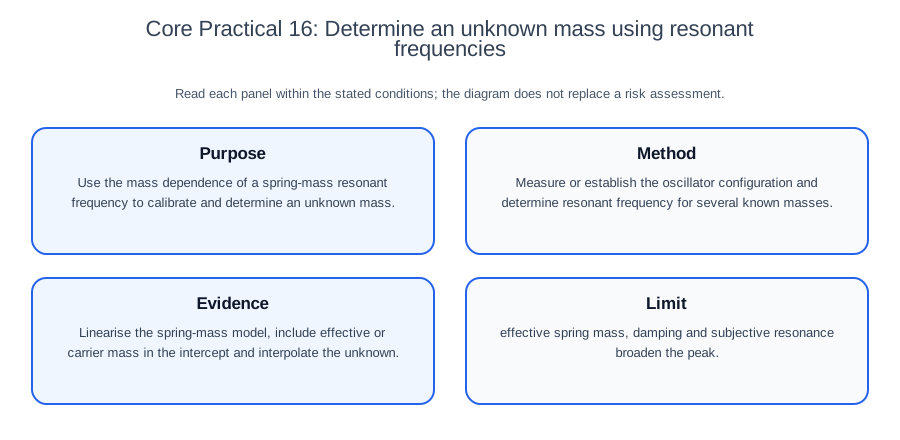
This outline calibrates a stated oscillator response against known attached masses before inferring an unknown. It supports development of a locally approved method and mechanical/electrical risk assessment; it is not a complete validated procedure. Specify the actual drive,mode and response criterion rather than treating every resonance frequency as an undamped natural frequency. Check current Pearson documents for course-specific requirements.
Aim and scientific principle
Use a reproducible frequency-response measurement to calibrate known masses and interpolate an unknown under the same oscillator configuration. State whether the measured quantity is a driven displacement peak,a different response peak or a free-oscillation period; these are not automatically interchangeable. A straight calibration does not independently validate every spring or damping assumption.
Begin by translating the title into a testable question. Identify what is deliberately changed, what is measured directly, what is calculated and what must remain controlled. Predict a relationship only after naming the mechanism. A prediction without a reason is weak; a reason without measurable variables cannot guide a practical design.
Apparatus and setup
Use the specified spring/oscillator,known masses,unknown mass,secure support,appropriate drive and a motion/frequency measurement method. Record the holder,attachments,mass distribution,drive coupling and measured response. A free-decay sensor measurement is a different method from locating a driven peak; do not mix their periods in one calibration without a justified model. Consider measuring range, resolution, uncertainty, calibration and suitability for the sample, not the instrument name alone. Draw a labelled scientific setup that shows the working geometry and exactly where readings are taken. Include a control or blank when it distinguishes the target effect from drift, contamination or background response.
Before collecting results, check zero readings, calibration, leaks, alignment or sterility as relevant. Record the instrument resolution beside the first raw-data table. If a digital device displays more digits than its underlying accuracy supports, do not treat every digit as equally certain.
Method
Record the oscillator,spring working range,holder/attachments,drive geometry and oscillation mode. For known attached masses,measure the stated response with the same instrument and criterion. Include any fixed moving mass consistently; do not assume an effective spring contribution is universally one third of its mass.
Keep displacement within a justified small-amplitude linear range. For driven sweeps,document drive conditions,allow transients to settle and sample both sides of the response peak. Drive amplitude can vary with frequency,and a peak can shift with damping or the chosen response; a generator display alone does not establish peak-frequency accuracy.
Check this topic from memory
Attempt the matching topic bank before reopening the notes. Use each missed idea to decide what to review next.
Derive or empirically justify a transformation for the actual measured frequency. Fit a calibration with a free intercept where warranted,inspect residuals and repeats,and include frequency/response uncertainty. Period squared or inverse frequency squared is linear in attached mass for the appropriate ideal spring model,not for every driven or damped measurement.
Attach the unknown in the same way,repeat the same response measurement and interpolate only within the validated calibration range. Check that its shape,mounting,mode and damping have not changed the response model. Report calibration and unknown-measurement uncertainty; extrapolation needs additional justification.
Plan the analysis before starting. This reveals whether an additional measurement is needed for a derived quantity and prevents a completed experiment from lacking a mass, length, concentration, background or calibration value. A method should be detailed enough for another trained student to reproduce, while avoiding decorative steps that do not affect validity.
Variables and controls
Independent variable: known attached mass.
Dependent variable: the explicitly defined response frequency or period,not an unspecified mixture of driven and free-oscillation measures.
Important controls: spring working range,mode,displacement amplitude,support,measurement method,holder/attachments and drive coupling/conditions. Monitor damping and settling where material; using the same spring does not establish the same stiffness or response for every mass.
For each control, state how it is maintained or monitored. Simply writing "keep temperature constant" is incomplete if the method has no bath, probe, equilibration time or other means of doing so. Choose a range wide enough to reveal the relationship but within safe and scientifically valid limits. Choose the number, range and spacing of values for the expected response and analysis. Concentrating values near an uncertain threshold or optimum can be more useful than uniform spacing; no fixed count establishes an adequate design.
What is distinctive about this practical
For a linear single-mode ideal spring model,the undamped natural angular frequency obeys ω02=k/M. If a constant effective moving contribution is justified, M=m+m0, where m is the varied attached mass and the offset includes the holder and applicable effective spring/attachment contributions. Then 1/f02=4π2(m+m0)/k. Fixed stiffness,mode and effective contribution are assumptions to check,not consequences of drawing a straight line.
A driven displacement-amplitude peak need not occur at that natural frequency. For the specific linear model whose damping force is minus 2 M beta times velocity,with constant-amplitude sinusoidal applied force and a nonzero displacement peak, ωpeak2=ω02−2β2. This follows by minimising the squared response denominator; it is not a universal rule for base-driven motion,velocity/power peaks or a frequency-dependent drive. The free damped period is also distinct. In weak damping these frequencies can be close,but adequacy depends on the required uncertainty.
For a measured frequency define q=1/fmeas2. Use q=am+c only if that calibration is justified for the actual response and range; its coefficients need not have the ideal natural-frequency interpretation when damping or drive effects matter. The unknown follows mu=(qu−c)/a. Retain the intercept and its covariance with the slope. An intercept may absorb fixed moving mass or other offsets; it does not uniquely measure the spring's effective mass. If residuals show curvature,use an appropriate model or restrict the supported range rather than forcing a line.
Recording and processing results
Retain raw frequencies/periods,amplitude-response evidence where used,known masses,attachments,drive conditions and repeats. Distinguish hertz from angular frequency and use consistent mass units. For the ideal natural-frequency calibration,inverse frequency squared against attached mass has slope 4pi squared divided by stiffness; reversed axes change the slope meaning. For an empirical calibration,use its actual fitted coefficients without silently treating them as physical spring constants. Include mass standards,frequency resolution,peak width,drift,fit covariance and mounting/damping changes. Put units in column headings,record readings consistently with instrument resolution and the method,and distinguish repeats from calculated means. Investigate and document anomalies rather than removing them to straighten the calibration.
Choose a fitted line, curve or ruled joins according to the data, scientific relationship and question; do not connect or smooth points mechanically. A gradient should use a large triangle and values read from the fitted line. When a relationship is linearised, explain the transformation and connect gradient or intercept to the requested physical quantity. When observations are categorical, define the category rule before seeing the result.
Safety, ethics and responsible practice
Secure the stand and masses, keep clear of a snapping spring and limit amplitude. A useful safety statement names the hazard, identifies who or what could be harmed and gives a control that reduces likelihood or severity. "Take care" does not specify an action that reduces the identified risk.
Worked application: from raw evidence to a defensible conclusion
This is a constructed calibration example,not measured oscillator data or an approved spring loading. Suppose inverse measured frequency squared in seconds squared is calibrated against attached mass in kilograms with slope 4.0 seconds squared per kilogram and intercept 0.20 seconds squared. An unknown with transformed value 0.84 seconds squared then gives (0.84 minus 0.20) divided by 4.0,or 0.160 kg,provided it lies in the supported range and the same response conditions apply. Omitting the intercept would give 0.210 kg,an overestimate of 0.050 kg in this example.
These constructed coefficients do not establish stiffness,effective spring mass,weak damping or a valid linear calibration for real data. An unknown that changes the damping or mode may need a new calibration/model even when its frequency lies between the known readings.
This chain is stronger than a memorised recipe because every step answers the practical question. If the graph contradicts the prediction, report the evidence honestly and investigate method, range, controls and model assumptions before claiming a new scientific law.
Evaluation: limitation, effect and improvement
Limitation: omitted fixed/effective moving mass changes the calibration;damping,drive conditions and subjective peak identification can change or obscure the measured response.
Likely effect: forcing a zero intercept can bias the unknown mass when a fixed moving contribution or offset is present. Damping can broaden a driven peak and shift a displacement peak relative to the undamped natural frequency. Effective mass alone changes the frequency scale;it does not by itself establish peak broadening. A holder or unknown that changes coupling/mode can invalidate transfer of the calibration.
Targeted improvement: measure the chosen response objectively,use documented small-amplitude drive conditions,allow settling and fit a justified calibration including its intercept. Inspect sweep/repeat consistency and test an independent known mass as a check where practical. A sensor or frequency sweep does not automatically remove damping,drive-frequency variation or model bias; investigate those effects explicitly.
Separate random variation, systematic bias and model limitation. Repeats help reveal random variation but do not remove a zero error. Calibration establishes the relation between reference values and indications; appropriate adjustment or correction can address an identified offset. It does not make biased sampling representative. Finer resolution and greater repeatability are distinct properties, and finer resolution may improve an estimate only when the reading is a material source of uncertainty.
Common misconceptions and corrections
Repeats automatically make a result accurate. Repeats estimate random variation; they do not correct a biased method or calibration error.
A control variable is just a list item. Explain the apparatus or procedure that keeps it stable.
The line must pass through every point. Use the overall pattern and a best-fit relationship, then investigate justified anomalies.
Percentage error and percentage uncertainty are interchangeable. Error compares a measured value with a suitable reference. Uncertainty characterises dispersion of values attributed to the measurand; it may be expressed as a standard uncertainty or an interval with stated coverage, and includes more than resolution alone. State the reference, denominator and uncertainty convention used.
A successful endpoint proves the theory. The observation supports a conclusion only within the method, range and assumptions tested.
More sophisticated apparatus is always better. The improvement must address the dominant limitation and be practical in the stated context.
Assessment guidance
Pearson assesses practical understanding throughout the science papers and concentrates it in written Units 3 and 6. Planning answers need an operational independent variable, a measured dependent variable, a justified range, controls, repeats, safety and a stated analysis. Data answers need units, consistent precision, sensible significant figures and transparent calculations. Graph answers need labelled axes, a scale using the grid well and line treatment appropriate to the data and question. Evaluation answers should use a limitation-effect-improvement chain specific to the apparatus. Do not claim that a memorised core-practical recipe is the only acceptable method when the question supplies a different valid context.
Retrieval practice
Extend or adapt this practical to answer a related question. Where the design uses a continuous variable, justify its planned values. List apparatus with range and resolution where relevant, control methods, a raw record layout, the expected analysis and one hazard-control pair. Then identify one random uncertainty, one systematic bias and one model limitation. Explain which can be reduced by repeats, which needs calibration followed by appropriate correction or adjustment, or a redesign, and how your conclusion would change if the anomaly were confirmed.