

Pearson International GCSE Biology 1: Nature and Variety of Living Organisms
Pearson International GCSE Biology notes on life processes, organism groups and pathogens.
Living organisms share life processes but differ in cellular organisation, nutrition and reproduction.
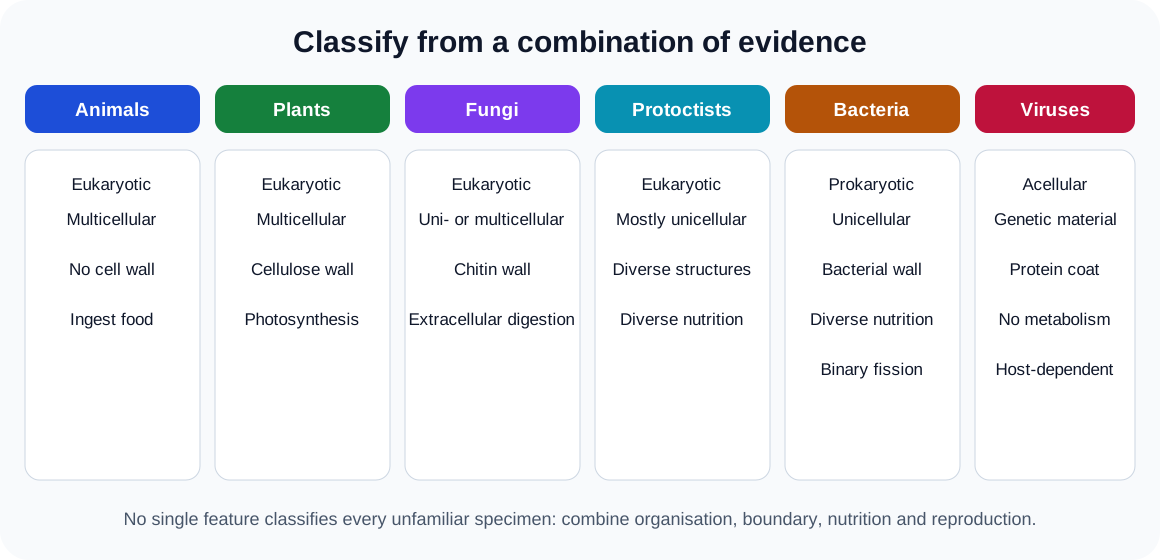
Pearson 4BI1 begins by establishing the language used throughout the course. Classification is not a list of labels to memorise in isolation. It is an evidence-based comparison of cellular structure, nutrition and reproduction, with viruses treated separately because they are acellular.
Main ideas
- Define nutrition, respiration, excretion, response, movement, control, reproduction and growth precisely.
- Compare plants, animals, fungi, protoctists and bacteria using cell structure and mode of nutrition.
- Viruses are non-cellular particles that reproduce only inside living cells.
- Recognise examples of pathogens and relate structural features to their way of life.
- Use classification evidence without assuming every organism fits an everyday category.
Characteristics of living organisms
Living organisms require nutrition: obtaining materials that supply energy or support growth. Plants make organic molecules using light energy, while animals ingest other organisms or their products. Respiration is the cellular release of energy from organic molecules. It is not the same as breathing, which ventilates a gas-exchange surface.
Organisms excrete metabolic waste, respond to changes in their surroundings, move themselves or parts of themselves, and control internal conditions. They grow through a permanent increase in size or dry mass and reproduce to form new organisms. No single visible behaviour is a perfect test of life. A dormant seed may show little obvious movement, while fire can spread and consume fuel without being cellular or reproducing through inherited information.
Animals and plants
Animals are multicellular. Their cells lack cellulose walls and chloroplasts, and they obtain organic nutrients by feeding on other organisms. They usually have nervous coordination and can move from place to place during at least part of the life cycle. Storage carbohydrate is commonly glycogen.
Plants are multicellular and contain chloroplasts in photosynthetic tissues. Their cellulose cell walls provide support, and they make carbohydrate by photosynthesis when conditions permit. Carbohydrate may be stored as starch or sucrose. Roots or non-green plant tissues still respire and may not photosynthesise, so plant cells contain chloroplasts should not be applied to every plant cell.
Fungi
Fungi include multicellular organisms such as moulds and mushrooms and unicellular yeast. Their cells have walls made of chitin, not cellulose. Fungi do not photosynthesise. Many secrete digestive enzymes onto food and absorb the soluble products, a mode called saprotrophic nutrition when dead organic material is used.
Check this topic from memory
Attempt the matching topic bank before reopening the notes. Use each missed idea to decide what to review next.
Start the topic quiz