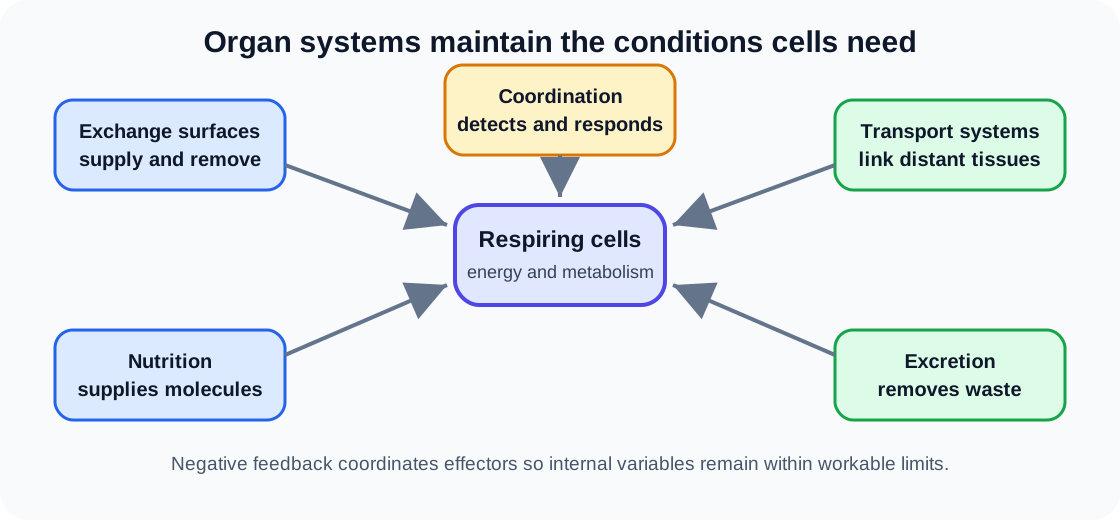
This topic connects cell processes to coordinated organ systems in plants and animals.
Pearson 4BI1 Topic 2 is broad because biological function is hierarchical. Molecules participate in reactions, membranes control exchange, specialised cells form tissues, and organ systems maintain conditions in which cells can respire. Explanations should follow those causal links rather than list adaptations without their consequences.
Main ideas
Relate organelle structure to function and explain diffusion, osmosis and active transport.
Link biological molecules, enzymes and digestion to absorption and assimilation.
Explain photosynthesis, mineral nutrition and limiting factors in plants.
Compare transport in plants with circulation, blood and gas exchange in humans.
Distinguish aerobic and anaerobic respiration and trace energy transfers.
Explain nervous and hormonal coordination, homeostasis and excretion.
Cells, organisation and exchange
Animal and plant cells contain a nucleus, cytoplasm, cell membrane, mitochondria and ribosomes. Plant cells additionally have a cellulose wall, a permanent vacuole and chloroplasts in photosynthetic tissues. The nucleus contains genetic information, ribosomes make proteins and mitochondria carry out aerobic respiration. Structure must be linked to demand: an active muscle cell contains many mitochondria because contraction requires a high rate of energy transfer.
Diffusion is net particle movement from higher to lower concentration due to random motion. Osmosis is net water movement through a partially permeable membrane from a dilute solution, with higher water potential, to a more concentrated solution. Active transport moves substances against a concentration gradient using energy released by respiration and carrier proteins.
Exchange is faster with a large surface area, short diffusion distance and steep concentration gradient. Villi, alveoli, root hairs and leaves apply these principles in different contexts. A large surface area does not cause diffusion; it allows more particles to cross simultaneously when a gradient exists.
Biological molecules and enzymes
Carbohydrates contain carbon, hydrogen and oxygen and include sugars, starch and glycogen. Proteins contain amino acids and also nitrogen. Lipids are built from fatty acids and glycerol. Food tests use Benedict's reagent with heating for reducing sugars, iodine for starch, Biuret reagent for protein and an ethanol emulsion for lipids. The practical procedures belong in the practical hub; theory questions require the molecule, reagent and positive result.
Check this topic from memory
Attempt the matching topic bank before reopening the notes. Use each missed idea to decide what to review next.
Enzymes are proteins that catalyse reactions by lowering activation energy. Their active sites bind substrates with complementary shapes. Increasing temperature raises collision frequency until an optimum, after which bonds maintaining enzyme shape are disrupted and the active site changes. Extreme pH can also alter the active site. Denaturation is not the enzyme being killed, and low temperature usually slows activity without permanently changing structure.
Human nutrition and digestion
A balanced diet supplies carbohydrate and lipid for energy, protein for growth and repair, vitamins and minerals for specific functions, fibre for gut movement and water as solvent and transport medium. Energy imbalance can contribute to obesity or mass loss, while particular deficiencies have specific consequences.
Digestion converts large insoluble molecules into small soluble molecules. Amylase forms maltose from starch, proteases form amino acids from proteins and lipases form fatty acids plus glycerol from lipids. Bile is not an enzyme: it neutralises acidic stomach contents and emulsifies fat, increasing surface area for lipase.
The small intestine has folds, villi and microvilli for large surface area, a thin epithelium, rich capillary supply and lacteals. Digested glucose and amino acids enter blood; lipid products enter lacteals. Absorption moves products into transport systems, while assimilation uses absorbed molecules in cells.
Plant nutrition and transport
Photosynthesis transfers light energy into chemical energy:
carbon dioxide + water produces glucose + oxygen, using light and chlorophyll.
Light intensity, carbon dioxide concentration and temperature can limit rate. Raising one factor increases rate only until another becomes limiting. Temperature affects enzyme-controlled reactions, so very high temperatures reduce rate. Plants use glucose for respiration, cellulose, amino acids with nitrate ions, storage starch and lipids.
Root hair cells absorb water by osmosis and mineral ions often by active transport. Xylem carries water and mineral ions upward in dead, lignified vessels. Water evaporates from mesophyll surfaces and diffuses through stomata, creating a transpiration pull. Phloem translocates sucrose and amino acids between sources and sinks in living tissue; movement can occur in either direction in different tubes.
Gas exchange and circulation
Ventilation renews air in the alveoli. During inhalation, external intercostal muscles contract, ribs move up and out, the diaphragm flattens, thoracic volume increases and pressure falls below atmospheric pressure. Air enters because of the pressure difference. Gas exchange then occurs by diffusion across alveolar and capillary walls.
Alveoli provide large surface area, thin moist walls and a rich blood supply. Ventilation and circulation maintain oxygen and carbon dioxide gradients. Smoking damages cilia and alveolar walls and increases risks of disease.
The heart provides double circulation. The right side pumps deoxygenated blood to lungs; the left side pumps oxygenated blood at higher pressure to the body. Arteries have thick elastic muscular walls, veins have a wider lumen and valves, and capillaries have one-cell-thick walls. Red blood cells carry oxygen using haemoglobin, white blood cells defend against pathogens, platelets help clotting and plasma transports dissolved substances and heat.
Respiration and energy
Aerobic respiration transfers energy from glucose using oxygen, producing carbon dioxide and water. Anaerobic respiration releases less energy per glucose. In muscles it produces lactate, whose removal requires oxygen after exercise. In yeast it produces ethanol and carbon dioxide.
Respiration occurs continuously in living cells; breathing and gas exchange support it but are not respiration. Released energy supports movement, active transport, synthesis, growth and temperature regulation. Statements should name the energy-requiring process rather than say cells use respiration as a material.
Coordination and response
Receptors detect stimuli, coordinators process information and effectors produce responses. In a reflex arc, impulses pass from receptor through sensory neurone, relay neurone and motor neurone to an effector. Synapses transmit chemically in one direction. Reflexes are rapid and automatic but can still involve the central nervous system.
Hormones are chemical messengers carried in blood. Adrenaline prepares the body for activity; insulin lowers blood glucose by promoting uptake and glycogen formation, while glucagon raises it through glycogen breakdown. Nervous responses are usually rapid, targeted and short-lived; hormonal responses may be slower and longer-lasting.
Plants respond through growth. Shoots show positive phototropism and roots commonly show positive gravitropism. Auxin distribution produces unequal cell elongation. Explanations must distinguish the stimulus direction, auxin distribution and resulting growth.
Excretion and homeostasis
Excretion removes toxic materials, metabolic waste and substances in excess. Carbon dioxide is excreted by the lungs, while kidneys remove urea, excess ions and water. Egestion removes undigested food and is not excretion because that material was never metabolised by cells.
Kidney filtration forms a filtrate containing small molecules. In a healthy person with blood glucose below the renal threshold, selective reabsorption normally returns filtered glucose, needed ions and much water to blood. Urea remains for excretion in urine. The amount of water reabsorbed is regulated by antidiuretic hormone. When blood water concentration is low, more hormone increases collecting-duct permeability and concentrated urine forms.
Homeostasis maintains internal conditions within limits, not at one perfectly fixed value. Negative feedback detects departure from a set range and activates responses that reverse it. Temperature regulation uses sweating, vasodilation, vasoconstriction and shivering; blood glucose regulation coordinates insulin and glucagon.
Worked application
After a carbohydrate-rich meal, glucose is digested and absorbed through small-intestinal villi into blood, so blood glucose concentration rises. Pancreatic cells detect this increase and release insulin. Insulin promotes glucose uptake by body cells and conversion of glucose to glycogen in liver and muscle, lowering blood glucose toward its normal range. As the concentration falls, insulin secretion decreases, preventing an excessive fall. During prolonged exercise, cells remove more glucose for respiration. If blood glucose drops, glucagon promotes glycogen breakdown in the liver and glucose release. This is negative feedback because each response opposes the original change. Insulin does not turn glucose into energy; respiration transfers energy from glucose, while insulin regulates uptake and storage.
Common mistakes
Saying active transport moves substances down a concentration gradient.
Confusing ventilation with cellular respiration.
Describing homeostasis as keeping conditions completely constant.
Calling bile a digestive enzyme.
Saying xylem transports sugar or phloem transports only downward.
Describing arteries as always carrying oxygenated blood.
Treating egestion as excretion.
Saying insulin itself converts glucose into energy.
Assessment guidance
Structure-function questions require a feature, its immediate effect and the biological consequence. For example, one-cell-thick alveolar wall is incomplete without short diffusion distance and faster gas exchange. In process questions, preserve sequence: stimulus, receptor, coordination, effector and response; or digestion, absorption, transport and assimilation. Use concentration gradients explicitly for diffusion, water movement for osmosis and energy plus movement against a gradient for active transport. Distinguish ventilation, gas exchange and respiration. For homeostasis, identify the monitored variable, direction of departure and response that reverses it. Avoid absolute claims such as all arteries carrying oxygenated blood or all plant transport moving upward.
Check yourself
Explain how the small intestine is adapted for both digestion and absorption.
Then retrieve: Which enzymes complete digestion of starch, protein and lipid? How do villi maintain a concentration gradient? Where do lipid products enter transport? Why is bile useful without being an enzyme, and how is assimilation different from absorption?
Official specification boundary
This note follows Topic 2, Structures and functions in living organisms, in Pearson Edexcel International GCSE Biology 4BI1. It develops theory across cells, nutrition, transport, respiration, coordination, excretion and homeostasis. Experimental methods remain in the separate Pearson Biology practical hub.