

Pearson International GCSE Biology 4: Ecology and the Environment
Pearson International GCSE Biology notes on ecosystems, cycles, sampling, biodiversity and human impacts.
Ecology explains interactions among organisms and their physical environment across food webs, cycles and populations.
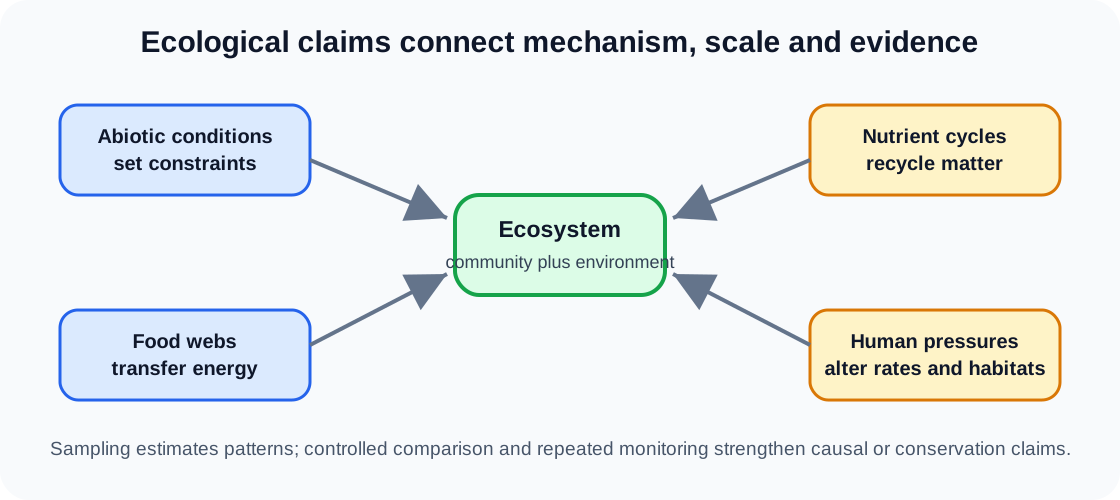
Pearson 4BI1 ecology questions move between scale and evidence. A change in one abiotic factor can alter individual survival, population size, community interactions and ecosystem processes. Sound answers identify that causal chain and distinguish measured association from demonstrated cause.
Main ideas
- Define population, community, habitat and ecosystem at the correct scale.
- Construct food chains and webs and explain inefficient energy transfer between trophic levels.
- Trace carbon, water and nitrogen through biological and physical processes.
- Use quadrats and transects to estimate abundance or distribution with representative sampling.
- Explain how pollution, deforestation and climate change affect biodiversity.
- Evaluate conservation strategies by considering evidence and trade-offs.
Ecological levels and factors
A population consists of organisms of one species in an area. A community contains populations of different species, and an ecosystem includes that community plus its non-living environment. A habitat is the place where an organism lives. These terms are nested but not interchangeable.
Biotic factors include food availability, predation, competition, disease and mating opportunities. Abiotic factors include temperature, light, water, oxygen, pH and mineral availability. A limiting factor restricts population growth or distribution. Its importance can change with location, season or population density.
Food chains, webs and trophic levels
Producers transfer light energy into chemical energy by photosynthesis. Primary consumers feed on producers, while higher consumers feed at later trophic levels. Decomposers digest dead material and waste, releasing mineral ions and carbon dioxide through their metabolism.
Food-chain arrows point from the food to the consumer because they show transfer of energy and biomass. Food webs reveal that a species can have several food sources and predators. Removing one species can therefore cause direct and indirect effects, including changed competition.
Only a fraction of energy becomes biomass available to the next trophic level. Energy is transferred to the surroundings through respiration, remains in uneaten parts or is lost in waste. This limits food-chain length and means less biomass can usually be supported at higher levels. Energy flows through ecosystems, while matter is recycled.
Population change
Check this topic from memory
Attempt the matching topic bank before reopening the notes. Use each missed idea to decide what to review next.
Start the topic quiz