

Pearson IGCSE Biology Practical 5: Food Tests, Enzymes and Movement of Substances
Pearson International GCSE Biology practical notes on food tests, enzymes, diffusion and osmosis.
These investigations convert molecular processes into observable colour, mass, length or time changes.
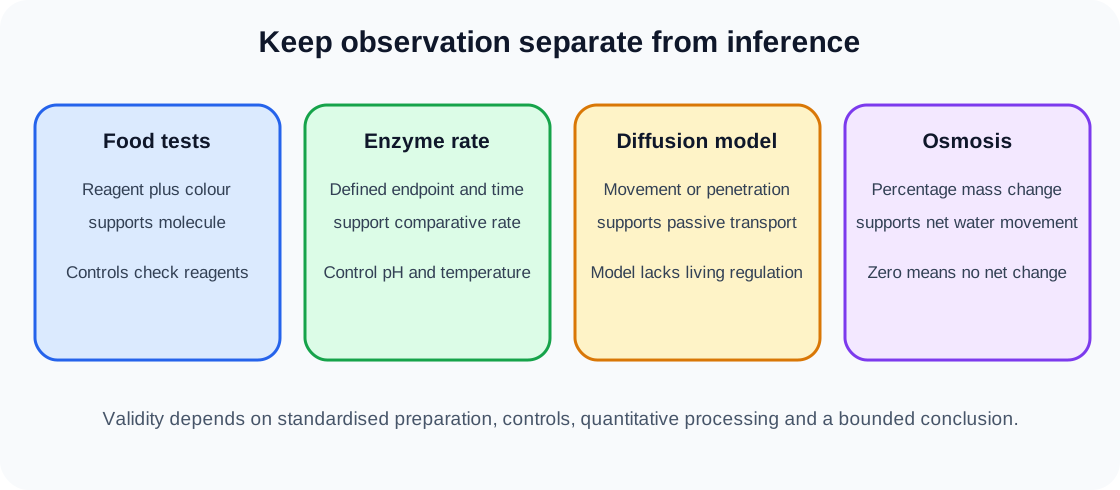
Pearson 4BI1 written practical questions require the observation to remain separate from the biological inference. A colour change is the evidence for a food molecule, an endpoint estimates enzyme rate, and tissue mass change is evidence of net water movement under defined conditions.
Core contexts
- Use Benedict's reagent with heating for reducing sugars, iodine for starch, Biuret reagent for protein and an emulsion test for lipid.
- Investigate enzyme rate by defining an objective endpoint and controlling pH and temperature.
- Use dialysis tubing or agar to model diffusion while stating where the model differs from living tissue.
- Investigate osmosis with equal-sized plant samples, blotting consistently before mass measurement.
- Calculate percentage change when starting sizes differ.
Food-test sequence and evidence
Prepare a liquid sample by crushing food with distilled water and filtering if necessary. Include a distilled-water negative control and known positive control when reagent performance is uncertain. Use separate clean droppers to prevent one reagent or food contaminating another.
For reducing sugar, add Benedict's reagent and heat in a hot-water bath. A positive result changes from blue through green, yellow or orange to brick-red depending on amount and conditions. For starch, add iodine solution at room temperature; orange-brown changing to blue-black is positive. For protein, add Biuret reagent as specified; blue changing to lilac or purple is positive. For lipid, shake the sample with ethanol, then add water; a cloudy white emulsion is positive.
Report both observation and conclusion. Protein present without the purple observation omits evidence. Colour intensity is only semi-quantitative unless volumes, concentrations, heating and comparison scale are standardised. A colorimeter needs a suitable calibration and blank.
Ethanol is flammable, so keep it away from flames. Benedict's test tubes are heated in a water bath rather than directly and should be handled with a holder. Iodine and Biuret reagents require eye protection and prompt rinsing of splashes.
Enzyme rate investigations
For amylase and starch, equilibrate separate enzyme and substrate tubes in a water bath, mix and start timing at the same event. Sample at fixed intervals into iodine wells. The endpoint is the first sample that remains orange-brown, indicating no detectable starch. Reciprocal endpoint time can compare rates when initial quantities and endpoint are identical.
Check this topic from memory
Attempt the matching topic bank before reopening the notes. Use each missed idea to decide what to review next.
Start the topic quiz