

Pearson IGCSE Biology Practical 7: Germination, Ecology and Biological Resources
Pearson International GCSE Biology practical notes on germination, field sampling and yeast fermentation.
Whole-organism and field investigations require careful controls because natural variation is unavoidable.
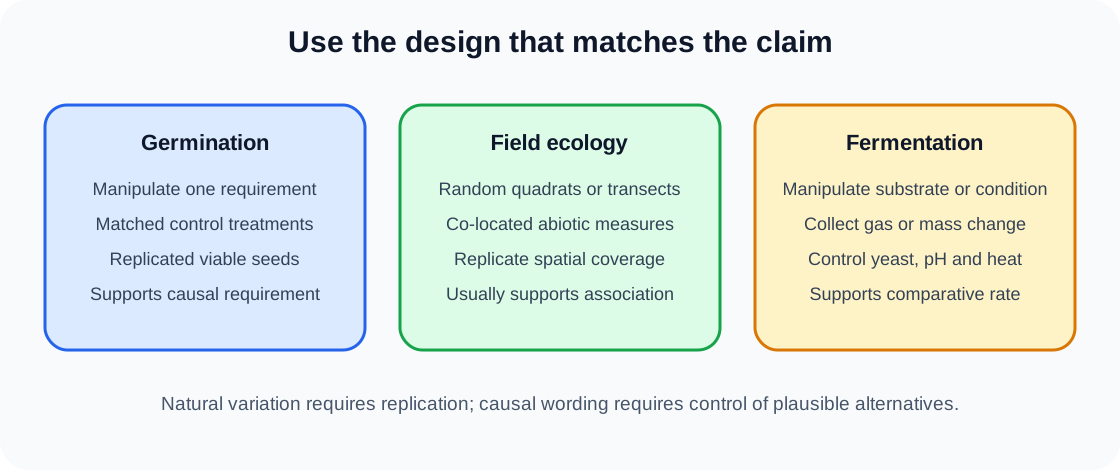
Pearson 4BI1 practical questions in these contexts use three different evidence designs. Germination tests can isolate requirements experimentally, transects observe distributions with limited causal control, and fermentation investigations manipulate microbial conditions while measuring product rate.
Core contexts
- Test germination requirements with viable seeds and controls that isolate water, oxygen or temperature.
- Estimate population abundance with randomly placed quadrats and sufficient repeats.
- Use a belt or line transect to investigate distribution along an environmental gradient.
- Measure the relevant abiotic factor at the same locations as organism abundance.
- Investigate yeast fermentation by gas volume or mass loss while controlling temperature and substrate concentration.
Testing germination requirements
Use viable seeds from the same batch and allocate them randomly among treatments. Keep seed number, species, age, container and observation time constant. Germination can be defined as radicle emergence beyond a stated length so every observer uses the same endpoint.
To test water, compare seeds on moist and dry support while keeping oxygen and temperature available. To test oxygen, compare an oxygen-excluded treatment with an otherwise similar aerated setup. To test temperature, use identical moist aerated sets at several controlled temperatures. Change one requirement at a time; a cold dry treatment cannot show which missing factor prevented germination.
Use several seeds per treatment and independent containers, because non-germination may reflect non-viable seeds. Record proportion germinated and time, not just one final seed. Do not seal seeds indefinitely or expose them to unsafe extremes. Light is not a universal requirement for germination, so it should be tested only when the question specifies it.
Random quadrat sampling
Define the study area with two perpendicular tape measures and generate random coordinate pairs. Place the quadrat at each coordinate using a consistent corner rule. This prevents conscious selection of dense or sparse patches. Use enough positions and, where possible, replicate areas.
Count individuals when they are distinct, estimate percentage cover for overlapping plants, or record frequency across quadrats. Convert counts to density using total sampled area before extrapolating. The quadrat must suit organism size and patchiness; a tiny quadrat can miss clustered species, while one huge quadrat gives few independent positions.
Check this topic from memory
Attempt the matching topic bank before reopening the notes. Use each missed idea to decide what to review next.
Start the topic quiz