

Pearson IGCSE Biology Practical 4: Conclusions, Evaluation and Improvements
Draw evidence-based conclusions and improve Pearson International GCSE Biology investigations.
Evaluation connects a specific limitation to its likely effect and a practical improvement.
Pearson 4BI1 evaluation is biological reasoning applied to evidence. The conclusion must respect variation and the tested range; the limitation must identify a mechanism; and the improvement must change that mechanism without creating a worse confounding factor.
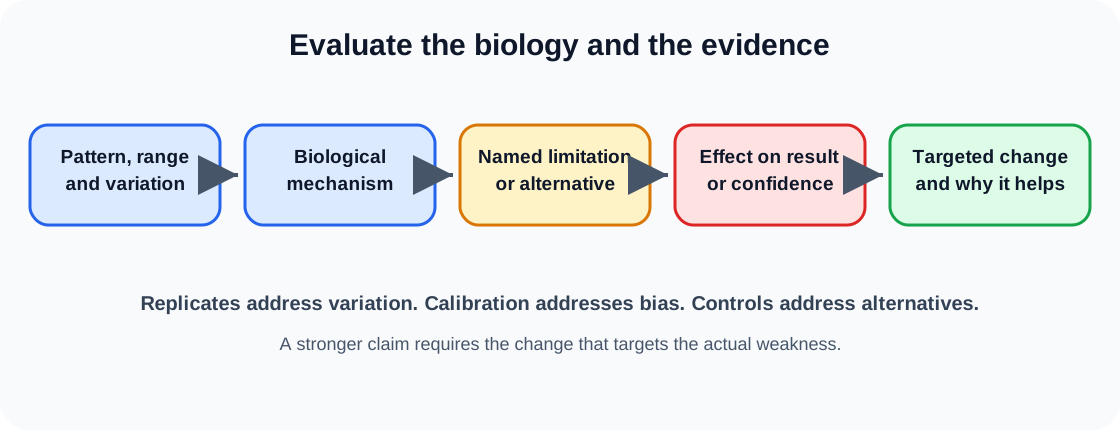
Evaluation method
- State the pattern with data, including any optimum, plateau or anomaly.
- Explain the pattern using relevant biology without exceeding the evidence.
- Distinguish random variation, measurement uncertainty and systematic bias.
- Link each limitation to the result it could distort.
- Propose a specific feasible improvement, such as tighter temperature control or objective endpoint measurement.
- Suggest a justified extension that tests a new range or related variable.
State the biological pattern
Describe direction, shape and range with numerical evidence. A rate may rise to an optimum and then fall, percentage mass change may cross zero, or abundance may correlate with distance. Quote representative values or a gradient rather than saying only it increased.
Restrict the claim to the organism, conditions and range tested. An amylase optimum in one buffered preparation does not establish the optimum of every amylase. A field correlation does not prove that one environmental variable caused the distribution because other conditions were not controlled.
Explain without overclaiming
Use relevant mechanisms to explain the supported pattern. Increasing enzyme temperature raises collision frequency until structural disruption changes the active site. A sucrose solution with lower water potential causes net water movement out of plant cells. Reduced plant cover near a path may be consistent with trampling or compaction, but observational data alone may not distinguish them.
Separate observation from interpretation. The graph supplies the pattern; biological theory supplies a plausible mechanism. If two mechanisms fit, state what additional evidence would distinguish them.
Classify variation and error
Biological variation arises from genetic and environmental differences among organisms or tissue samples. Increase independent biological replicates, randomise allocation and report spread. Technical variation comes from repeated measurement or preparation and can be estimated with repeat readings.
Random measurement uncertainty causes scatter in either direction, such as judging a colour endpoint or counting rapidly moving organisms. A systematic bias shifts results consistently, such as a balance zero error, heat from a lamp or a colorimeter blank containing the wrong solution. Repeats reduce the influence of random variation on a mean but preserve systematic bias.
Check this topic from memory
Attempt the matching topic bank before reopening the notes. Use each missed idea to decide what to review next.
Start the topic quiz