

Pearson IGCSE Biology Practical 2: Measurement, Apparatus and Resolution
Choose biological apparatus, record measurements and use microscopy accurately for Pearson International GCSE.
Apparatus should match the scale and biological process being measured.
Pearson 4BI1 practical questions often offer several plausible instruments. The best choice measures the intended biological outcome over a useful range and with a resolution that can distinguish the expected change. A proxy, such as bubble number or visual colour, must be identified as a proxy and evaluated accordingly.
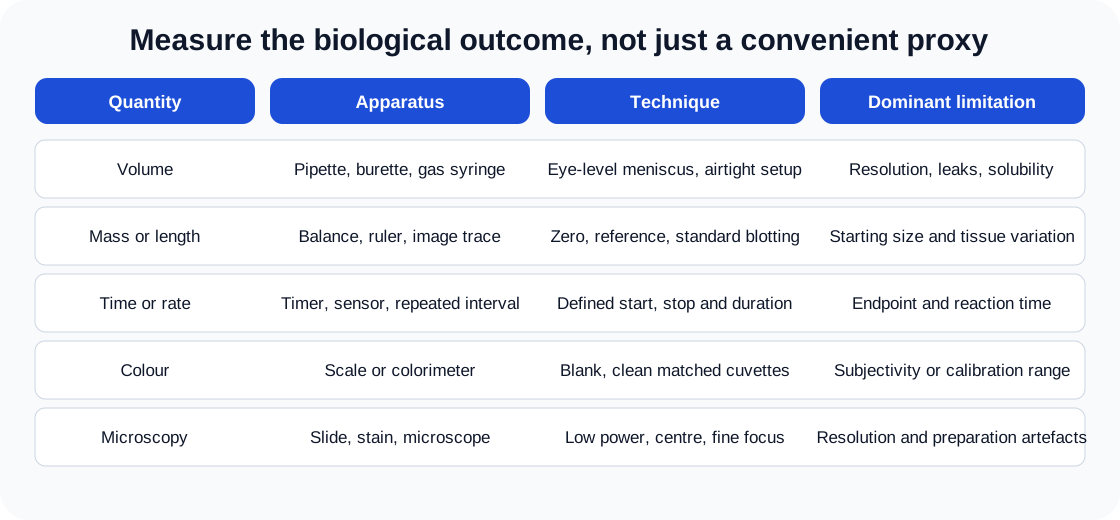
Measurement choices
- Use volumetric apparatus with resolution appropriate to the required precision.
- Measure time from a clearly defined biological event and keep intervals consistent.
- Use balances, rulers, thermometers, colorimeters or gas collection only when they directly measure the dependent variable.
- Focus a microscope on low power first, centre the specimen, then increase magnification.
- Calculate magnification from image size divided by actual size after matching units.
- Record instrument resolution and avoid invented decimal places.
Range, resolution and biological variation
Range is the span an instrument can measure; resolution is the smallest scale division or display change. Accuracy is closeness to the accepted value and is not guaranteed by a fine display. Select apparatus with enough capacity for the whole measurement and divisions small enough relative to the change.
Instrument uncertainty and biological variation are different. A balance may resolve small mass differences while leaf discs still vary biologically. Technical repeats estimate measurement variation; independent samples estimate biological variation. Increasing decimal places does not solve an unrepresentative sample.
Volume and liquid handling
Use a measuring cylinder for moderate volumes when high precision is unnecessary, a pipette or syringe for smaller controlled transfers, and a burette for variable accurately read volumes. Read the appropriate meniscus at eye level and record to the instrument's supported precision. Use the same apparatus across treatments where possible.
Gas can be collected in a gas syringe or by water displacement when the gas is not too soluble and the setup is appropriate. Check airtight connections and begin from a defined zero. Counting bubbles is simpler but bubble volume changes with nozzle, temperature and pressure. It estimates bubble frequency, not directly gas volume.
Mass, length and percentage change
Zero the balance with the container or use tare. Remove surface liquid consistently before weighing biological tissue; blot gently for the same duration and pressure. Excess blotting can remove cellular water or damage tissue, while no blotting includes adhering solution.
Check this topic from memory
Attempt the matching topic bank before reopening the notes. Use each missed idea to decide what to review next.
Start the topic quiz