

Pearson IGCSE Biology Practical 1: Planning, Variables and Fair Tests
Plan valid Pearson International GCSE Biology investigations with clear variables, controls and repeats.
A strong biological plan links one testable question to measurable variables while accounting for living variation.
Pearson 4BI1 assesses practical understanding through written questions based on investigations and biological evidence. A usable plan must define the organism or biological material, the treatment range, the measurement endpoint, controls, repeats, ethics and safety. Living systems vary naturally, so replication and standardisation are part of validity rather than optional decoration.
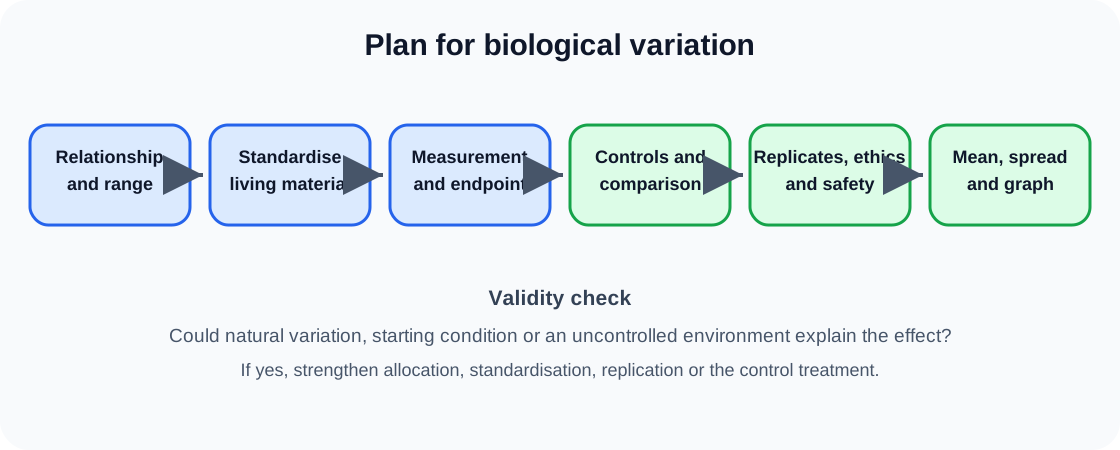
Planning checklist
- State the independent variable and a suitable range with at least five values where practical.
- Define the dependent variable operationally, including how and when it is measured.
- Control temperature, time, organism size, solution volume and starting conditions as relevant.
- Use repeats and calculate a mean, but identify anomalous results before averaging.
- Include a control treatment when it helps separate the tested effect from background change.
- State biological and chemical hazards with specific precautions.
Turn a biological question into variables
Rewrite the question as a relationship. In How does temperature affect amylase activity?, temperature is the independent variable. Activity must be operationally defined, for example as the reciprocal of time until starch is no longer detected. See how fast it reacts is not measurable enough.
Choose a range that is biologically informative and safe. At least five values can reveal an optimum or threshold that two values would miss. A pilot can identify conditions that are neither too fast to time nor too slow for the lesson period. Use evenly spaced values when appropriate, but include extra values near a suspected change if the question requires it.
Standardise living material
Organisms differ in age, genotype, size, health and previous environment. Reduce this variation by using material from the same source, randomising individuals among treatments, matching size or developmental stage, and using several biological replicates. Identical-looking organisms are not guaranteed identical.
For plant discs, keep species, leaf age, disc diameter, tissue region and starting condition constant. For germinating seeds, use the same species and batch, similar initial mass and equal germination time. For human physiological measurements, use a repeated-measures design where appropriate, standardise rest and exercise conditions, obtain consent and avoid unsafe exertion.
Technical repeats measure the same sample more than once and estimate measurement variation. Biological replicates use separate organisms or samples and capture natural variation. A strong design knows which source of variation needs replication.
Check this topic from memory
Attempt the matching topic bank before reopening the notes. Use each missed idea to decide what to review next.
Start the topic quiz