Pearson International GCSE Chemistry 4: Organic Chemistry
Pearson International GCSE Chemistry notes on crude oil, homologous series, reactions and polymers.
Organic chemistry organises carbon compounds into homologous series. Members of one series share a functional group and general formula, react in similar ways, and show gradual physical-property trends as molecular size changes.
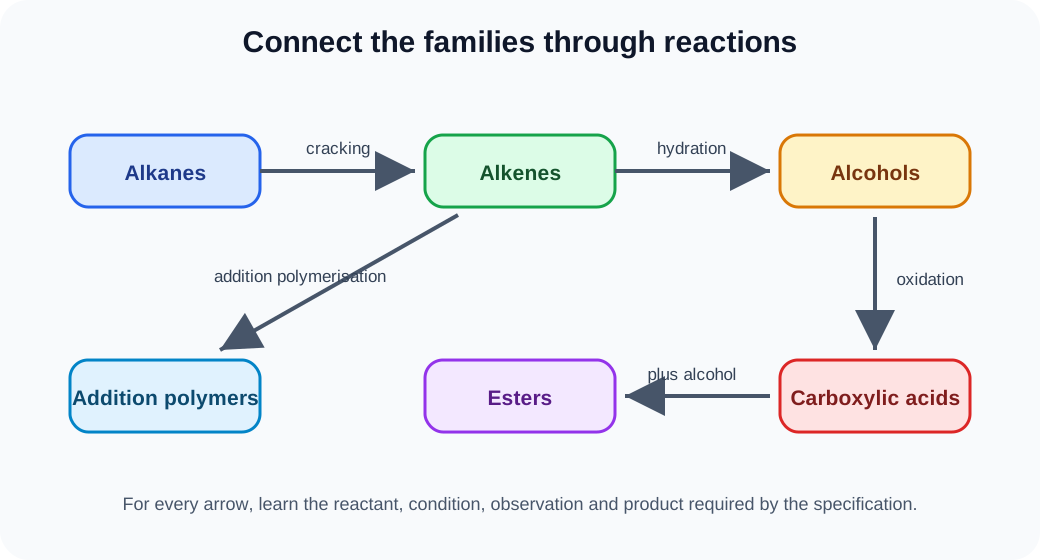
The official 4CH1 specification distinguishes common content from additional bold statements assessed through Paper 2. Learn structures, conditions, observations and products as a connected reaction system rather than isolated equations.
Crude oil and fuels
Crude oil is a mixture of hydrocarbons. Fractional distillation separates it physically because its components have different boiling temperatures. The column is hot at the bottom and cooler at the top. Vapours rise and condense at levels where the temperature falls below their boiling range.
Shorter-chain fractions are generally more volatile, more flammable, less viscous and lower boiling. Longer chains have stronger intermolecular attractions, so more energy is needed to separate their molecules. Fractional distillation does not break covalent bonds and does not create new substances.
Complete combustion of a hydrocarbon in excess oxygen forms carbon dioxide and water. Limited oxygen can produce carbon monoxide and carbon. Cracking converts less useful long-chain hydrocarbons into shorter alkanes and alkenes by heating vaporised hydrocarbons over a catalyst or under the specified conditions.
Homologous series and representation
Alkanes are saturated hydrocarbons containing only carbon-carbon single bonds. Alkenes are unsaturated and contain a carbon-carbon double bond. Alcohols contain the hydroxyl functional group, carboxylic acids contain , and esters contain the
Check this topic from memory
Attempt the matching topic bank before reopening the notes. Use each missed idea to decide what to review next.
Start the topic quiz