

Pearson IGCSE Chemistry Practical 6: Formulae, Electrolysis and Quantitative Chemistry
Pearson International GCSE Chemistry practical notes on empirical formulae, electrolysis and reacting quantities.
Quantitative investigations connect measured mass, volume or charge to chemical formulae and equations.
The method must preserve the material being quantified and provide enough raw readings to audit the calculation. A chemically correct mole method cannot rescue a mass lost from the apparatus, an uncompleted reaction or an electrode that was weighed wet.
Core contexts
- Determine a metal oxide formula from initial metal mass and final oxide mass.
- Heat, cool and reweigh to constant mass where completion must be demonstrated.
- Investigate aqueous electrolysis with inert electrodes and test electrode products.
- Keep current, time, electrode area and electrolyte concentration controlled when comparing deposition.
- Convert measurements to moles before applying the balanced-equation ratio.
Determine an empirical formula by mass
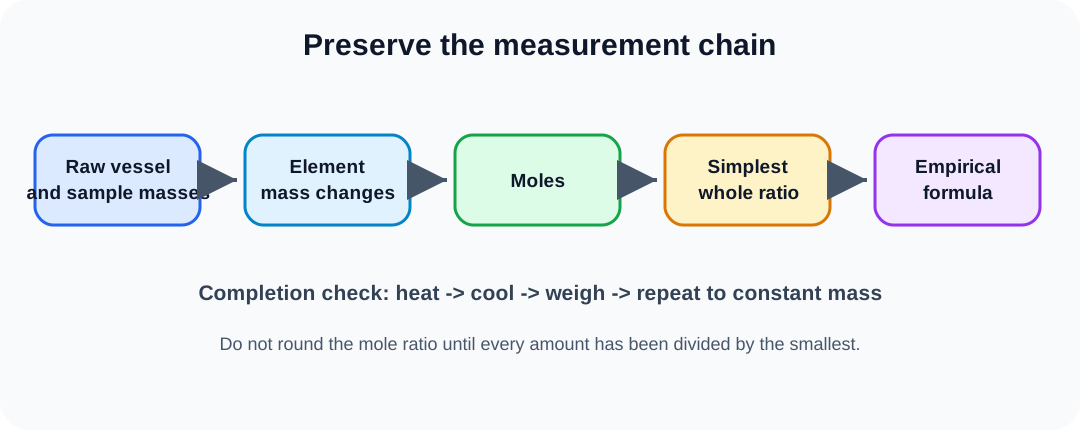
To determine a metal oxide formula, first weigh the clean, dry reaction vessel and lid. Add the metal and reweigh so metal mass can be found by subtraction. Heat under the specified conditions so oxygen reacts with the metal, then cool before weighing the vessel and product. Oxygen mass gained is final oxide mass minus initial metal mass, after correcting for the vessel.
Use a crucible lid to reduce loss of solid while still allowing controlled access of oxygen where appropriate. Heat gently at first if vigorous reaction could eject material, then more strongly to complete the reaction. Handle the lid and crucible with tongs and cool on a heat-resistant surface. Do not weigh while hot because convection currents and balance effects can make the reading unstable and unsafe handling may contaminate the vessel.
Demonstrate completion with constant mass
Heat, cool and weigh, then repeat the cycle until consecutive masses agree within the stated measurement resolution. Constant mass supports completion or complete removal of a volatile component. It is stronger evidence than heating for an arbitrary time.
Keep the heating, cooling and weighing sequence consistent. Leaving a hygroscopic product exposed can increase mass by absorbing water, while transferring product between vessels can cause loss. If product escapes as powder or smoke, the measured oxide mass becomes too low and oxygen gain is underestimated.
Process masses into a formula
Calculate each element's mass, then divide by its relative atomic mass to obtain moles. Divide all mole amounts by the smallest. If the values are close to whole numbers, apply justified rounding only at the ratio stage. If a simple fraction remains, multiply every ratio by the same small integer.
Check this topic from memory
Attempt the matching topic bank before reopening the notes. Use each missed idea to decide what to review next.
Start the topic quiz