

Pearson IGCSE Chemistry Practical 7: Acids, Salts and Gas Tests
Pearson International GCSE Chemistry practical notes on acid reactions, salt preparation and qualitative gas tests.
Preparation and analysis require the method to match salt solubility and the observation to match the claimed ion or gas.
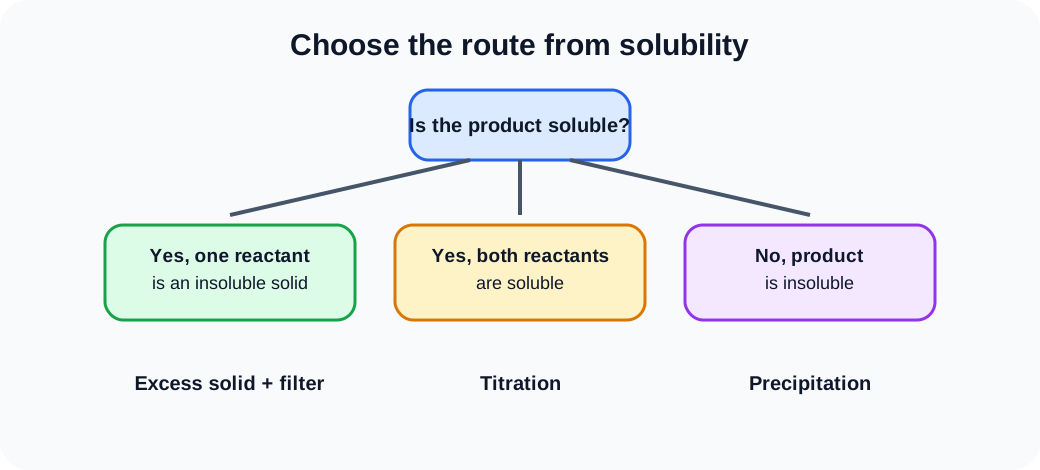
The practical reasoning begins with the product. Decide whether the salt is soluble, whether excess reactant can be removed physically and whether the task is preparation or identification. This prevents a memorised method from being applied to the wrong chemical system.
Core contexts
- Compare acids reacting with metals, bases and carbonates using controlled quantities.
- Prepare a soluble salt from excess insoluble solid, then filter and crystallise.
- Use titration when both reactants are soluble and excess reagent cannot be filtered away.
- Prepare an insoluble salt by precipitation, followed by filtration, washing and drying.
- Record gas tests as reagent or action plus positive observation.
- Use specified ion tests in a sequence that avoids interference.
Compare reactions of acids
When comparing acid reactions with metals, bases or carbonates, control acid volume and concentration, reactant amount and surface area, temperature and apparatus. Select a dependent measurement such as gas volume over time, temperature change or mass of product rather than relying only on visible vigour.
For metal and acid reactions, hydrogen can be collected and tested with a lighted splint, giving the specified positive result. Carbonates release carbon dioxide, which is passed through limewater for the specified observation. Keep ignition tests small and controlled, point vessels away from people and wear eye protection when corrosive or irritant solutions are used.
Prepare a soluble salt from an insoluble solid
Warm the acid gently, then add the insoluble base or carbonate in small portions with stirring until some solid remains and no further reaction is evident. The excess ensures all acid has reacted. Filter to remove unreacted solid, leaving the soluble salt in the filtrate.
Heat the filtrate gently to evaporate some water until it is near saturation. Allow it to cool, filter the crystals, wash them with a small amount of cold distilled water and dry them between suitable absorbent materials or by the specified method. Using hot wash water or too much water dissolves product and lowers yield.
Use titration when both reactants are soluble
An acid and alkali cannot be separated from excess reagent by filtration. Use a pipette to transfer a fixed alkali volume, add a few drops of a suitable indicator, and titrate with acid from a burette to determine the neutralising volume. Repeat to obtain concordant titres.
Check this topic from memory
Attempt the matching topic bank before reopening the notes. Use each missed idea to decide what to review next.
Start the topic quiz