

Pearson IGCSE Chemistry Practical 8: Energetics, Rates and Organic Preparation
Pearson International GCSE Chemistry practical notes on temperature changes, reaction rates, catalysts and ester preparation.
These investigations measure energy transfer, collision-controlled rate and formation of an organic product.
The three contexts share one practical principle: the observation must track the intended chemical change while other mechanisms are controlled. Temperature change can be hidden by heat transfer, measured rate depends on the chosen observable, and an organic product requires safe heating and evidence stronger than smell alone.
Core contexts
- Measure temperature change in combustion, displacement, dissolving or neutralisation with insulated apparatus.
- Record a stable initial temperature and the highest or lowest temperature reached.
- Investigate rate by varying one factor and measuring gas volume, mass loss or time to a visible endpoint.
- Compare catalysts while controlling catalyst mass and surface form.
- Prepare an ester with careful heating, ventilation and awareness of flammable or corrosive reagents.
Measure temperature change
Use an insulated container such as a polystyrene cup supported in a beaker, with a lid where practical. Measure fixed reactant quantities, record a stable initial temperature, mix using a consistent procedure and stir gently. Record temperature at short regular intervals until a clear maximum or minimum has passed.
The temperature change is the final extreme temperature minus the initial temperature, with its sign preserved where required. For an exothermic process, heat loss to the cup, air and thermometer makes the observed rise smaller than the ideal change. A lid, added insulation, consistent stirring and extrapolation from a temperature-time graph can improve the estimate.
When comparing reactions, control total solution volume or mass, concentrations, starting temperature, apparatus and mixing. If a solid is used, control its mass and surface form. Do not compare raw maximum temperatures when starting temperatures differ; compare calculated changes under controlled conditions.
Choose a rate measurement
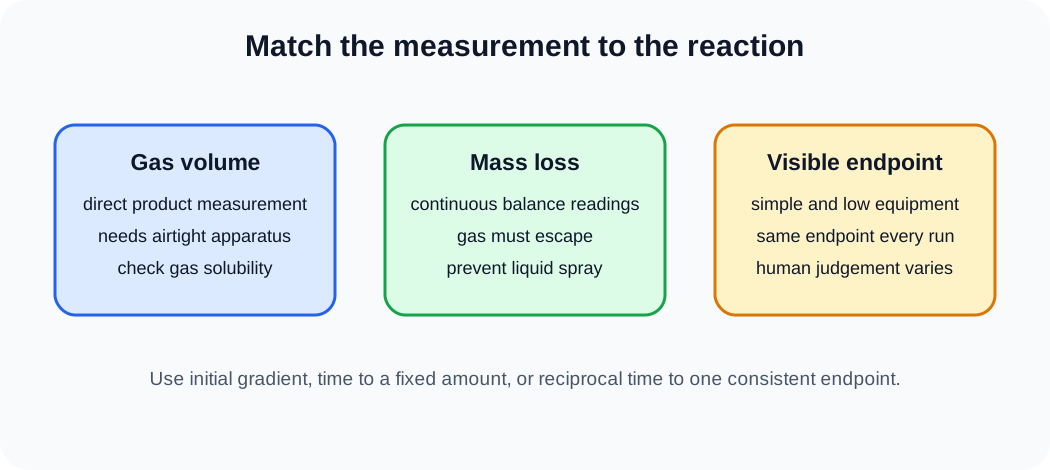
Gas volume against time is suitable when a gas is produced and can be collected without excessive dissolution. Assemble an airtight system before starting and use a gas syringe of sufficient capacity. Mass loss against time is suitable when gas escapes but all other material remains in the vessel; use a cotton-wool plug if it prevents spray without trapping the gas.
A visible endpoint, such as a mark becoming obscured by precipitate, is simple but depends on human judgement. Keep viewing position, lighting, vessel and observer method consistent. For colour change, a colorimeter can give a more objective continuous measurement if available and appropriate.
Check this topic from memory
Attempt the matching topic bank before reopening the notes. Use each missed idea to decide what to review next.
Start the topic quiz