

Pearson IGCSE Chemistry Practical 4: Conclusions, Evaluation and Improvements
Evaluate Pearson International GCSE Chemistry investigations using evidence, uncertainty and specific improvements.
A useful evaluation identifies how a limitation changes the measured result and how the method can be improved.
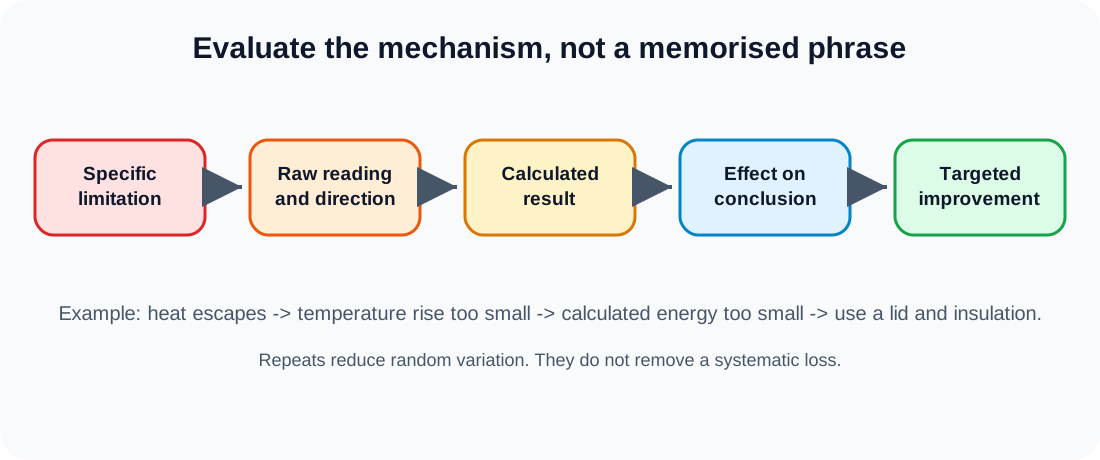
Evaluation is not a list of generic errors. It is a chain of reasoning from a specific feature of the method, through its effect on a measurement, to the conclusion and a feasible correction. Pearson may present an unfamiliar investigation, so the reliable approach is to trace matter, energy and readings rather than memorise stock phrases.
Evaluation method
- Support the conclusion with a trend and representative values.
- Explain the trend using particles, collisions, equilibrium or energetics as appropriate.
- Separate random scatter from systematic losses such as heat transfer or escaped gas.
- Link each source of uncertainty to an overestimate, underestimate or reduced precision where possible.
- Replace vague advice with a feasible apparatus or procedure change.
- Distinguish anomalous data from evidence that contradicts the hypothesis.
Write an evidence-based conclusion
Start with the relationship supported by the results. Name the independent and dependent variables and quote representative values or describe the best-fit trend. Then use the relevant chemistry to explain it. For example, if increasing acid concentration increases initial reaction rate, connect the higher concentration to more reacting particles per unit volume, more frequent collisions and more successful collisions per second.
Do not claim causation beyond the controlled design. A correlation in poorly controlled results may be consistent with the prediction without isolating the proposed mechanism. If uncertainty ranges overlap strongly or repeats scatter widely, use cautious language and identify what additional evidence would strengthen the conclusion.
Random variation and systematic bias
Random effects make repeated readings vary in either direction. Human judgement of a colour endpoint, small differences in chip size or inconsistent timing can contribute random scatter. Repeats, anomaly checks and a mean can reduce the influence of this variation.
Systematic effects shift measurements mainly in one direction. Heat lost to the surroundings makes a measured exothermic temperature rise too small. Carbon dioxide dissolving in collection water makes collected gas volume too small. A balance zero error may shift every mass reading, although subtraction can sometimes cancel a shared offset. Repeating an unchanged method does not remove systematic bias.
Classify the effect only after examining the measurement route.
Check this topic from memory
Attempt the matching topic bank before reopening the notes. Use each missed idea to decide what to review next.
Start the topic quiz