

Pearson IGCSE Chemistry Practical 1: Planning, Variables and Fair Tests
Plan valid Pearson International GCSE Chemistry investigations with controlled variables, repeats and safety.
A chemical plan must produce measurable evidence while controlling quantities that affect reaction outcome or rate.
Pearson assesses practical knowledge through written questions based on familiar and unfamiliar investigations. A plan must therefore be executable: another student should be able to identify the chemicals, apparatus, measurements, variable range, controls, repeats and safety actions without inventing missing steps.
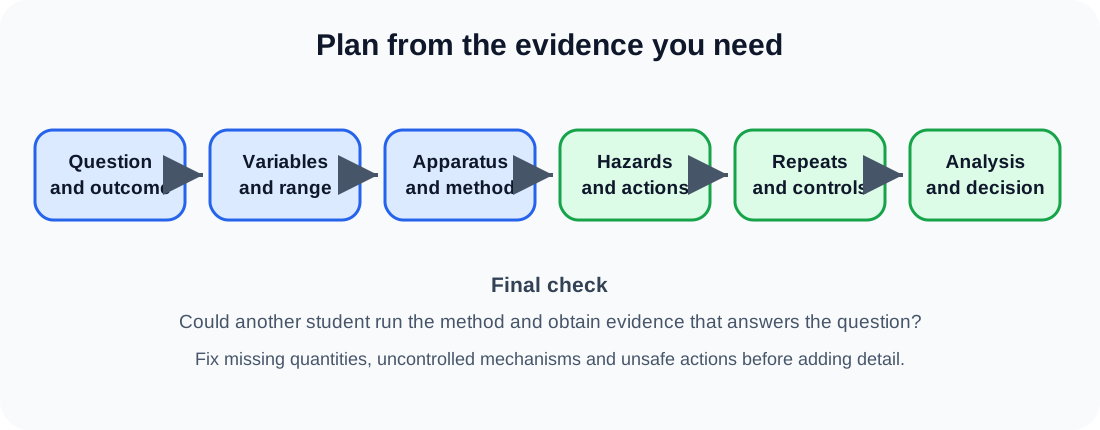
Planning checklist
- State the independent-variable range and how each value is prepared or measured.
- Define a dependent variable such as gas volume, mass change, temperature change or time to endpoint.
- Control reactant amount, concentration, total volume, surface area and temperature where relevant.
- Choose repeats and a mean when random variation matters.
- Include a blank or comparison reaction when it isolates the chemical effect.
- Name chemical hazards and match each to a specific precaution.
Turn a question into variables
Begin by rewriting the investigation question as a relationship. In How does hydrochloric acid concentration affect its reaction rate with marble chips?, acid concentration is the independent variable. Rate is the dependent variable, but it must be operationally defined. Measuring carbon dioxide volume every ten seconds gives a stronger definition than saying only observe how fast it reacts.
Select a range broad enough to reveal a pattern and include at least five values when the question permits. Explain how each concentration is prepared. If a stock solution is diluted, keep the total liquid volume constant so concentration is the only intended chemical change.
Controls are chosen from the mechanism. For an acid and marble investigation, control the mass and size range of chips, acid volume, temperature, flask, gas-collection apparatus and mixing procedure. Keep everything the same is not a usable control statement because it neither identifies the variables nor says how they are held constant.
Write a reproducible method
Give quantities, apparatus and sequence. A strong gas-volume method might specify a measured acid volume in a conical flask, a fixed mass of similarly sized marble chips, an airtight bung connected to a gas syringe, readings at fixed time intervals, and a defined stopping point. Start timing at a reproducible event. If gas would escape while a bung is fitted, describe how that loss will be reduced and acknowledge any remaining limitation.
Separate a pilot decision from the final method. A short pilot can identify a concentration range that is neither too fast to measure nor too slow to complete. It can also confirm that the gas syringe capacity is sufficient.
Check this topic from memory
Attempt the matching topic bank before reopening the notes. Use each missed idea to decide what to review next.
Start the topic quiz