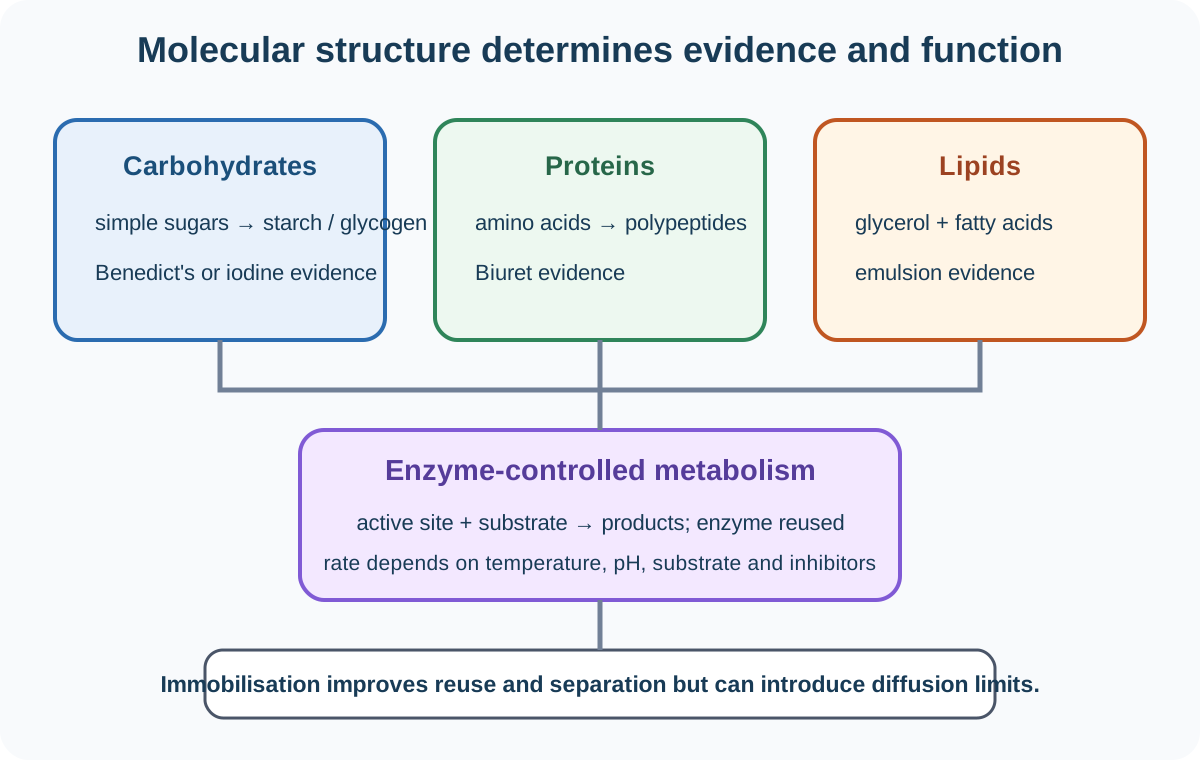
Biological molecules provide structure, energy storage and the chemistry of metabolism. Pearson Edexcel International GCSE Human Biology (4HB1) Topic 2 covers carbohydrate, protein and lipid composition; their smaller units; food tests; vitamin C and food-energy investigations; enzyme action and four controlling factors; and immobilised-enzyme applications. This theory chapter explains molecular and enzyme principles plus how evidence is interpreted. The practical hub owns executable protocols, safety, apparatus, variables, data processing and evaluation.
1. Elements and molecular groups
Carbohydrates contain carbon, hydrogen and oxygen. Lipids also contain carbon, hydrogen and oxygen, but their elemental proportions differ from carbohydrates. Proteins contain carbon, hydrogen, oxygen and nitrogen, and some contain sulfur.
These elemental descriptions do not mean the molecules have identical structures. Structure determines solubility, energy density, catalytic behavior and biological function. Avoid defining a food group only by the elements it contains.
Water is also biologically essential, serving as a solvent, transport medium and reactant, but the official molecular-building emphasis here is carbohydrates, proteins and lipids.
2. Large molecules and smaller units
Simple sugars are smaller carbohydrate units. Starch and glycogen are large carbohydrate molecules built from many glucose units. Starch is a plant storage carbohydrate; glycogen is the main storage carbohydrate in animals and is stored notably in liver and muscle.
Proteins are polypeptides built from amino acids. The amino-acid sequence influences folding and therefore function. Proteins include enzymes, receptors, antibodies, transport proteins and structural components.
Lipids are formed from glycerol and fatty acids. Many familiar fats and oils are triglycerides, with three fatty acids joined to one glycerol. Lipids store energy, contribute to membranes, provide insulation and protect organs.
Digestion breaks large dietary molecules into absorbable smaller units, while cells can assemble smaller units into larger molecules. Do not describe starch as a single glucose molecule or protein as “made of enzymes”; enzymes are themselves mostly proteins.
3. Food-test evidence
Food tests detect chemical groups through observable changes. Required interpretations include:
reducing sugar such as glucose: Benedict's reagent changes from blue toward green, yellow, orange or brick-red precipitate after controlled heating, depending on amount;
starch: iodine solution changes from orange-brown to blue-black;
Check this topic from memory
Attempt the matching topic bank before reopening the notes. Use each missed idea to decide what to review next.
protein: Biuret reagent changes from blue to lilac or purple;
lipid: an ethanol emulsion test produces a milky-white emulsion after water is added.
A negative control shows the reagent's baseline behavior, while a known positive confirms that reagents and conditions can produce the expected result. Qualitative tests show presence or absence. Semi-quantitative comparisons need standardized volumes, concentrations, timings, temperatures and an objective measurement such as colorimetry.
The separate practical hub provides protocol and safety details, including heating and flammable-ethanol controls. Theory answers should still state the correct reagent, condition where central, and positive observation.
4. Vitamin C evidence
Vitamin C is a reducing substance and can decolourise a suitable redox indicator such as DCPIP. In a comparison, a sample requiring less volume to decolourise a fixed indicator volume generally contains more vitamin C, if dilution and delivery conditions are controlled.
A quantitative estimate needs calibration with known vitamin C concentrations. Food color can mask an endpoint, vitamin C can oxidize during storage, and unequal sample preparation changes the comparison. A claim should therefore identify the measured endpoint and its limitations.
The practical hub owns the detailed investigation, while this theory chapter owns the chemical interpretation and relationship between titre-like volume and concentration.
5. Energy content of food
Food chemical energy can be estimated by burning a sample to heat water. The water's energy gain is approximated by
energy transferred = mass of water × specific heat capacity of water × temperature rise.
Energy per gram divides this estimate by mass of food actually burned. The experiment usually underestimates food energy because heat escapes to surroundings, combustion may be incomplete and apparatus absorbs energy.
Comparisons require similar distance, water volume, initial conditions and combustion arrangements. The calculated transfer to water is not automatically the food's complete energy content. Practical fire safety and detailed evaluation belong in the practical hub.
6. Enzymes as biological catalysts
Enzymes increase reaction rate without being used up overall. They lower the activation-energy barrier for metabolic reactions. Each enzyme has an active site with shape and chemical properties complementary to particular substrate molecules.
Substrate binds to form an enzyme-substrate complex. Reaction occurs, products leave, and the enzyme can catalyse again. The active site is flexible rather than a rigid mechanical lock, but at this level the key principle is specificity through complementary interaction.
Enzymes do not change the final equilibrium or create energy. They allow reactions to proceed fast enough under cell conditions.
7. Temperature and pH
At low temperature, molecules have less kinetic energy, so successful collisions and enzyme-substrate complex formation occur less frequently. Increasing temperature raises rate until an optimum.
Above the optimum, bonds maintaining enzyme shape are disrupted. The active site changes, fewer substrates bind, and activity falls. This denaturation is not simply “the enzyme dies”; enzymes are molecules, not living organisms.
Each enzyme has an optimum pH range. Moving away can alter charges and bonds that maintain active-site structure, reducing binding or catalysis. Extreme pH may denature the enzyme. Human enzymes have different optima because their physiological environments differ.
8. Substrate concentration
At low substrate concentration, increasing substrate increases collision frequency and rate. Eventually most active sites are occupied much of the time. The enzyme becomes the limiting factor and rate approaches a maximum plateau.
Adding more substrate beyond this region has little effect unless more active enzyme is available. The plateau does not mean the reaction has stopped; it means the maximum initial rate for that enzyme concentration has been approached.
When comparing rates, use an initial-rate region before substrate depletion, product accumulation or other changes distort the relationship.
9. Competitive and non-competitive inhibition
A competitive inhibitor resembles or otherwise competes with substrate for the active site. It reduces substrate binding. Increasing substrate concentration can reduce its relative effect because substrate competes more successfully.
A non-competitive inhibitor binds elsewhere and changes enzyme shape or catalytic behavior. Increasing substrate does not fully overcome this effect because the amount of functional enzyme activity is reduced.
Do not define the types merely as “temporary” and “permanent”. The required distinction is binding relationship and how substrate concentration affects inhibition.
10. Immobilised enzymes
Immobilisation traps enzymes in or attaches them to an insoluble support while substrates and products pass around them. Advantages include easy separation from product, reduced contamination, repeated use, continuous processing and often improved stability.
Lactase immobilised in beads or a column hydrolyses lactose into glucose and galactose, producing lactose-free milk. Immobilised sucrase or invertase converts sucrose into glucose and fructose. Glucose-testing strips immobilise enzymes so a small sample produces a localized measurable response useful in diabetes monitoring.
Limitations include diffusion slowing substrate access, preparation cost, enzyme leakage and activity loss. The support must allow molecules to reach the enzyme.
Alginate beads can entrap enzymes when enzyme-alginate mixture is added to calcium ions. The practical hub owns bead preparation, size control, flow-rate measurement and evaluation; theory owns why immobilisation changes reuse, separation and diffusion.
Worked example: identify an inhibitor from rate data
An enzyme has an initial rate of 12 units at low substrate and 30 units at high substrate. With inhibitor X, the rates are 5 and 29 units respectively. With inhibitor Y, the rates are 6 and 15 units. Interpret the patterns. Inhibitor X has a large effect at low substrate but almost no effect at high substrate. This is consistent with competitive inhibition because abundant substrate outcompetes X for active sites. Inhibitor Y reduces rate at both concentrations and the high-substrate rate remains far below 30 units. This is consistent with non-competitive inhibition because extra substrate cannot restore the unavailable or altered enzyme activity. The conclusion is supported by the concentration response, not merely by both substances lowering rate. Replicates and uncertainty would still be needed before claiming the mechanisms conclusively.
Common misconceptions and how to correct them
Saying carbohydrates, lipids and proteins contain identical elements. Proteins include nitrogen, and molecular proportions and structures differ.
Calling starch a simple sugar. It is a large carbohydrate built from glucose units.
Saying proteins are made from enzymes. Proteins are built from amino acids; many enzymes are proteins.
Calling a colored food-test result quantitative by itself. Without calibration and controlled measurement it is qualitative or semi-quantitative.
Reversing the DCPIP comparison. Less sample needed for a fixed endpoint generally indicates greater vitamin C concentration.
Equating water heating with all food energy. Heat loss and incomplete combustion usually cause underestimation.
Saying enzymes supply activation energy. They lower the activation-energy barrier.
Saying an enzyme dies above its optimum. Its molecular structure and active site denature.
Assuming every human enzyme has the same optimum pH. Optima reflect different physiological environments.
Saying a substrate plateau means reaction rate is zero. It means active sites are saturated and rate is near its maximum.
Defining competitive inhibition without the active site. Competition concerns substrate access to that site.
Saying more substrate overcomes non-competitive inhibition. It cannot fully restore altered functional enzyme capacity.
Assuming immobilisation always increases reaction rate. Diffusion into beads can slow access even while reuse and separation improve.
Assessment guidance
For molecules, name both building units and relevant functions. Food-test answers need reagent, essential condition and positive observation, while evaluation should distinguish qualitative evidence from calibrated measurement. Energy calculations must identify water mass, temperature rise, food mass burned and systematic heat losses. Enzyme explanations should form a causal chain from molecular motion or active-site shape to complex formation and rate. On graphs, distinguish optimum, denaturation and saturation. In inhibitor questions, compare how increased substrate changes the inhibited rate. Immobilisation evaluations should balance separation, reuse and stability against diffusion and preparation limits. Keep theory interpretation separate from practical method detail while still linking claims to observable evidence.
Retrieval practice
List the elements and smaller units of carbohydrates, proteins and lipids, then state positive outcomes for all four food tests. Explain vitamin C and food-energy evidence, reconstruct enzyme action, compare all four activity factors, distinguish competitive from non-competitive inhibition using a rate graph, and evaluate three immobilised-enzyme applications with one benefit and limitation each.