

Pearson Edexcel International GCSE Human Biology 3: Movement of substances in and out of cells
Pearson Edexcel International GCSE Human Biology 4HB1 notes on movement of substances in and out of cells.
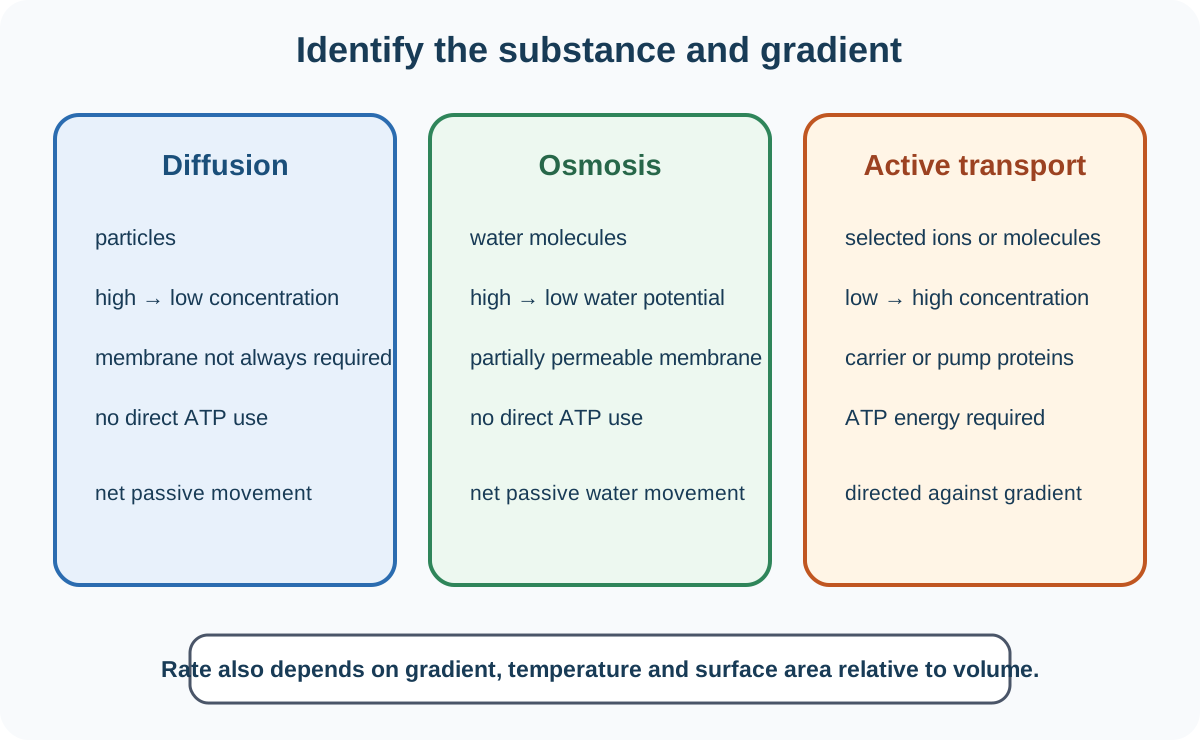
Cell survival depends on controlled exchange across membranes. Pearson Edexcel International GCSE Human Biology (4HB1) Topic 3 requires definitions and understanding of diffusion, osmosis and active transport, including water potential, plus the effects of surface-area-to-volume ratio, temperature and concentration gradient on movement rate. Theory owns these mechanisms and human examples; the practical hub owns diffusion and osmosis protocols, measurement and evaluation.
1. The cell membrane as an exchange boundary
The cell membrane separates cytoplasm from extracellular fluid. Its phospholipid bilayer and proteins make it selectively permeable: some small molecules cross readily, while ions and many polar substances require proteins. Selectivity lets cells regulate composition rather than reaching uncontrolled equilibrium with their surroundings.
Net movement describes the balance of random molecular movements in both directions. At equilibrium, molecules still move, but equal opposing rates produce no net change. Do not describe particles as “wanting” to move; motion results from kinetic energy and interactions.
2. Diffusion
Diffusion is the net movement of particles from a region of higher concentration to a region of lower concentration, down a concentration gradient, because of random motion. It is passive and does not require ATP supplied directly by the cell.
Oxygen diffuses from alveolar air into blood and from blood into respiring tissues when concentration gradients favor those directions. Carbon dioxide diffuses in the reverse overall direction. Small lipid-soluble molecules may cross the bilayer, while facilitated diffusion uses membrane proteins for substances that cannot pass readily through lipids.
Facilitated diffusion is still passive: proteins provide a route but movement remains down the gradient. Channels and carriers can be selective, and their availability may limit rate.
3. Osmosis and water potential
Osmosis is the net movement of water molecules through a partially permeable membrane from higher water potential to lower water potential. Pure water has a higher water potential than a concentrated solution under comparable pressure conditions. Adding solute lowers water potential.
Water moves in both directions, but the net direction is down the water-potential gradient. The solute itself need not cross. A membrane is essential to the definition because it separates solutions while allowing water movement.
If human cells are placed in a solution with much higher water potential, water enters and cells may swell or burst because they lack a cell wall. In a lower-water-potential solution, water leaves and cells shrink. An isotonic solution produces no net water movement, though individual water molecules continue to exchange.
Check this topic from memory
Attempt the matching topic bank before reopening the notes. Use each missed idea to decide what to review next.
Start the topic quiz