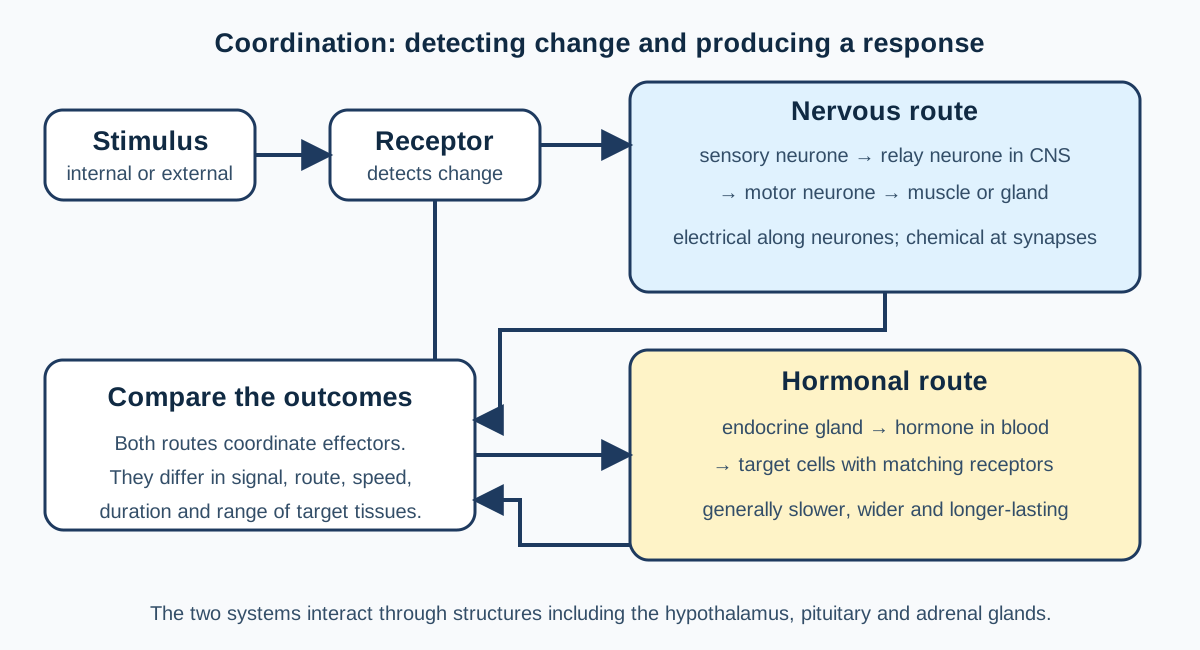
Coordination converts detected change into an appropriate response. Pearson Edexcel International GCSE Human Biology (4HB1) Topic 5 links neurones, the central nervous system, reflexes, synapses and sense organs with hormonal control, drug effects and selected disorders. The central examination habit is to trace a complete pathway and explain how each named structure contributes.
1. Neurones and the central nervous system
A sensory neurone carries electrical impulses from a receptor toward the central nervous system (CNS). Its cell body lies along the fibre. A motor neurone carries impulses from the CNS to an effector; its cell body is at one end and it has a long axon. A relay neurone connects neurones within the CNS and is usually shorter, with many branching connections. Myelin electrically insulates many axons and helps impulses travel rapidly.
The CNS consists of brain and spinal cord. It receives sensory information, integrates it and coordinates output. The cerebral hemispheres support conscious sensation, thought, memory, language and voluntary movement. The cerebellum coordinates balance and fine muscular action. The midbrain participates in visual and auditory reflexes. The hypothalamus monitors internal conditions and links nervous control with the endocrine system. The pituitary releases hormones that regulate water balance, growth and other endocrine glands.
The spinal cord carries impulses between brain and body and coordinates many rapid reflexes. It is protected by vertebrae, while the brain is protected by the skull.
2. Receptors, impulses and responses
A receptor is a cell or sense organ that detects a stimulus and converts it into an electrical signal. Photoreceptors detect light; thermoreceptors detect temperature; mechanoreceptors detect pressure or touch; pain receptors respond to potentially damaging stimuli; chemoreceptors in taste buds detect dissolved chemicals.
The general pathway is:
a stimulus changes the receptor;
the receptor initiates an impulse in a sensory neurone;
the CNS processes the information through relay neurones;
a motor neurone carries an impulse away;
an effector, such as a muscle or gland, produces a response.
An impulse begins when stimulation changes ion movement across a neurone membrane. The resulting electrical change travels along the axon in one direction because recently active membrane cannot immediately fire again. At a synapse, the arriving impulse causes neurotransmitter release. The chemical diffuses across the gap, binds to receptors on the next cell and may initiate a new impulse. Synaptic transmission is one-way because transmitter is released from one side and receptors are concentrated on the other.
Check this topic from memory
Attempt the matching topic bank before reopening the notes. Use each missed idea to decide what to review next.
A reflex is a rapid, automatic response that can protect the body. In a withdrawal reflex, a pain receptor initiates an impulse in a sensory neurone. It enters the spinal cord, crosses synapses through a relay neurone and activates a motor neurone. The motor neurone stimulates a flexor muscle to contract, withdrawing the limb. The brain also receives information, so awareness may follow, but conscious decision is not required to begin withdrawal.
Reflex does not mean instantaneous or brainless. Impulse conduction and synaptic transmission take time, and the CNS still coordinates the pathway.
4. Hormonal coordination
Hormones are chemical messengers released by endocrine glands into the blood. They travel throughout the circulation but act only on target cells with suitable receptors.
The pituitary releases antidiuretic hormone (ADH), which increases water reabsorption by kidney collecting ducts, and gonadotrophic hormones that regulate the gonads.
The adrenal glands release adrenaline, preparing the body for acute challenge by increasing heart rate and redirecting resources.
The thyroid releases thyroxine, influencing metabolic rate and growth and development.
Pancreatic islets release insulin, which lowers elevated blood glucose, and glucagon, which raises low blood glucose.
Ovaries release oestrogen and progesterone; testes release testosterone. These contribute to reproductive function and sexual development.
Nervous responses use electrical impulses along specific neurones, are usually rapid and short-lived, and affect precise effectors. Hormonal responses travel chemically in blood, are generally slower and longer-lasting, and can affect several target tissues. The systems interact rather than operating independently.
5. The eye
The cornea refracts incoming light strongly. The iris controls pupil diameter and therefore light entry. The lens fine-tunes refraction. The ciliary muscles and suspensory ligaments alter lens shape during accommodation. The retina contains photoreceptors; the fovea has a high density of cones for detailed colour vision; the optic nerve carries impulses to the brain.
For near focus, ciliary muscles contract, suspensory ligaments slacken and the lens becomes thicker and more convex. For distant focus, ciliary muscles relax, ligaments become taut and the lens is pulled thinner. In bright light, circular iris muscles contract and radial muscles relax, constricting the pupil. Dim light produces the opposite response.
Two forward-facing eyes receive slightly different images. The brain compares this binocular information to support stereoscopic depth perception.
Short sight forms distant images in front of the retina and can be corrected with a diverging lens. Long sight forms near images behind the retina and can be corrected with a converging lens. Astigmatism results from uneven corneal or lens curvature and needs appropriately shaped corrective lenses. A cataract is clouding of the lens and may be treated by replacing it with an artificial lens. A damaged cornea may sometimes be treated by transplantation.
6. The ear, hearing and balance
The pinna collects sound. The ear canal directs waves to the tympanic membrane, which vibrates. Ossicles transmit and amplify vibrations to the oval window. Pressure waves in cochlear fluid bend sensory hair cells, producing impulses that travel in the auditory nerve.
The Eustachian tube helps equalize pressure across the eardrum. The semicircular canals detect rotational movement: movement of fluid bends receptor cells. Other vestibular structures detect head position and linear acceleration. The brain combines this information with vision and proprioception to maintain balance.
Prolonged high-intensity noise can damage cochlear hair cells, causing permanent hearing loss or tinnitus. Risk depends on sound level, duration and protection. Audible-frequency investigations and maps of skin receptor sensitivity belong to the separate practical hub, where sampling, control variables, safety and uncertainty are developed.
7. Drugs, alcohol and the nervous system
A drug is a substance that changes chemical reactions or physiological processes in the body. Legal status varies by jurisdiction and does not by itself measure biological harm.
Heroin is an opioid that can produce dependence and dangerously suppress breathing, with additional infection and overdose risks. Cocaine is a stimulant that can increase alertness and heart activity but carries dependence and cardiovascular risks. Cannabis can alter perception, memory, coordination and reaction time, and in some people is associated with mental-health harms. Paracetamol is a legal analgesic that reduces pain signaling and perception; it does not switch off every nerve impulse, and overdose can cause severe liver damage.
Alcohol depresses CNS activity, impairing judgment, reaction time, balance and coordination. Heavy long-term consumption can damage brain and peripheral nerves and cause liver disease. Immediate behavioural consequences can include risk-taking, conflict, accidents and unsafe driving. Biological effect, dose, pattern of use and social context all matter.
8. Mental and neurodegenerative conditions
These descriptions support syllabus comparison, not self-diagnosis. One isolated symptom cannot establish a condition, and assessment and treatment must be individualized by qualified professionals.
Schizophrenia is a long-term mental-health condition that may include hallucinations, delusions, disorganized thinking and reduced motivation or social engagement. Its causes are multifactorial, involving genetic vulnerability and environmental influences rather than one personal failing. Treatment commonly combines antipsychotic medicine, psychological therapy and social support.
Clinical depression involves persistent low mood or loss of interest, often with changes in sleep, appetite, energy, concentration and feelings of worthlessness. Biological, psychological and social factors can contribute. Depending on severity and need, management may include guided self-help, exercise, talking therapies and prescribed antidepressants.
Dementia is a syndrome involving progressive decline in cognitive function that interferes with daily life. Alzheimer’s disease is a common cause and involves progressive neurodegeneration. Vascular dementia results from reduced or interrupted blood flow damaging brain tissue and may show a stepwise or variable course. Support, risk-factor management and some medicines may help symptoms or progression in selected people, but there is no simple cure.
Parkinson’s disease is associated with loss or dysfunction of dopamine-producing neurones involved in movement. Typical features include slowed movement, rigidity and tremor, though presentation varies. Levodopa, dopamine agonists, supportive therapies and sometimes surgery can reduce symptoms, but current treatment does not cure the disease.
Worked application: withdrawing from heat while stress hormones rise
A person touches a hot tray and immediately pulls their hand away, then notices a racing heart. Heat and pain receptors initiate impulses in a sensory neurone. In the spinal cord, neurotransmitters carry signals across synapses to relay and motor neurones. The motor impulse activates flexor muscles, so withdrawal begins before a conscious decision. Other impulses reach the brain, producing pain awareness. At the same time, nervous signals stimulate adrenal adrenaline release. Adrenaline travels in blood and acts on target organs, increasing heart rate and helping mobilize fuel. The reflex is rapid, localized and brief because impulses follow specific neurones. The hormonal effect starts less directly, reaches several organs and can persist longer. This example shows interaction between nervous and endocrine coordination, not two isolated systems.
Common misconceptions and how to correct them
Calling every long neurone a sensory neurone. Identify direction of transmission and cell-body position.
Saying the brain controls every reflex before movement begins. The spinal cord can initiate withdrawal while information also reaches the brain.
Describing an impulse as neurotransmitter flowing down an axon. The axon signal is electrical; transmitter crosses a synapse chemically.
Saying synapses transmit equally in both directions. Their release sites and receptors make transmission one-way.
Treating hormones as acting on every cell they reach. Only cells with appropriate receptors respond.
Saying hormonal control is always slow. It is generally slower than neural signaling, but rates vary.
Reversing accommodation. Near focus uses contracted ciliary muscle, slack ligaments and a thicker lens.
Saying the pupil itself is a muscle. It is an opening controlled by iris muscles.
Calling cataract a cloudy cornea. Cataract is clouding of the lens.
Saying the semicircular canals detect sound. Cochlear receptors support hearing; semicircular canals support balance.
Assuming legal means harmless. Legal status and physiological risk are different classifications.
Saying paracetamol blocks all nervous activity. It reduces pain but does not stop general impulse transmission.
Equating schizophrenia with split personality or inevitable violence. Neither claim defines the condition.
Calling ordinary sadness clinical depression. Diagnosis depends on persistent patterns, effects and professional assessment.
Treating all dementia as Alzheimer’s disease. Alzheimer’s and vascular disease are different causes of dementia.
Saying Parkinson’s disease is simply weak muscles. It is a neurological disorder of movement control.
Assessment guidance
Trace pathways in sequence and name the receptor, neurone type, CNS region, synapse, motor neurone and effector. Comparisons need paired contrasts, such as electrical versus chemical transmission, route, speed, duration and target range. Eye and ear questions reward structure linked directly to function, not an unlabeled list. For accommodation, state all three linked changes. Drug and disease responses should distinguish cause or risk, symptoms, mechanism and management, avoid deterministic claims, and use respectful language. When interpreting receptor or hearing data, separate the biological conclusion from limitations of the practical method. Do not import practical protocols into a theory mechanism answer unless the question asks for investigation design.
Retrieval practice
Draw a sensory-relay-motor reflex arc and annotate where electrical and chemical transmission occur. Compare nervous and hormonal control across five features. Reconstruct near and distant accommodation, the pupil reflex, hearing and balance pathways, then make a four-column table for schizophrenia, depression, Alzheimer’s or vascular dementia, and Parkinson’s disease covering causes, characteristic symptoms, treatments and cautions about diagnosis.