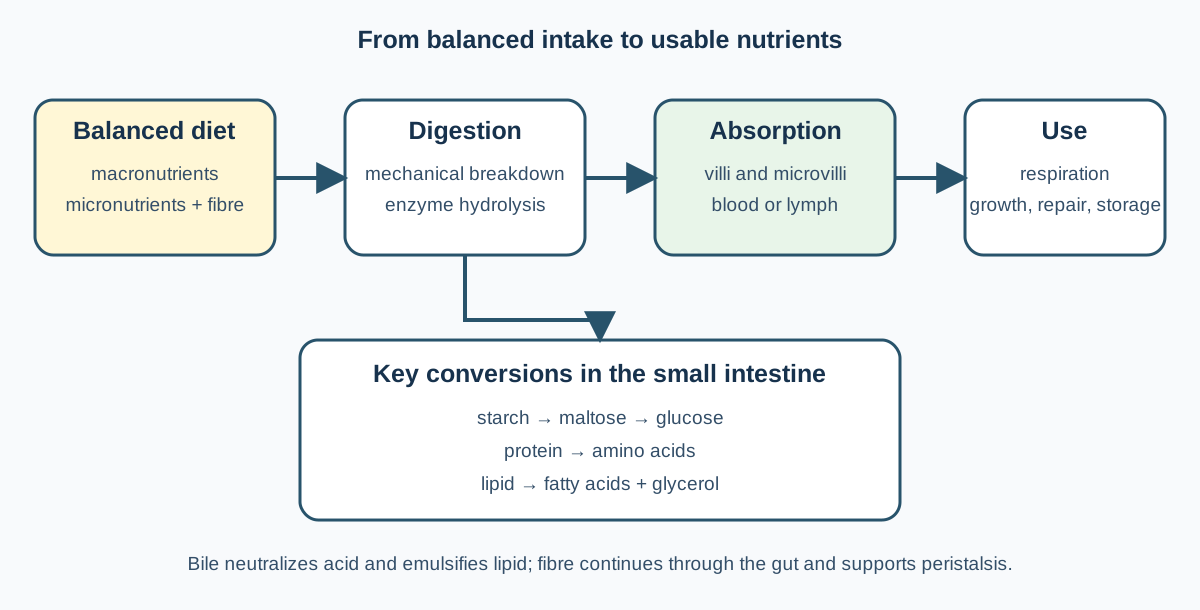
Nutrition supplies substrates for energy release, raw materials for growth and repair, and micronutrients needed for normal physiology. Pearson Edexcel International GCSE Human Biology (4HB1) Topic 6 connects a balanced diet to digestion, absorption, teeth, deficiency disease, body mass index and food hygiene. Energy release itself belongs to Topic 7 Respiration.
1. A balanced diet
A balanced diet provides appropriate proportions and quantities of nutrients, energy and fibre for an individual. It is not one fixed menu. Recommended intake varies with age, pregnancy, climate, activity and occupation. A growing adolescent needs materials for new tissue; pregnancy increases several nutrient demands; physical work raises energy expenditure; and temperature can change energy use and fluid loss.
Carbohydrates are important respiratory substrates. Sources include cereals, rice, bread, potatoes and fruit. Proteins provide amino acids for growth, repair, enzymes, antibodies and some hormones; sources include meat, fish, eggs, dairy products, beans and lentils. Lipids provide concentrated energy, insulation, protection and membrane components; sources include oils, nuts, seeds, dairy products and fatty foods.
Vitamin A supports vision and healthy epithelia, and occurs in liver, dairy foods and carotene-rich vegetables. Vitamin C supports collagen formation and wound healing, and occurs in many fruits and vegetables. Vitamin D supports calcium absorption and bone mineralization and can come from diet and synthesis in skin exposed to sunlight. Calcium supports bones, teeth, muscle and nerve function. Iron is needed to make haemoglobin. Dietary fibre adds bulk, retains water and supports movement through the gut.
Recommended intake is a population guide, not proof that every individual has identical needs. Energy intake and expenditure also need to be considered over time.
2. Deficiency diseases
Deficiency occurs when intake, absorption or use of a nutrient is inadequate for long enough to impair function.
Vitamin C deficiency causes scurvy, with weak connective tissue, bleeding gums and poor wound healing.
Iron deficiency can cause anaemia because less haemoglobin is produced. Symptoms may include fatigue, pallor and breathlessness.
Vitamin A deficiency can impair vision and may lead to blindness, especially through damage associated with severe deficiency.
Severe protein deficiency can cause kwashiorkor, characterized by impaired growth, muscle wasting and oedema.
Symptoms are not unique diagnoses. Fatigue, for example, has many possible causes. Examination answers should connect a named deficiency to the disrupted biological role.
Check this topic from memory
Attempt the matching topic bank before reopening the notes. Use each missed idea to decide what to review next.
The alimentary canal is a continuous muscular tube. In the mouth, teeth mechanically break food, saliva moistens it and salivary amylase begins starch digestion. The oesophagus moves a bolus to the stomach. The stomach stores and churns food, releases acid and provides conditions for pepsin action.
The small intestine receives pancreatic enzymes and bile, completes digestion and absorbs soluble products. The pancreas produces amylase, proteases and lipase and releases them into the small intestine. The large intestine absorbs water and mineral ions and compacts undigested material into faeces.
The liver produces bile; the gall bladder stores and concentrates it before release into the small intestine. These accessory organs are not sections through which food passes.
4. Peristalsis and fibre
Peristalsis is a coordinated wave of circular and longitudinal muscle activity in the gut wall. Circular muscle contracts behind a bolus while muscle ahead relaxes, pushing material forward. Longitudinal contraction shortens a segment and assists movement.
Dietary fibre is not digested by human enzymes. It adds bulk and helps material retain water, giving the gut wall contents against which muscular contractions can act. Adequate fibre and fluid support regular movement, but fibre does not itself contract or chemically digest food.
5. Digestive enzymes
Digestion converts large insoluble molecules into smaller soluble molecules that can be absorbed.
Amylase is produced by salivary glands and pancreas and acts in the mouth and small intestine, digesting starch to maltose. Maltase is produced by the small-intestinal lining and digests maltose to glucose. Pepsin is a protease produced in the stomach and works in acidic conditions. Trypsin is released from the pancreas and acts in the small intestine. Together, proteases digest proteins to amino acids. Lipase, produced mainly by the pancreas for this syllabus, acts in the small intestine to digest lipids into fatty acids and glycerol.
Enzymes are specific because their active sites fit particular substrates. They catalyse hydrolysis rather than merely making food physically smaller.
6. Bile and lipid digestion
Bile is alkaline, so it helps neutralize acidic chyme entering the small intestine from the stomach. This provides a more suitable pH for intestinal and pancreatic enzymes.
Bile salts emulsify large lipid globules into many small droplets. This is physical dispersion, not chemical digestion. It increases the total surface area available to lipase, raising the rate at which fatty acids and glycerol are produced.
7. Absorption by villi
The small intestine has folds bearing many villi, and epithelial cells have microvilli. These features create a very large surface area. The epithelium is one cell thick, giving a short diffusion distance. A dense capillary network carries away glucose and amino acids, maintaining concentration gradients. A central lacteal absorbs lipid digestion products into the lymphatic system.
Epithelial cells contain transport proteins and many mitochondria, supporting facilitated diffusion and active transport where required. Good blood flow does not absorb nutrients by itself; it maintains conditions that favour continued transfer.
8. Teeth and oral health
Incisors have sharp edges for cutting, canines help grip and tear, and premolars and molars have broader surfaces for crushing and grinding. A tooth has an enamel-covered crown, dentine beneath, a pulp cavity containing nerves and blood vessels, and roots anchored in the jaw. Cement and periodontal fibres help secure the root; gums form a protective seal.
Calcium, phosphate, vitamin D, protein and normal development support tooth growth. Plaque bacteria metabolize sugars and produce acids that dissolve enamel, promoting dental caries. Regular brushing with fluoride toothpaste, interdental cleaning, limiting frequent sugary intake and dental care reduce risk. Gum inflammation can progress if plaque persists around the gum margin.
9. BMI, obesity and cardiovascular risk
Body mass index is calculated as
BMI = mass in kg ÷ (height in m)².
BMI is a screening measure, not a direct measurement of body fat or an individual diagnosis. Muscle mass, age and body composition affect interpretation.
Obesity raises the risk of earlier type 2 diabetes by increasing insulin resistance, although it is not the only risk factor. Persistently high blood cholesterol, especially in an adverse lipoprotein pattern, contributes to fatty deposits and inflammatory changes in artery walls. Atherosclerotic plaques narrow arteries and can promote clot formation, increasing the risk of heart attack or stroke.
Use “risk factor” precisely: it changes probability rather than guaranteeing disease.
10. Food hygiene and preservation
Food may carry pathogenic microorganisms or their toxins. Hygienic preparation includes clean hands and surfaces, preventing cross-contamination between raw and ready-to-eat food, using safe water and protecting food from pests. Thorough cooking can kill many pathogens, but it may not remove every pre-formed toxin.
Cool storage slows microbial reproduction; freezing slows it further but does not reliably sterilize food. Drying, salting, sugaring, pickling, pasteurization and canning preserve food by reducing available water, changing pH or applying heat. Safe storage time and temperature remain important after cooking.
Food-test protocols, calorimetry, enzyme-rate investigations and hygiene culturing methods belong to the separate practical hub. This theory chapter owns the biological explanation and interpretation of evidence.
Worked example: interpreting BMI without overclaiming
A person has a mass of 78 kg and a height of 1.70 m. Their BMI is 78 ÷ (1.70)² = 27.0 kg m⁻² to three significant figures. This value can be compared with the classification system supplied in a question, but it cannot reveal body-fat distribution, muscle mass, blood glucose or artery condition. If the question asks about disease risk, explain that greater adipose tissue can contribute to insulin resistance, increasing type 2 diabetes risk. A high-cholesterol pattern can also promote plaque formation in artery walls, narrowing the lumen and increasing clot risk. Neither pathway makes disease inevitable. Genetics, activity, diet, smoking, age and other health factors also contribute, so BMI is a screening clue rather than a diagnosis.
Common misconceptions and how to correct them
Defining balance as equal amounts of every nutrient. Required quantities and proportions differ.
Assuming everyone has the same recommended intake. Age, pregnancy, climate and occupation can change needs.
Calling fibre a source of human digestive glucose. Human enzymes do not digest it.
Diagnosing iron deficiency from tiredness alone. Symptoms are nonspecific and require evidence.
Saying the liver stores bile. The liver produces bile; the gall bladder stores it.
Putting the pancreas inside the alimentary canal. It is an accessory gland that secretes into the canal.
Saying peristalsis is gravity moving food. Coordinated gut-wall muscles propel it.
Saying amylase converts starch directly to glucose. Pearson requires starch to maltose by amylase, then maltose to glucose by maltase.
Saying bile digests lipids. It emulsifies them; lipase hydrolyses them.
Saying villi increase volume. Their key geometrical effect is increased surface area.
Confusing lacteals with capillaries. Lacteals receive lipid products; blood capillaries receive glucose and amino acids.
Calling enamel living tissue that regrows readily. Mature enamel has very limited repair capacity.
Using BMI as a direct body-fat percentage. It is mass divided by height squared and needs context.
Saying obesity causes every case of type 2 diabetes. It is one important risk factor.
Saying refrigeration kills all microorganisms. It mainly slows their growth.
Assessment guidance
For nutrient questions, pair each named source with a physiological function and distinguish intake from absorption. Digestion answers should follow food through named organs and match every enzyme to substrate, product, production site and action site. Explain bile through both neutralization and emulsification. Villi questions need a feature-mechanism-benefit chain, such as thin epithelium causing short diffusion distance and faster transfer. Show BMI substitution with kilograms and metres, then interpret cautiously using any supplied thresholds. Risk questions must use causal links without deterministic language. Food-hygiene answers should name a contamination route, a control and how that control changes microbial survival or reproduction.
Retrieval practice
Build a table for carbohydrate, protein, lipid, vitamins A, C and D, calcium, iron and fibre, including sources, functions and deficiency effects where required. Trace starch, protein and lipid from ingestion to absorbed products. Draw and annotate a villus and tooth, calculate BMI from a fresh data set, and explain one diabetes-risk pathway, one atherosclerosis pathway and three distinct preservation mechanisms.