

Pearson Edexcel International GCSE Human Biology 8: Gas exchange
Pearson Edexcel International GCSE Human Biology 4HB1 notes on gas exchange.
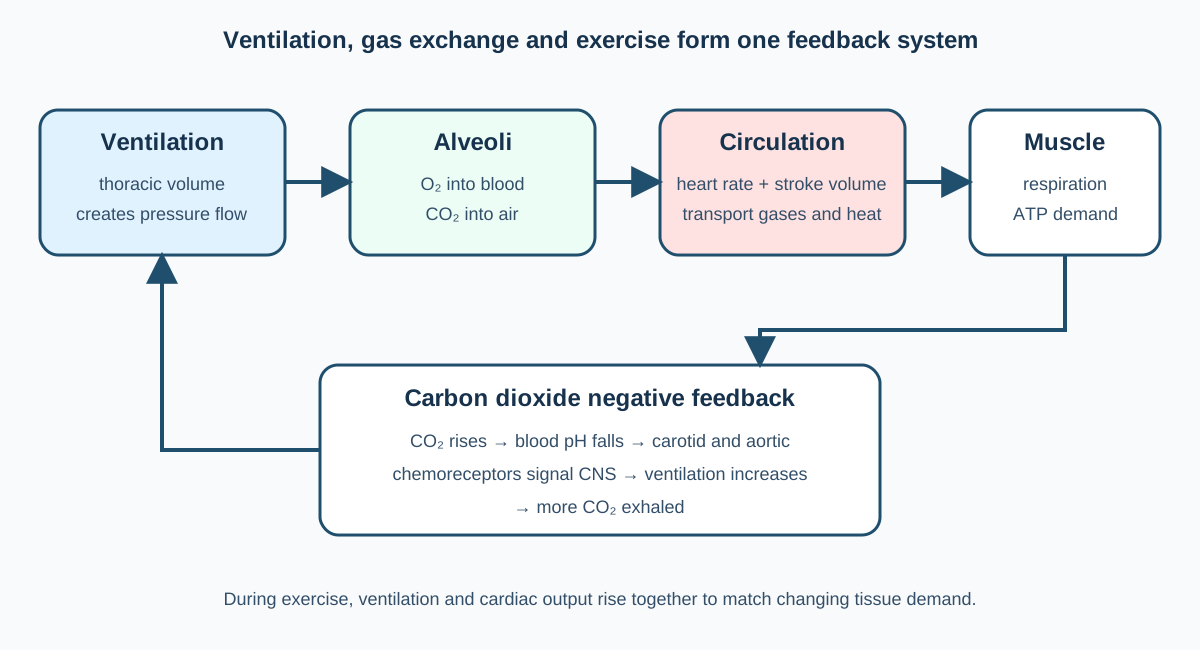
Gas exchange maintains diffusion gradients between air and blood, while ventilation renews alveolar air. Pearson Edexcel International GCSE Human Biology (4HB1) Topic 8 connects thoracic structure and spirometry to exercise, pulse, carbon dioxide control, oxygen debt and smoking damage. Strong answers keep ventilation, gas exchange, circulation and cellular respiration distinct while explaining how they interact.
1. Thorax and airways
Air passes through the trachea, which is supported by cartilage and lined with ciliated epithelium and mucus-producing cells. The trachea divides into bronchi, then progressively smaller bronchioles, ending at clusters of alveoli.
The lungs lie within the thorax, protected by ribs. Intercostal muscles lie between ribs, and the diaphragm forms a muscular sheet below the lungs. Pleural membranes surround each lung with a thin film of pleural fluid between them. This reduces friction and helps couple lung movement to the thoracic wall while keeping the lungs in an airtight pressure system.
Cartilage prevents major airways collapsing, mucus traps particles and microorganisms, and cilia move contaminated mucus toward the throat. Bronchioles contain smooth muscle that can alter airway diameter.
2. Ventilation mechanics
During inspiration, external intercostal muscles contract, moving ribs upward and outward. The diaphragm contracts and flattens. Thoracic volume increases, pressure inside the lungs falls below atmospheric pressure and air enters.
During quiet expiration, these muscles relax. Ribs move downward and inward, the diaphragm becomes dome-shaped, thoracic volume decreases, lung pressure rises and air leaves. Elastic recoil contributes. Forced expiration additionally recruits internal intercostal and abdominal muscles.
Muscles change volume; the pressure difference then drives air. It is incomplete to say that the lungs “suck in” air without explaining pressure.
3. Alveolar adaptations
Millions of alveoli provide a very large surface area. Alveolar epithelium and capillary endothelium are each one cell thick, creating a short diffusion distance. A moist lining allows gases to dissolve. Dense capillary flow brings deoxygenated blood and removes oxygenated blood, while ventilation refreshes alveolar air.
These features maintain steep oxygen and carbon dioxide concentration gradients. Oxygen diffuses from alveolar air into blood and carbon dioxide diffuses in the opposite direction. The folded surface does not actively pump gases; diffusion is passive.
4. Lung volumes and spirometry
Tidal volume is the volume moved in or out during one normal breath.
Check this topic from memory
Attempt the matching topic bank before reopening the notes. Use each missed idea to decide what to review next.
Start the topic quiz