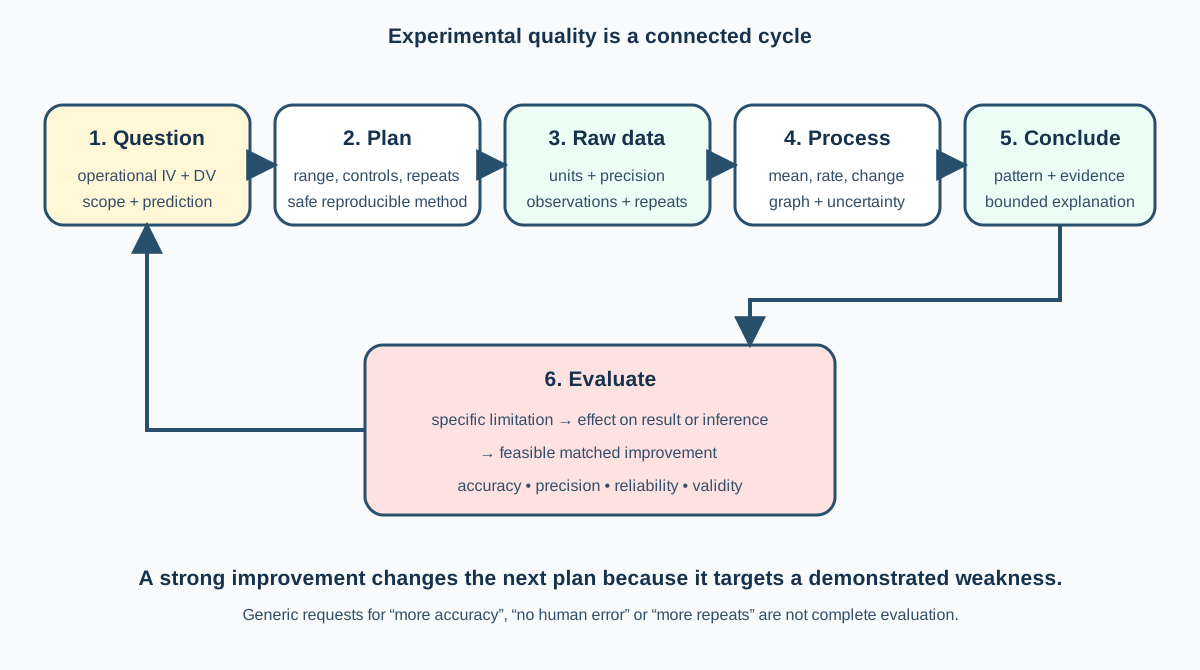
This chapter consolidates the experimental-skills contract in Pearson Edexcel International GCSE Human Biology (4HB1), Issue 2, pages 21 to 22. Pearson assesses practical skills through written examinations: solving practical problems, planning, safe method selection, precise observation, variables, analysis, communication, reliability, accuracy and validity. This is a cross-cutting skills chapter, not a sixth numbered Pearson investigation.
1. Start with a testable question
A testable question names the system, independent variable and measurable dependent variable. “How does temperature affect amylase?” is incomplete until activity is operationalized, for example as reciprocal time for starch disappearance under specified conditions.
A hypothesis predicts a direction or pattern and gives biological reasoning. It is not a conclusion written before data. A null hypothesis states no association or difference where statistical testing is relevant, but Pearson questions may focus on ordinary evidence-based predictions.
Define the population or material and the conditions to which the conclusion will apply. A study on one food extract or one participant cannot justify a universal claim.
2. Variables
The independent variable is deliberately changed or used to form comparison groups. The dependent variable is measured. Control variables are factors kept sufficiently constant so the independent variable provides the most plausible explanation for change.
List how each variable is changed, measured or controlled. “Keep temperature the same” is weaker than “maintain all tubes at 30 °C in a thermostatically controlled water bath and verify with a thermometer”.
Some biological variables cannot be fixed, such as participant physiology. Restrict, match, randomize, block or use within-participant designs, then acknowledge remaining variation.
3. Range and intervals
Choose an independent-variable range wide enough to reveal a trend but safe and biologically relevant. Include enough levels to distinguish a curve from a straight line. Intervals can be narrower around a suspected threshold or optimum.
A pilot study checks whether the range, method, endpoint and timing are workable. It can prevent ceiling effects, where all values hit the maximum, or floor effects, where none is detectable.
Do not choose a range simply because apparatus labels are convenient. Justify it using biology and safety.
4. Controls and comparisons
A negative control lacks the factor expected to cause the result and reveals background change or contamination. A positive control contains a factor known to produce the expected response and checks that the method can detect it. A solvent control separates an active substance from its carrier.
Check this topic from memory
Attempt the matching topic bank before reopening the notes. Use each missed idea to decide what to review next.
A control variable is not the same as a control group. The former is held constant; the latter is a comparison treatment.
Controls should answer a defined interpretive question. Adding unnecessary treatments can consume materials or increase risk without improving validity.
5. Method detail and reproducibility
A reproducible method specifies material quantities, apparatus, sequence, timing, endpoint, environmental conditions, repeats and processing. Write enough for another trained student to reproduce the investigation without guessing.
Choose equipment by range and resolution. A 10 cm³ measuring cylinder is usually more appropriate than a 100 cm³ cylinder for 6 cm³, while a volumetric pipette may be better when one exact volume is required. Record measurements to the precision supported by the scale, not invented decimal places.
State when timing begins and ends. “Time the reaction” is incomplete without mixing and endpoint rules.
6. Risk, ethics and environmental responsibility
Identify hazard, route of harm, exposed person and control. “Wear goggles” is not a complete risk assessment unless splash risk exists and the control matches it. Consider hot water, glass, chemicals, microorganisms, allergens, flames, exercise and electrical equipment.
Human work requires voluntary consent, privacy, appropriate screening and stopping criteria. Microbiology requires approved organisms, containment and disposal. Use the smallest suitable quantities, avoid unnecessary living material and dispose of chemicals and biological waste through approved routes.
Safety is an overriding Pearson requirement. A method that gathers more data by increasing avoidable harm is not a better method.
7. Raw data tables
Design the table before collecting data. Put the independent variable first, include units in headings, keep raw repeats separate and use consistent decimal places matching apparatus resolution. Qualitative observations need precise descriptions rather than “good” or “bad”.
Do not put units inside every cell. Do not mix processed means with raw readings without clear labels. Record anomalies rather than silently deleting them.
For human studies, use participant codes rather than names. For repeated time measurements, distinguish time point from elapsed interval.
8. Processing data
Useful calculations include mean, range, rate, percentage change and sometimes standard deviation or statistical tests when supplied by the course. Show the relationship, substitution and units.
A mean reduces the influence of random variation but does not fix systematic bias. Range is simple spread. Rate is change divided by time, or reciprocal time when a fixed endpoint represents the same amount of change. Percentage change normalizes change to the starting value.
Retain appropriate significant figures. A processed result should usually not imply greater precision than its raw measurements.
9. Graphs
Put the independent variable on the horizontal axis and dependent variable on the vertical, with quantity and unit. Use a scatter graph for two continuous variables and a line or smooth best-fit curve when the independent variable is ordered and continuous. Use bars for discrete categories.
Choose a sensible scale occupying most of the grid. Plot accurately and use a best-fit line or curve rather than dot-to-dot connections unless sequential change itself is being followed. Error bars can show variability when the measure is defined.
A graph’s gradient represents rate of change. A plateau, optimum or intercept should be read with uncertainty rather than excessive precision.
10. Conclusions
A conclusion states the pattern, supports it with processed evidence and gives a biological explanation within the design’s scope. Quote representative values or a gradient, not every number.
Distinguish observation from mechanism. Data may show that reaction rate fell above 45 °C; denaturation is a biological explanation supported by knowledge, not something directly seen unless structure was measured.
Do not say a hypothesis was “proved”. Evidence supports, does not support or is inconclusive under tested conditions.
11. Reliability, accuracy, precision and validity
Repeatability asks whether the same person using the same method obtains similar results. Reproducibility asks whether different people, equipment or settings obtain comparable results. Reliability concerns consistency and sufficient evidence.
Precision concerns the closeness of repeated values or measurement resolution. Accuracy concerns closeness to a true or accepted value. A precise instrument can be systematically miscalibrated and therefore inaccurate.
Validity asks whether the design measures the intended relationship. Confounding variables, poor controls or an unsuitable proxy weaken validity even if readings are precise.
12. Anomalies and uncertainty
An anomaly differs substantially from the pattern. Investigate transcription, apparatus or procedural causes. Repeat the condition when feasible. Exclude a value only with a stated objective reason; never remove it merely because it weakens the conclusion.
Measurement uncertainty comes from scale resolution and judgement of endpoints. Repeats reveal random spread but do not automatically remove systematic error. Calibration, blanks and reference standards address different problems.
13. Evaluation that earns marks
Use a three-part chain:
name the specific limitation;
explain how it affects result direction, spread or interpretation;
propose a feasible matched improvement.
For example: heat lost from an open food calorimeter makes water temperature rise too small, underestimating energy transfer; use insulation, a lid and a shield while keeping flame distance fixed.
“Use better equipment”, “avoid human error” and “repeat more” are incomplete unless the equipment, error mechanism or benefit is explained. Further work should answer a new uncertainty rather than merely repeat the same range.
Worked application: diagnosing a weak enzyme plan
A plan compares amylase at 20 °C and 60 °C, uses unbuffered mixtures, starts timing before reagents reach bath temperature and records one endpoint per condition. Any difference cannot be attributed confidently to temperature because pH may vary, actual reaction temperature is uncertain and there is no estimate of random variability. Improve it by adding several temperatures across the range, using one buffer, pre-equilibrating enzyme and substrate separately, mixing to define time zero and preparing independent repeats. Convert fixed-endpoint times to reciprocal-time rates and plot a best-fit curve. These changes improve validity, resolution and reliability. They still do not prove molecular denaturation directly; that remains the biological explanation for a reproducible high-temperature decline.
Common misconceptions and how to correct them
Writing a topic as a testable question. Name the changed and measured variables.
Calling the dependent variable a control. It is the measured outcome.
Listing control variables without methods. State how each is maintained.
Using only two independent-variable values. More levels are needed to establish shape.
Confusing a control group with a controlled variable. They serve different roles.
Adding a control without saying what it tests. Every comparison needs a purpose.
Giving apparatus without quantities or timing. A method must be reproducible.
Writing “be careful” as safety. Link hazard, harm and control.
Treating consent as permission that cannot be withdrawn. Participants may stop.
Averaging before preserving raw repeats. Record raw data first.
Adding excessive decimal places to a mean. Match source precision.
Joining every graph point dot-to-dot. Use the representation suited to variable type.
Saying data prove a hypothesis. State support within tested conditions.
Equating precision with accuracy. Systematic bias can produce precise wrong values.
Calling repeats a cure for calibration error. They mainly expose random variation.
Deleting anomalies automatically. Investigate and justify treatment.
Writing “human error” as an evaluation. Name the actual action and effect.
Suggesting more repeats without explaining why. Connect repeats to mean and spread.
Assessment guidance
Answer the command word. A “describe” response gives the method or pattern; an “explain” response adds biological reasoning; an “evaluate” response weighs evidence and limitations. Planning answers need variables, range, apparatus, reproducible sequence, controls, repeats, safety and processing. Data answers should show calculations and units before interpretation. Conclusions must quote evidence and remain within scope. Evaluation should prioritize the largest validity or accuracy threats, not produce a generic list. When proposing further work, identify the unresolved question, new range or improved measurement it addresses.
Retrieval practice
Turn three broad topics into operational questions, classify all variables and design purposeful controls. Build a raw-data table and choose graph types for continuous, categorical and time-series examples. Diagnose one systematic and one random error, distinguish repeatability from reproducibility and precision from accuracy, then write three limitation-effect-improvement chains for unfamiliar methods.