

Pearson International GCSE Mathematics A 1: Number
Pearson Edexcel International GCSE Mathematics A notes on number systems, fractions, percentages, standard form and bounds.
Number work supports every later 4MA1 topic, so accuracy with representation, estimation and proportional reasoning matters as much as calculator use.
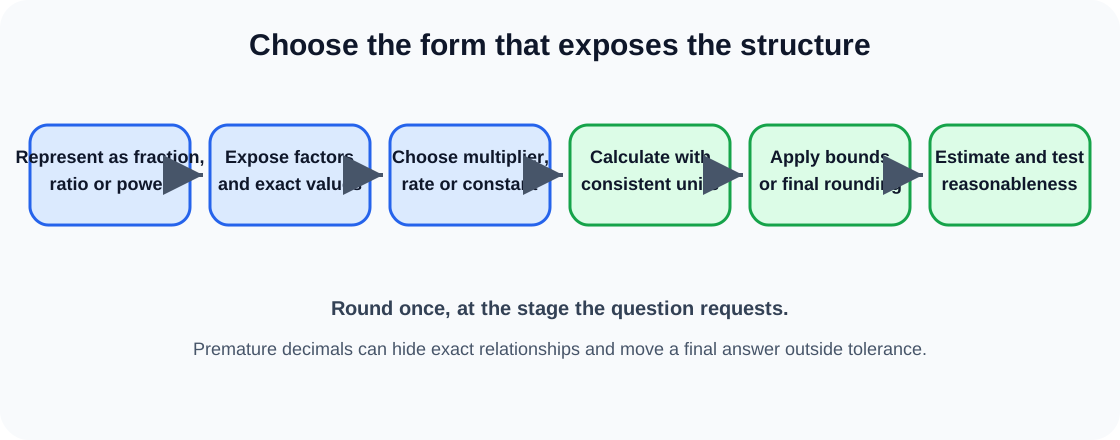
Pearson 4MA1 Number combines fluency with judgement. The same value may be represented as a fraction, decimal, percentage, ratio, power or standard-form number, and the useful form depends on the problem. Exact work should remain exact until the requested rounding stage.
Main ideas
- Use integers, fractions, decimals, percentages, ratios, powers, roots and standard form fluently.
- Apply prime factors, highest common factors and lowest common multiples.
- Distinguish exact values from rounded values and calculate upper and lower bounds.
- Solve direct and inverse proportion problems, including rates and compound measures.
- Use a calculator efficiently while keeping enough intermediate accuracy.
Number structure and exact arithmetic
Integers include positive and negative whole numbers and zero. Rational numbers can be written as fractions of integers; terminating and recurring decimals are rational. Irrational numbers, such as non-square roots, cannot be expressed as an exact integer fraction.
Use prime factorisation to expose structure. The highest common factor uses the lowest shared powers of primes, while the lowest common multiple uses the highest powers needed across all numbers. Prime factors also simplify roots and determine whether a fraction terminates after cancellation.
Preserve exact fractions when possible. To add fractions, use a common denominator; to divide, multiply by the reciprocal. Cancel common factors in products, not terms separated by addition. A calculator decimal may conceal an exact answer or introduce premature rounding.
Powers, roots and standard form
Index laws apply to the same base: multiplying adds powers, division subtracts powers and raising a power to a power multiplies indices. A zero power equals one for a non-zero base, and a negative power represents a reciprocal. Fractional powers connect roots and powers.
Standard form writes a number as a value at least 1 but less than 10 multiplied by a power of 10. Multiply leading numbers and add powers; divide leading numbers and subtract powers; then renormalise. For addition or subtraction, first express terms with the same power of 10.
Check magnitude. Multiplying two small positive numbers should not unexpectedly produce a huge answer, and a negative power of 10 represents a small magnitude.
Fractions, decimals and percentages
Check this topic from memory
Attempt the matching topic bank before reopening the notes. Use each missed idea to decide what to review next.
Start the topic quiz