

Pearson International GCSE Mathematics A 3: Geometry
Pearson Edexcel International GCSE Mathematics A notes on shape, measure, trigonometry, transformations and vectors.
Geometry combines diagrams, proof and calculation across two-dimensional and three-dimensional settings.
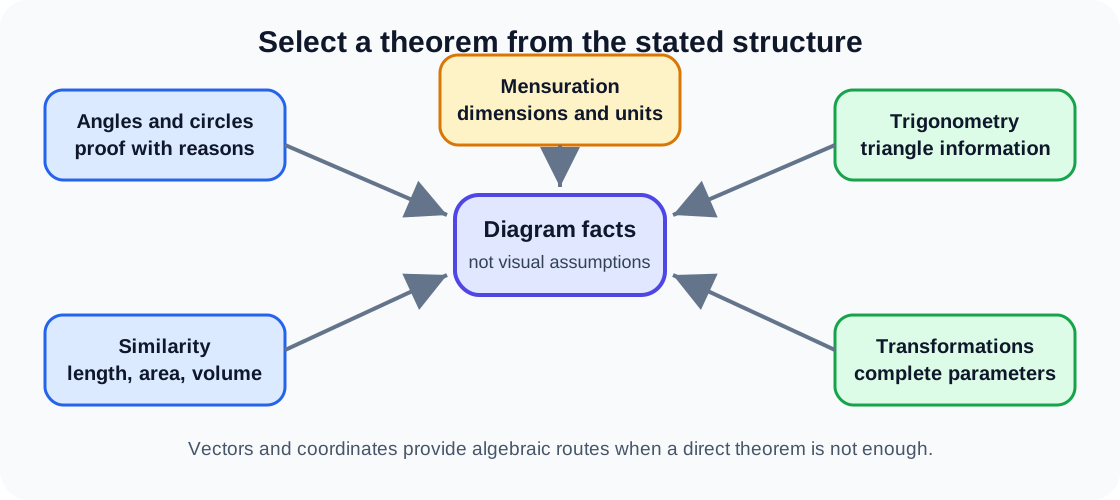
Pearson 4MA1 Geometry rewards a chain from stated fact to conclusion. A diagram organises information but is not evidence that lines are parallel, lengths are equal or an angle is a right angle. Units and dimensional scale factors must remain consistent throughout.
Main ideas
- Apply angle facts, polygon properties, congruence, similarity and circle theorems.
- Calculate lengths, areas, surface areas and volumes with consistent units.
- Use Pythagoras, right-triangle trigonometry, sine rule, cosine rule and triangle area formula.
- Describe reflections, rotations, translations and enlargements precisely.
- Use bearings, scale drawings, loci, constructions and coordinate geometry.
- Represent translations and geometric relationships with vectors.
Angles, polygons and proof
Use angle facts with reasons: angles on a straight line sum to 180 degrees, around a point sum to 360 degrees, vertically opposite angles are equal, and corresponding or alternate angles are equal for parallel lines. Co-interior angles on parallel lines sum to 180 degrees.
The interior-angle sum of an n-sided polygon is 180 times n - 2 degrees. For a regular polygon, divide by n. Exterior angles sum to 360 degrees. A proof should identify each relationship rather than present an unexplained string of numbers.
Congruence establishes identical size and shape through sufficient side and angle conditions. Similarity establishes equal corresponding angles and proportional corresponding lengths. Angle-angle is enough for triangle similarity, but not triangle congruence.
Circle geometry
A radius is perpendicular to a tangent at the contact point. The angle at the centre is twice the angle at the circumference subtended by the same arc. Angles in the same segment are equal, the angle in a semicircle is 90 degrees, and opposite angles in a cyclic quadrilateral sum to 180 degrees.
The alternate-segment theorem links an angle between tangent and chord to the angle in the opposite segment. Name the shared chord or arc so the theorem is applied to the correct angle. A theorem diagram should not be stretched to unrelated points merely because it looks similar.
Perimeter, area, surface area and volume
Perimeter is one-dimensional, area is two-dimensional and volume is three-dimensional. Convert units before calculating or convert using squared and cubed factors. One metre equals 100 centimetres, but one square metre equals 10,000 square centimetres.
Check this topic from memory
Attempt the matching topic bank before reopening the notes. Use each missed idea to decide what to review next.
Start the topic quiz