

Pearson International GCSE Physics 1: Forces and Motion
Pearson International GCSE Physics notes on motion graphs, forces, momentum, moments and deformation.
Mechanics links motion measurements to resultant forces, momentum, turning effects and deformation.
This topic is a connected model rather than a formula list. Motion graphs describe what an object does, resultant force explains how its velocity changes, momentum links force to collision time, and moments or deformation describe other effects of forces. The official 4PH1 specification distinguishes common content from additional Paper 2 statements; always use the issue applying to your examination series.
Main ideas
- Calculate speed, velocity and acceleration and interpret motion graphs.
- Apply Newton's laws and distinguish mass from weight.
- Use momentum conservation and impulse in collisions and safety contexts.
- Calculate moments using perpendicular distance and apply equilibrium conditions.
- Relate force and extension, recognise the limit of proportionality and calculate work done.
Describing motion and reading graphs
Speed is distance travelled per unit time. Velocity includes direction, so a change in direction is a change in velocity even if speed stays constant. Acceleration is change in velocity per unit time. Choose signs consistently when motion has an identified positive direction.
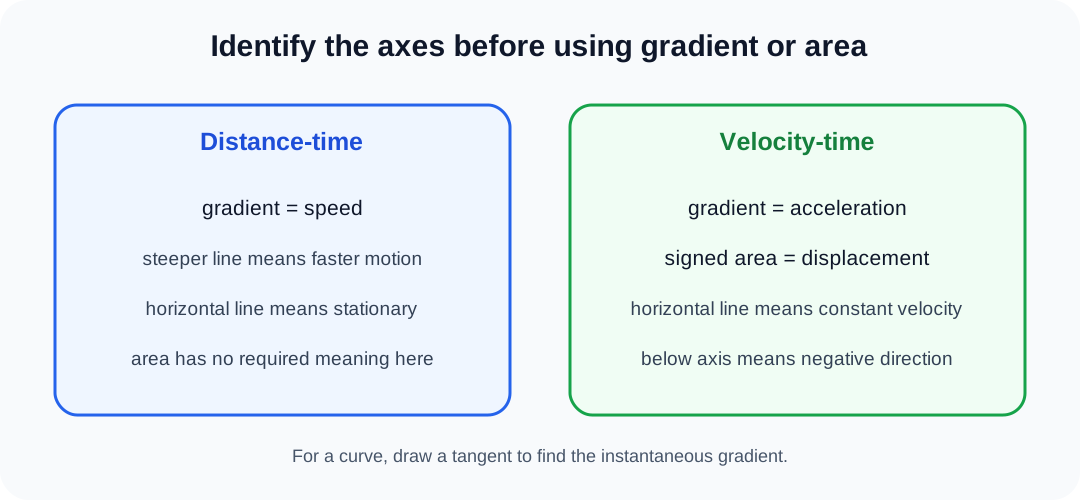
On a distance-time graph, gradient gives speed. A horizontal line means the distance from the reference point is unchanged. Distance cannot decrease, but displacement can, so check the axis label before interpreting a downward slope. On a velocity-time graph, gradient gives acceleration and signed area gives displacement. Area below the time axis represents displacement in the negative direction, not negative distance travelled.
For a curved graph, instantaneous speed or acceleration is found from a tangent gradient at the required point. Average values use total change over the stated interval. A steeper graph does not always mean the same thing: it means greater speed on a distance-time graph but greater acceleration on a velocity-time graph only when comparing gradients.
Resultant force and Newton's laws
Draw or identify all forces acting on the chosen object, then combine them with direction. Balanced forces mean zero resultant force, so velocity remains constant; the object may be stationary or moving steadily. An unbalanced resultant force causes acceleration in its direction.
Newton's second law links resultant force, mass and acceleration. Use the resultant force after resolving opposing forces, not one force in isolation. For the same resultant force, a larger mass produces a smaller acceleration. Newton's third-law pairs are equal and opposite forces of the same interaction acting on different objects, so they do not cancel on one object's force diagram.
Check this topic from memory
Attempt the matching topic bank before reopening the notes. Use each missed idea to decide what to review next.
Start the topic quiz