

Pearson International GCSE Physics 2: Electricity
Pearson International GCSE Physics notes on charge, current, voltage, resistance, circuits and electrical energy.
Circuit behaviour follows conservation of charge and energy together with component current-voltage characteristics.
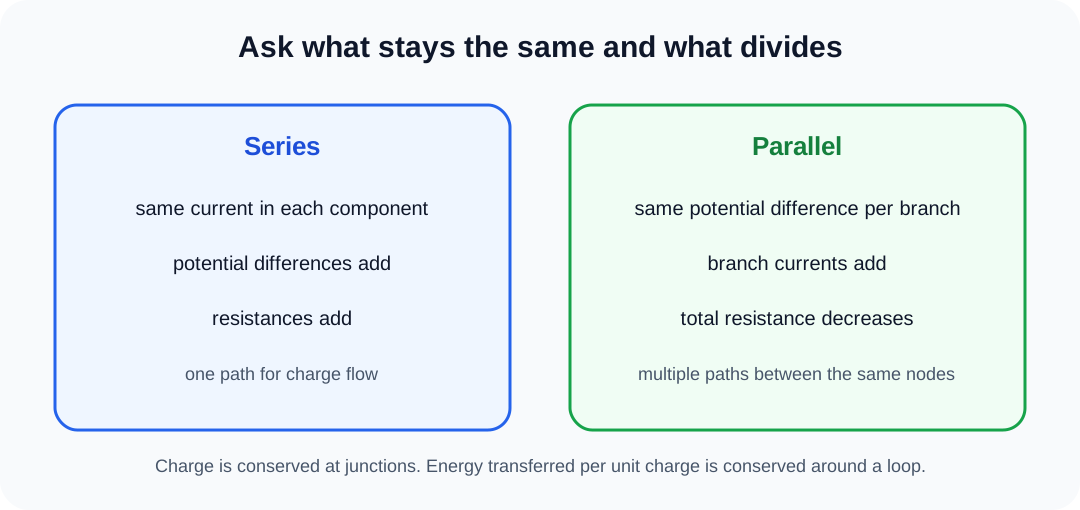
The useful questions are always: what is conserved, what divides, and what property of the component changes? Charge is conserved at junctions, energy transferred per unit charge is shared around a loop, and resistance links potential difference to current under the component's operating conditions.
Main ideas
- Relate current to charge flow and potential difference to energy per unit charge.
- Apply resistance, power and electrical-energy relationships.
- Use series and parallel circuit rules and calculate equivalent resistance.
- Interpret current-voltage graphs for resistors, lamps and diodes.
- Explain static charging, electric fields and hazards.
- Apply household safety ideas including fuses, earthing and insulation.
Charge, current and potential difference
Current is the rate of flow of charge. Conventional current is defined in the direction positive charge would move, which is opposite to electron drift in a metal. Current is not consumed by a component; charge enters and leaves while energy is transferred.
Potential difference is energy transferred per unit charge between two points. A cell transfers chemical energy to electrical energy, while a resistor or lamp transfers electrical energy to thermal or light energy. Distinguish the energy carried through the circuit model from the charge carriers that continue to move.
At a junction, total current entering equals total current leaving because charge is conserved. Over time, a branch carrying a larger current transfers more charge. Use current multiplied by time when a question asks for charge flow.
Resistance and current-voltage characteristics
Resistance is potential difference divided by current for the stated operating point. An ohmic conductor at constant temperature has current proportional to potential difference, giving a straight current-voltage graph through the origin. This proportionality can fail when temperature changes.
For a filament lamp, increasing current raises filament temperature. Greater lattice vibration makes electron motion more strongly opposed, so resistance rises and the graph curves. A diode conducts much more readily in one direction after the relevant threshold behavior and has very high resistance in the reverse direction under normal conditions.
Read graph axes before calculating resistance. If potential difference is on the vertical axis and current on the horizontal axis, gradient represents resistance only for that arrangement and interpretation. For a nonlinear graph, use the ratio at the specified point rather than assuming one constant gradient.
Check this topic from memory
Attempt the matching topic bank before reopening the notes. Use each missed idea to decide what to review next.
Start the topic quiz