

Pearson International GCSE Physics 3: Waves
Pearson International GCSE Physics notes on wave properties, light, sound and the electromagnetic spectrum.
Waves transfer energy and information through reflection, refraction, diffraction and superposition.
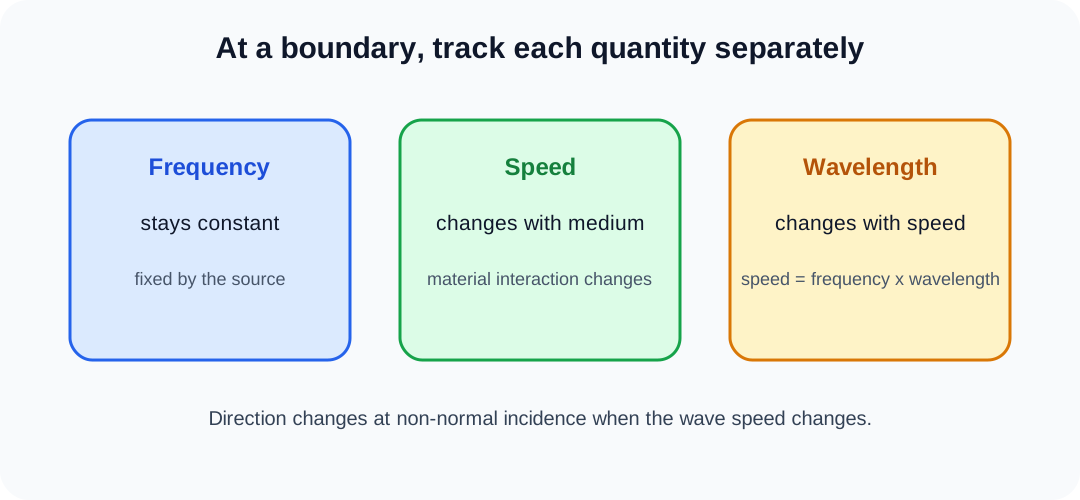
The same wave model applies across water waves, sound and electromagnetic radiation, but the oscillating quantity and need for a medium differ. Track speed, frequency, wavelength, direction and amplitude separately so that a change in one is not automatically assigned to all the others.
Main ideas
- Distinguish transverse and longitudinal waves and relate speed, frequency and wavelength.
- Interpret wave diagrams and oscilloscope traces.
- Apply reflection and refraction rules, refractive index and total internal reflection.
- Construct ray diagrams for mirrors and lenses.
- Order electromagnetic waves and explain uses and hazards.
- Relate sound pitch to frequency and loudness to amplitude.
Wave quantities and representations
Amplitude is maximum displacement from equilibrium and relates to the energy carried by the wave. Wavelength is the shortest distance between points in the same phase, such as crest to next crest. Frequency is the number of complete oscillations passing a point each second, while period is time for one oscillation.
Wave speed equals frequency multiplied by wavelength. Use consistent units: frequency in hertz, wavelength in metres and speed in metres per second. The relationship describes the propagation of the pattern, not the speed of individual particles in the medium.
A displacement-distance graph is a snapshot along the wave and can show wavelength. A displacement-time or oscilloscope trace is recorded at one position and can show period. The horizontal spacing of peaks therefore represents different quantities depending on the axis.
Transverse and longitudinal waves
In a transverse wave, oscillations are perpendicular to energy transfer. Electromagnetic waves are transverse. In a longitudinal wave, oscillations are parallel to energy transfer, forming compressions and rarefactions; sound in air is longitudinal.
Particles in a mechanical wave oscillate around equilibrium rather than travelling with the wave over long distances. Energy and information propagate through interactions between neighboring particles. Electromagnetic waves can travel through vacuum and do not require particles as a medium.
Reflection, refraction and diffraction
For reflection, angle of incidence equals angle of reflection. Both angles are measured from the normal, not from the surface. Incident ray, reflected ray and normal lie in the same plane under the model used.
Check this topic from memory
Attempt the matching topic bank before reopening the notes. Use each missed idea to decide what to review next.
Start the topic quiz