

Pearson International GCSE Physics 4: Energy Resources and Transfers
Pearson International GCSE Physics notes on energy stores, work, power, efficiency and electricity generation.
Energy accounting tracks transfers between stores and evaluates how quickly and efficiently useful outcomes occur.
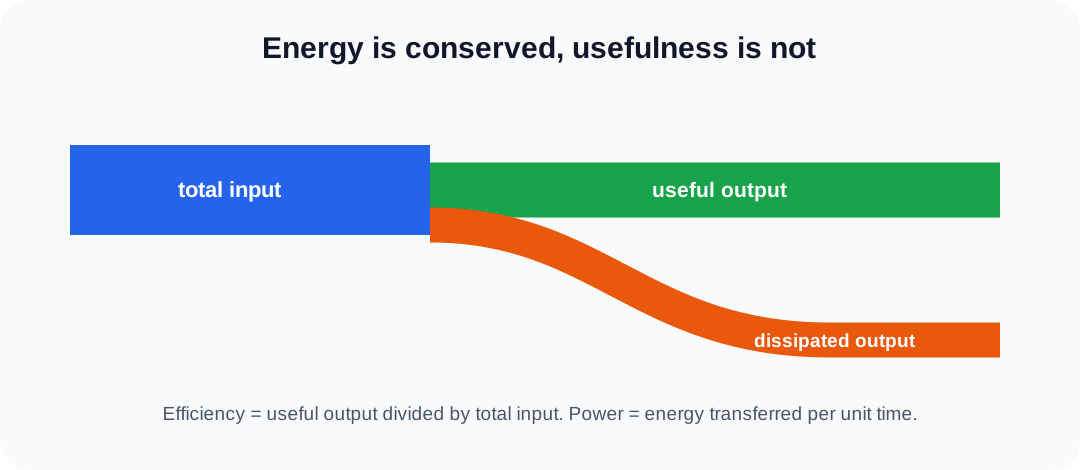
Energy is conserved, but it can spread into less useful stores and become harder to recover. Power describes the rate of transfer, while efficiency compares the useful transfer with the total input. Keeping those three ideas separate prevents most errors in this topic.
Main ideas
- Apply conservation of energy to mechanical, thermal and electrical systems.
- Calculate kinetic energy, gravitational potential energy, work and power.
- Calculate efficiency and identify dissipated energy.
- Compare renewable and non-renewable energy resources using reliability, cost and environmental impact.
- Trace energy transfers in electricity generation.
Energy stores and transfer pathways
Describe a process by identifying the initial and final energy stores and the pathway between them. Relevant stores include kinetic, gravitational potential, elastic, thermal, chemical, magnetic, electrostatic and nuclear. Transfer pathways include mechanically doing work, electrical transfer, heating and radiation.
Energy is not a substance that disappears. When friction slows a moving object, its kinetic store decreases while thermal stores of the object and surroundings increase. The energy remains conserved even though the thermal energy is less useful for producing the original motion.
A complete account chooses a system boundary. Energy entering or leaving the chosen system must be included. If only the falling object is the system, gravity transfers energy into its kinetic store; if the object-Earth system is chosen, gravitational potential energy decreases internally while kinetic energy increases.
Work, mechanical energy and power
Work done is energy transferred by a force acting through a distance in the force direction. If force and displacement are not parallel, only the component along the displacement contributes under the relevant model. No mechanical work is done by a force when the point of application has no displacement in its direction.
Kinetic energy depends on mass and the square of speed. Doubling speed multiplies kinetic energy by four, so braking-energy demands rise rapidly with speed. Gravitational potential energy change near Earth's surface depends on mass, gravitational field strength and vertical height change, not the path length up a slope.
Power is energy transferred or work done per unit time. Two machines can transfer the same total energy but have different power if one completes the task faster. Use seconds for watts when energy is in joules, and distinguish a high-power device from one that necessarily uses more total energy: operating time also matters.
Check this topic from memory
Attempt the matching topic bank before reopening the notes. Use each missed idea to decide what to review next.
Start the topic quiz