

Pearson International GCSE Physics 5: Solids, Liquids and Gases
Pearson International GCSE Physics notes on density, pressure, particle motion and thermal physics.
Particle behaviour explains density, pressure, expansion, internal energy and changes of state.
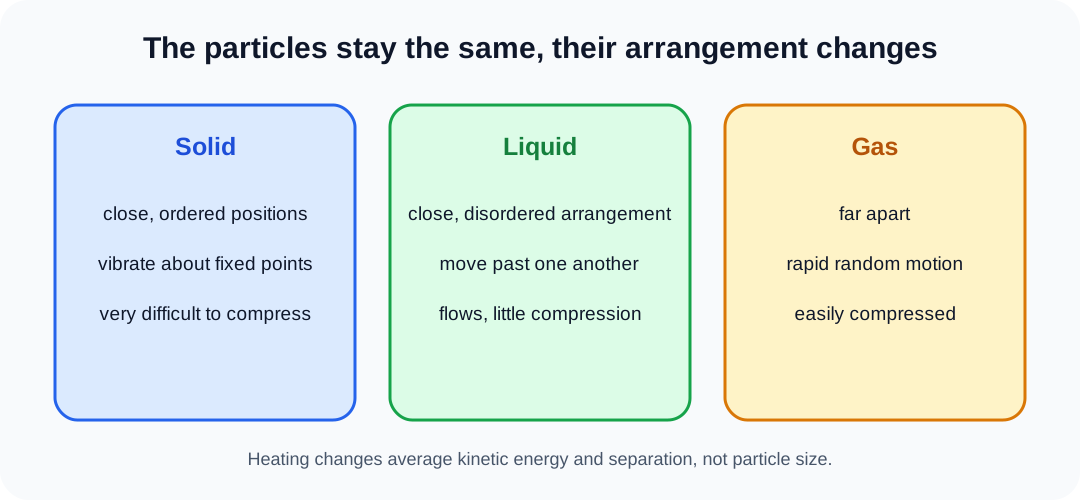
Macroscopic quantities such as pressure and temperature emerge from particle motion and interaction. Use the particle model to explain trends, but do not claim particles themselves expand, melt or contain heat. Energy is stored and transferred by the system.
Main ideas
- Calculate density and determine volume for regular and irregular objects.
- Apply pressure relationships in solids, liquids and gases.
- Explain temperature and internal energy using particle motion and separation.
- Use specific heat capacity and latent heat relationships.
- Describe conduction, convection and radiation and methods of reducing thermal transfer.
Density and floating
Density is mass per unit volume. Use kilograms per cubic metre or grams per cubic centimetre consistently and convert all quantities before substitution. A small dense object can have less mass than a large low-density object, so density and mass are not interchangeable.
For a composite or hollow object, average density uses total mass divided by external volume under the question's definition. An object tends to float when its average density is lower than the fluid density because it can displace enough fluid for upthrust to balance weight before becoming fully submerged.
Upthrust results from pressure increasing with depth, so the lower surface experiences a larger upward force than the downward force on the upper surface. Floating equilibrium requires upthrust equal to weight; it does not mean the object's density must equal the fluid's material density.
Pressure in solids and fluids
Pressure is normal force divided by the area over which it acts. For the same force, reducing contact area increases pressure. Use the area perpendicular to the force, not every exposed surface of the object.
Liquid pressure increases with depth, liquid density and gravitational field strength. At the same depth in the same connected liquid, pressure is the same regardless of container shape. Pressure acts in all directions, not only downward.
The pressure difference between two depths depends on vertical separation. When atmospheric pressure acts on both exposed sides, it may cancel in a difference calculation, but include it when absolute pressure is requested.
Gas pressure arises from particle collisions with container walls. More frequent collisions or greater momentum change per collision increases pressure. Compressing a fixed gas at constant temperature reduces volume, so particles strike walls more frequently and pressure rises.
Check this topic from memory
Attempt the matching topic bank before reopening the notes. Use each missed idea to decide what to review next.
Start the topic quiz