

Pearson International GCSE Physics 6: Magnetism and Electromagnetism
Pearson International GCSE Physics notes on fields, motors, induction, generators and transformers.
Magnetic fields link currents to forces and changing magnetic flux to induced voltages.
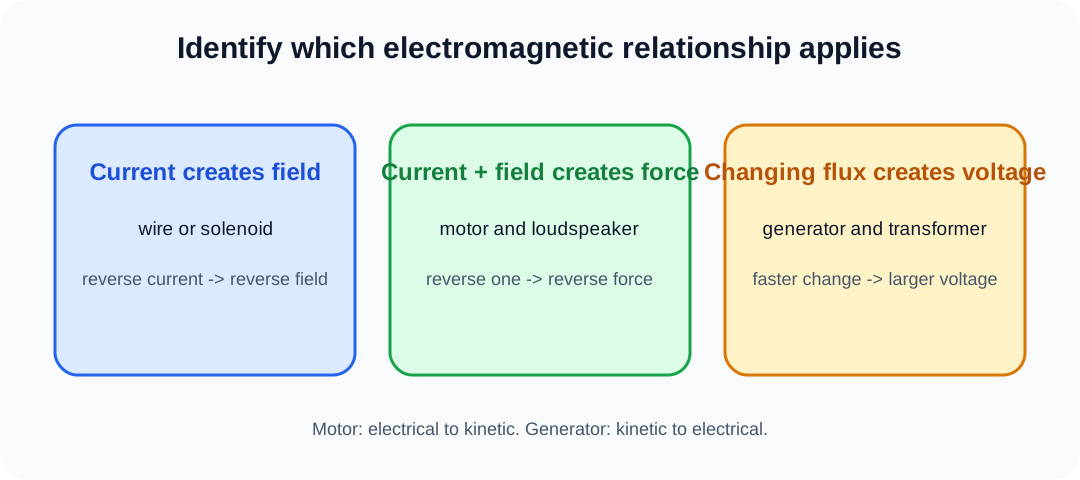
Three relationships organize the topic: currents create magnetic fields, a current in an external magnetic field can experience force, and a changing magnetic environment can induce a potential difference. Identify which relationship applies before choosing a direction rule or equation.
Main ideas
- Describe fields around magnets, wires and solenoids with direction.
- Distinguish permanent and induced magnetism.
- Explain the motor effect and determine force direction.
- Explain electromagnetic induction and factors affecting induced voltage.
- Compare motors, generators and loudspeakers by their energy transfers.
- Apply transformer ratios and explain efficient high-voltage transmission.
Magnetic fields and materials
A magnetic field is a region where a magnetic material, magnet or moving charge can experience force. Field direction is defined by the direction a north-seeking pole would move. Outside a bar magnet, field lines run from north to south, form continuous loops and never cross because a field cannot have two directions at one point.
Closer field-line spacing represents a stronger field. The pattern between unlike poles can be nearly uniform when lines are parallel and evenly spaced. Like poles produce a region where fields oppose and curve apart.
Permanent magnetic materials retain magnetisation. Soft magnetic materials magnetise and demagnetise readily, which suits electromagnets and transformer cores. Induced magnetism can make an unmagnetised magnetic material attract either pole because the nearer end becomes the opposite induced pole.
Fields from currents
A current in a straight wire produces concentric circular field lines. Field direction reverses when current reverses and strength increases with current while decreasing with distance from the wire.
A solenoid's field resembles that of a bar magnet, with a strong nearly uniform field inside. Increasing current or turns per unit length strengthens it, and a suitable iron core greatly increases field strength. Reversing current reverses the solenoid poles.
Electromagnets are useful because they can be switched and varied. Applications include relays, lifting magnets and devices where current controls force. Explain the complete causal chain: current produces a field, the core becomes magnetised and the resulting magnetic interaction creates force.
The motor effect
A current-carrying conductor in an external magnetic field experiences force when the current has a component perpendicular to the field. Force direction is perpendicular to both conventional current and field direction. Reversing either current or field reverses force; reversing both leaves force direction unchanged.
Check this topic from memory
Attempt the matching topic bank before reopening the notes. Use each missed idea to decide what to review next.
Start the topic quiz