

Pearson International GCSE Physics 7: Radioactivity and Particles
Pearson International GCSE Physics notes on atomic nuclei, radiation, half-life, fission and fusion.
Nuclear physics describes unstable nuclei, ionising emissions and energy released by changes in nuclei.
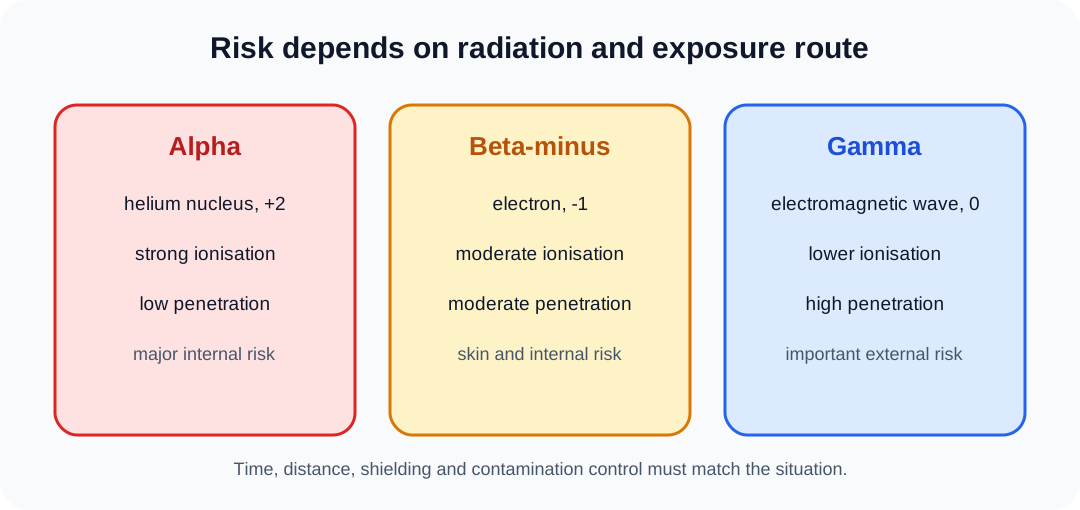
Radioactive decay is random for an individual nucleus but predictable statistically for a large sample. Radiation risk depends on ionisation, penetration, activity, exposure route and time, so most penetrating and most dangerous are not interchangeable claims.
Main ideas
- Compare alpha, beta and gamma radiation by nature, charge, ionisation and penetration.
- Balance nuclear equations and interpret isotope notation.
- Explain random decay, activity and half-life using graphs and repeated halving.
- Distinguish irradiation from contamination and apply safe-handling principles.
- Explain fission chain reactions and fusion of light nuclei.
- Evaluate medical and industrial uses against radiation risk.
Atomic nuclei and isotope notation
An atom contains a small positively charged nucleus surrounded by electrons. The nucleus contains protons and neutrons. Proton number identifies the element; nucleon number is total protons plus neutrons. Isotopes are nuclei of the same element with the same proton number but different neutron numbers.
Nuclear notation records nucleon number and proton number. In a nuclear equation, total nucleon number and total charge or proton number must balance. This bookkeeping identifies the daughter nucleus after an emission without implying that ordinary chemical reactions change nuclei.
Ionisation removes or adds electrons. A neutral atom has equal proton and electron numbers, while an ion differs in electron number. Radioactive decay changes the nucleus and may change the element; ordinary ion formation does not.
Alpha, beta and gamma radiation
Alpha radiation consists of helium nuclei containing two protons and two neutrons. It has charge plus two, is strongly ionising and has short range in air, and is stopped by paper or the outer dead layer of skin under typical contexts.
Beta-minus radiation consists of high-speed electrons emitted when a neutron changes into a proton with associated particle processes beyond the simple model. It has charge minus one, moderate ionising ability and moderate penetration, and can be reduced by thin metal or suitable shielding.
Gamma radiation is high-frequency electromagnetic radiation emitted from a nucleus. It has no charge or rest mass, is less ionising per interaction and is highly penetrating, requiring thick dense shielding to reduce intensity.
Electric and magnetic fields deflect charged alpha and beta emissions in opposite directions, with beta generally deflected more because of its much smaller mass. Gamma is not deflected because it is uncharged.
Check this topic from memory
Attempt the matching topic bank before reopening the notes. Use each missed idea to decide what to review next.
Start the topic quiz