

Pearson International GCSE Physics 8: Astrophysics
Pearson International GCSE Physics notes on gravity, orbits, stellar evolution, redshift and cosmology.
Astrophysics applies gravity, radiation and nuclear processes across planets, stars, galaxies and the Universe.
Astronomical explanations combine models with evidence carried by light. Gravity explains motion and structure, spectra reveal composition and relative motion, and stellar evolution follows how mass controls pressure, temperature and nuclear reactions. Keep direct observations separate from the inferences drawn from them.
Main ideas
- Describe Solar System structure and orbital motion under gravity.
- Use astronomical distances and understand that distant observations show the past.
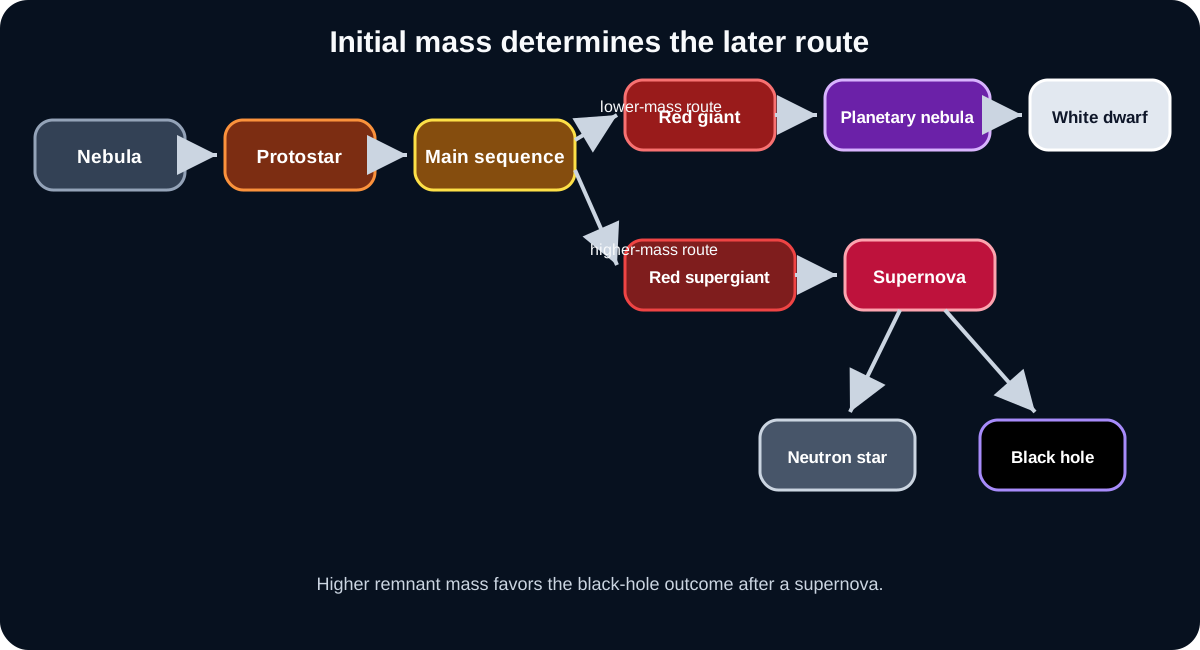
- Explain star formation, main-sequence stability and mass-dependent stellar evolution.
- Interpret luminosity, temperature and stellar spectra.
- Use redshift as evidence of galactic recession and universal expansion.
- Relate cosmic observations to Big Bang models while separating evidence from inference.
Solar System structure and scale
The Solar System contains the Sun, planets and their moons, dwarf planets, asteroids, comets and smaller bodies. A planet orbits a star and is sufficiently dominant in its orbital region under the definition used; a moon is a natural satellite orbiting another body.
Gravity provides the centripetal force for orbital motion. An orbiting body is continuously accelerating because its velocity direction changes, even when speed is approximately constant. It is not force-free or beyond gravity. Without the inward gravitational force, it would move tangentially rather than continue curving.
For a given central mass, closer circular orbits generally require greater speed and have shorter periods. The exact relationship depends on gravitational field and orbital radius. Elliptical orbits involve changing distance and speed, with energy exchanged between kinetic and gravitational potential stores.
Astronomical distances and look-back time
An astronomical unit is based on the mean Earth-Sun distance. A light-year is the distance light travels in one year, not a time. Parsecs may be used in astronomical contexts according to the specification and supplied data.
Because light speed is finite, observing a distant object shows it as it was when its light began the journey. Looking farther away means looking farther into the past. This does not mean the telescope causes time travel; it receives delayed information.
Use scientific notation and unit conversion carefully. If distance is given in light-years, the numerical value also states light travel time in years under that definition. For other units, divide distance by light speed after converting to compatible units.
Check this topic from memory
Attempt the matching topic bank before reopening the notes. Use each missed idea to decide what to review next.
Start the topic quiz