

Pearson IGCSE Physics Practical 5: Motion, Forces and Springs
Pearson International GCSE Physics practical notes on motion measurements and force-extension investigations.
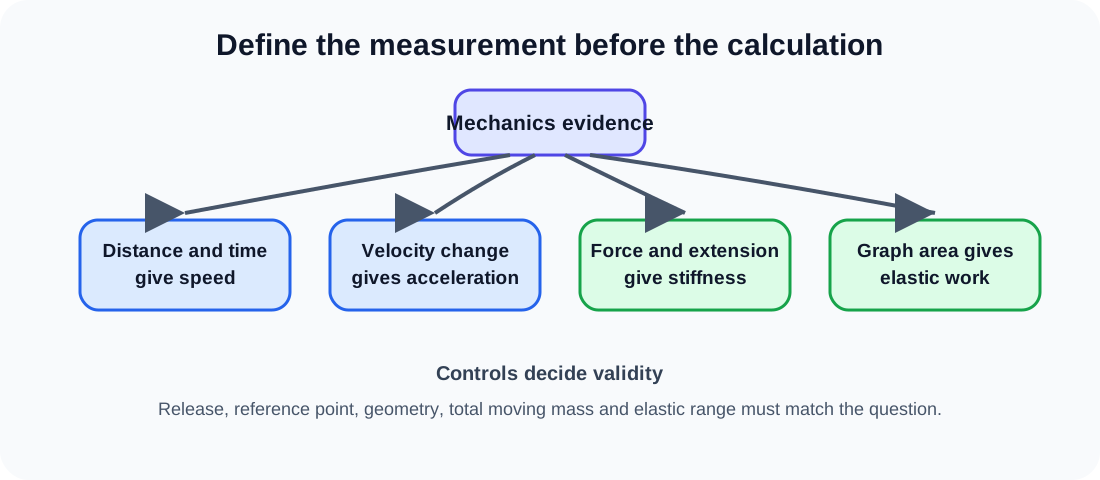
Mechanics investigations turn changes of position or extension into speed, acceleration and stiffness evidence.
Pearson 4PH1 may present familiar apparatus or an unfamiliar variation in a written question. The transferable skill is to define where and when each measurement is made, control the release and geometry, and connect the resulting graph or calculation to the mechanical model.
Core contexts
- Measure motion with known distances and times, light gates or frame-by-frame video.
- Define the reference point on the moving object consistently.
- Investigate spring extension from the unloaded length as force is increased.
- Add masses gently, wait for oscillations to settle and avoid exceeding the elastic limit.
- Plot force against extension and interpret gradient according to chosen axes.
Measuring average and instantaneous speed
Average speed requires a measured distance and the time for the same journey. Mark the start and finish positions, measure between those reference lines and decide which point on the moving object triggers each event. Release a trolley without an added push, for example with a card or gate, so repeated runs have comparable starting conditions. A longer safe distance reduces the percentage effect of reaction time, but friction and changes in speed may mean the result is only an average over that interval.
A light gate measures time electronically. With one gate, a card of known length interrupts the beam; card length divided by interruption time estimates speed at the gate. With two gates, the distance between defined beam positions divided by travel time gives an average between them. Keep the card rigid and aligned, and ensure the timer is in the intended mode. Video analysis can give position at equal frame intervals if the camera is fixed perpendicular to the track and a calibration scale lies in the plane of motion.
Investigating acceleration
To test how ramp angle affects acceleration, use the same trolley, track surface, starting position and release mechanism. Measure angle directly or define ramp height while keeping track length fixed. Use at least five values across a safe range. Two light gates can provide speeds at known positions, but acceleration requires a justified time interval or kinematic relationship. A ticker timer or video produces a sequence of positions at equal time intervals, allowing velocity changes to be estimated.
Do not infer constant acceleration merely because the trolley speeds up. Plot velocity against time where possible: a straight-line gradient supports approximately constant acceleration. Repeat each condition, reset the trolley and inspect scatter. Friction, a flexing track or inconsistent release can change the result systematically.
Check this topic from memory
Attempt the matching topic bank before reopening the notes. Use each missed idea to decide what to review next.
Start the topic quiz