

Pearson IGCSE Physics Practical 7: Waves, Refraction and Sound
Pearson International GCSE Physics practical notes on refraction, refractive index, sound speed and frequency.
Wave investigations depend on careful geometry, repeated distances or periods, and a clearly defined trace.
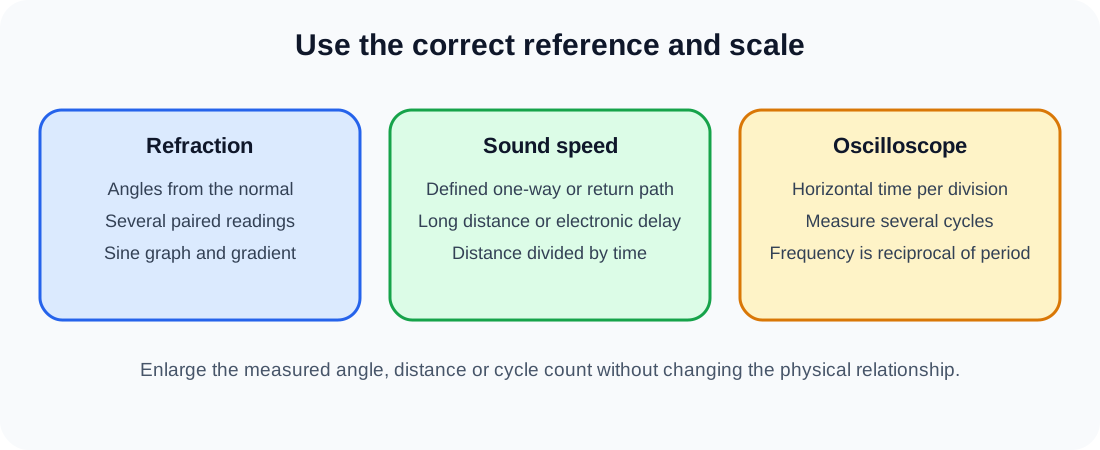
Pearson 4PH1 written practical questions move between spatial measurements, timing and electronic traces. The common principle is to enlarge the measured interval, define the reference precisely and use the scale belonging to that representation.
Core contexts
- Trace incident and refracted rays through a transparent block using narrow rays and well-spaced points.
- Draw the normal accurately and measure angles from it.
- Calculate refractive index from paired angle measurements or real and apparent depth where specified.
- Estimate sound speed using a measured path and time delay, with a long distance or electronic timing.
- Determine frequency from oscilloscope period and calibrated time-base settings.
Ray tracing through a transparent block
Place the block on plain paper and trace its outline before moving it. Use a narrow ray box beam, or align two well-spaced pins along the incident ray. Mark two points on each visible ray section so a ruler can reconstruct the path accurately. Replace the block in exactly the traced outline for every angle.
Draw a normal at the entry point with a set square. Measure incidence and refraction angles from the normal, never from the surface. Thin lines, widely separated marks and a large protractor radius reduce angular uncertainty. Repeat for at least five incidence angles while keeping the same material, face and wavelength of light.
For a rectangular block, the emergent ray is parallel to the incident ray but laterally displaced. Do not treat that parallel emergence as absence of refraction. At the second boundary the ray changes direction again because it passes from the block into air.
Refractive index from angles
Calculate the sine of each measured angle only after recording the raw angle table. Plot sine of incidence angle against sine of refraction angle using the specified axis order. If light travels from air into the block, the appropriate gradient can give refractive index when sine of incidence is vertical. A single angle pair is weaker because protractor and line-width errors strongly affect the ratio.
Use a best-fit gradient over a broad safe angle range. Very small angles produce small sine differences, while extreme angles may make the refracted ray difficult to mark. A non-zero intercept can indicate alignment or normal-construction error, but scatter must be considered before assigning a cause.
Real and apparent depth
View a marked object through a transparent block or water from close to the normal. Locate the apparent position by removing parallax against a movable marker, then measure real and apparent depth from consistent surfaces. Repeat the alignment and avoid oblique viewing. The ratio method depends on the stated geometry and small-angle approximation, so do not combine it casually with a different ray-angle definition.
Check this topic from memory
Attempt the matching topic bank before reopening the notes. Use each missed idea to decide what to review next.
Start the topic quiz