

Pearson IGCSE Physics Practical 8: Thermal Physics, Density and Radiation
Pearson International GCSE Physics practical notes on thermal transfer, density, cooling and radiation penetration.
Thermal, density and radiation experiments need controls for geometry, background effects and energy loss.
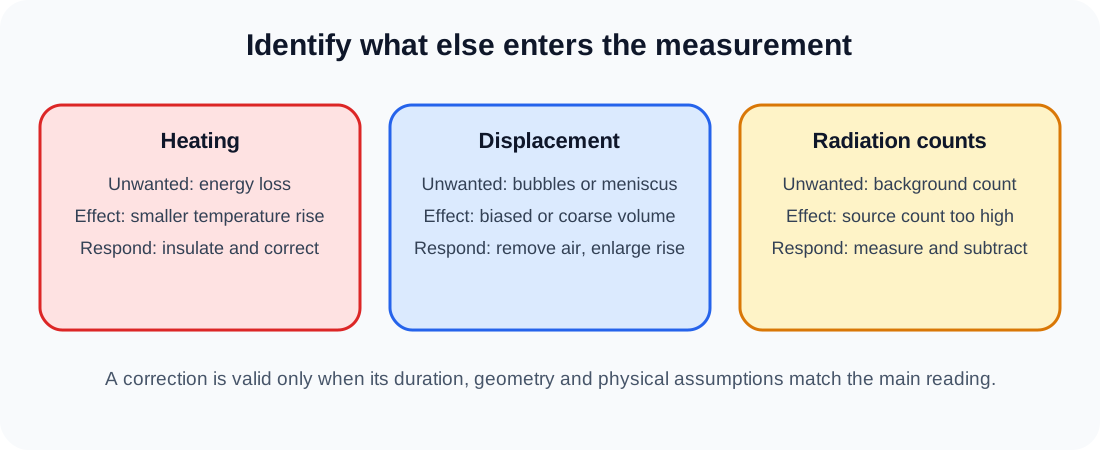
Pearson 4PH1 written practical contexts in this chapter share a correction problem: the measured change may include an unwanted contribution. Thermal energy escapes, displaced volume can include bubbles, and a detector records background radiation as well as the source. A valid method identifies and reduces or corrects that contribution.
Core contexts
- Compare conduction, convection or radiation while controlling dimensions and starting temperature.
- Measure density from mass and volume, using displacement for irregular solids.
- Record temperature against time through heating, cooling or a change of state.
- Estimate specific heat capacity from electrical energy supplied while reducing thermal losses.
- Measure radiation count rate for fixed intervals, subtract background and vary absorber or thickness safely.
Density of regular and irregular solids
Measure mass with a zeroed balance. For a regular block, measure each required dimension at several positions if the object may not be uniform, then calculate volume in consistent units. Avoid using a ruler for a very small diameter when callipers or a micrometer would materially reduce percentage uncertainty.
For an irregular solid, record initial water volume, submerge the object fully, remove trapped air and record final volume. The difference is the object's volume. Read the meniscus at eye level and use a cylinder narrow enough for a resolvable rise. For a small object, measure several identical items together and divide, provided their combined displacement stays within the cylinder range and the identical-object assumption is justified.
Density follows from mass divided by volume. Convert cubic centimetres and cubic metres consistently. Bubbles increase apparent volume and make calculated density too small. Water absorbed by a porous object or water left on it during weighing can invalidate the method.
Heating and specific heat capacity
Insert a heater and temperature sensor into close-fitting holes in a block, adding thermal paste where permitted to improve contact. Measure block mass, initial temperature, potential difference, current and heating time. Supply electrical energy is found from potential difference multiplied by current and time. Divide by mass and temperature rise to estimate specific heat capacity.
Insulate the block and use a lid or additional lagging around exposed surfaces. Start timing with switching and record current and voltage during heating rather than assuming they remain constant. Stir liquids gently or use consistent sensor placement so the measured temperature represents the material. Hot apparatus and exposed heaters require heat-resistant handling and switching off before adjustment.
Check this topic from memory
Attempt the matching topic bank before reopening the notes. Use each missed idea to decide what to review next.
Start the topic quiz