

Magnets, coils and galvanometers: function and handling
The magnet supplies a magnetic field. Some of that field passes through the coil; the amount passing through is called the magnetic flux. When the flux through the coil changes, a voltage called an electromotive force (emf) is induced in it. If the coil is part of a complete circuit, that emf drives a small current, and a galvanometer shows it. The galvanometer shows current, not voltage.
This guide covers a magnet-and-coil investigation with no battery or power supply. Your trainer chooses a coil, leads, meter and magnet that work together.
What the needle shows
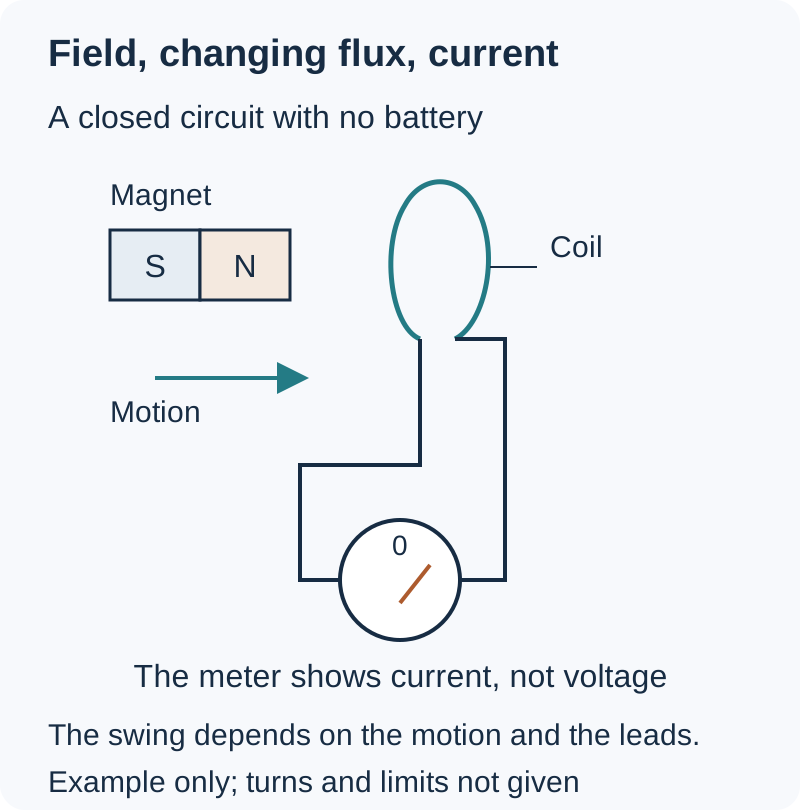
The drawing does not show how many turns the coil has or what the meter can take. The needle direction is only an example; the real direction depends on the connections and the motion.
With the same setup, compare three moments: pushing the magnet in, holding it still inside, and pulling it out. Emf is induced only while the flux is changing (OpenStax). While the magnet is held still, its field still passes through the coil but the flux is not changing, so the needle returns to where it started. That does not mean the magnet has lost its field. Pulling the magnet out changes the flux the opposite way, so the needle can swing the other way.
IOP's magnet-and-coil activity treats the emf made in the coil and the current seen on the galvanometer as two different things. How far the needle swings depends on the whole circuit and on the meter, not just on the emf.
Write down where the needle starts, how the leads are connected, and which pole goes into which end of the coil. Swapping the leads swaps the meaning of a left or right swing, so there is no single "correct" direction for a north pole going in.
A scale division on the galvanometer is not a voltage unit unless it has been properly calibrated. A faster push usually gives a bigger swing, because the flux changes in less time and the induced emf is larger, but this is only a rough comparison. It does not prove the emf doubled or tripled.
A needle at zero can mean different things. When the magnet is held still, the flux is not changing. But if a lead comes loose while the magnet is moving, an emf is still induced, yet no current can flow through the broken circuit, so the needle stays at zero. OpenStax's induction explanation separates the induced emf from whether there is a path for current.
The needle alone cannot tell you which of these happened. Note the motion and anything you saw happen to the leads, then ask your trainer to check the circuit. Do not disconnect a working circuit to test this.
Moving the magnet safely
A strong magnet held still next to a still coil induces nothing. Moving one relative to the other changes the flux, so the direction of motion and which pole leads both matter.
Keep the gap and support your trainer sets. Do not push the magnet into the coil, meter or fittings to get a bigger swing. The induction practical builds up the observations step by step.
Comparing two coils fairly
The number of turns is not the only difference between two coils. The wire's resistance, the coil's shape, the leads and the meter can all change the swing. IOP's comparison keeps the total wire length and resistance the same when it looks at the number of turns. Two coils that only differ in turns as far as you can see do not meet that condition automatically.
Record which coil and magnet you used, which way round they were, and the motion you compared. A bigger swing with a different coil tells you about the changed setup. It does not single out the number of turns or give an exact emf ratio.
Arizona State University's demonstration uses a magnet, coil and galvanometer to show induced current. It does not calibrate your meter or tell you how fast it is safe to move the magnet near your equipment.
When the needle barely moves
A small or missing swing does not on its own mean the coil is faulty. First describe the motion, where the needle started and whether the circuit stayed the same. Your trainer can then check the movement, the connections and the meter.
Do not hit the coil, swap in a stronger magnet or add a power supply to get the result you expected. Each brings new hazards and can damage the equipment.
Before you start, the trainer checks the parts, supports, clearance and what the needle should do. You record what you see and report anything unexpected; the trainer checks the meter's limits and replaces parts. Record a comparison that failed or was unclear; it does not show that induction did not happen. An emf may still have been induced even if no current could flow.
Why there is no battery in this circuit
A galvanometer is built to detect very small currents, and a large current can overload and damage it (Aakash: galvanometer). A battery would push far more current through it than induction does, and it would also make a different circuit from the one you are studying. So never add one to make a small swing bigger. Your trainer checks the prepared leads and the meter's range before use.
Use only the magnet you are given. A stronger one changes both the results and the hazards. Strong magnets can pinch fingers, and can chip, crack or shatter if they snap together (K&J Magnetics), so keep your fingers clear of points where they could be trapped. K&J recommends eye protection because shattered pieces can fly off fast; follow your trainer's instruction on it. Follow the cautions given for your magnet, including any about keeping it away from sensitive devices.
Stop if a magnet is chipped, a support is loose, a lead is damaged or the meter behaves oddly. Ask your trainer to check the setup, and do not change connections while you are moving the magnet.
Changing one thing at a time
Keep the setup the same and change only the one thing you are told to change. Record pushing in, holding still and pulling out separately. A coil that shifted or a lead that was swapped can change the pattern even if the thing you meant to test did not change.
Wait until everything is still before you disconnect or put anything away. Store the magnets and leads as you are told. See lab safety for preparation and supervision.
Sources
- https://spark.iop.org/magnet-and-coil
- https://openstax.org/books/college-physics-2e/pages/23-1-induced-emf-and-magnetic-flux
- https://openstax.org/books/college-physics-2e/pages/23-2-faradays-law-of-induction-lenzs-law
- https://www.aakash.ac.in/important-concepts/physics/galvanometer
- https://www.kjmagnetics.com/safety.asp