

Cambridge International AS and A Level Mathematics 4: Mechanics
Cambridge International AS and A Level Mathematics 9709 Paper 4 notes on forces, kinematics, momentum, Newton's laws, work, energy and power.
Mechanics is the content for Cambridge International AS and A Level Mathematics 9709 Paper 4. It is a numerical paper option built on Paper 1 algebra. The official boundary has five sections: forces and equilibrium, straight-line kinematics, momentum, Newton's laws, and energy, work and power.
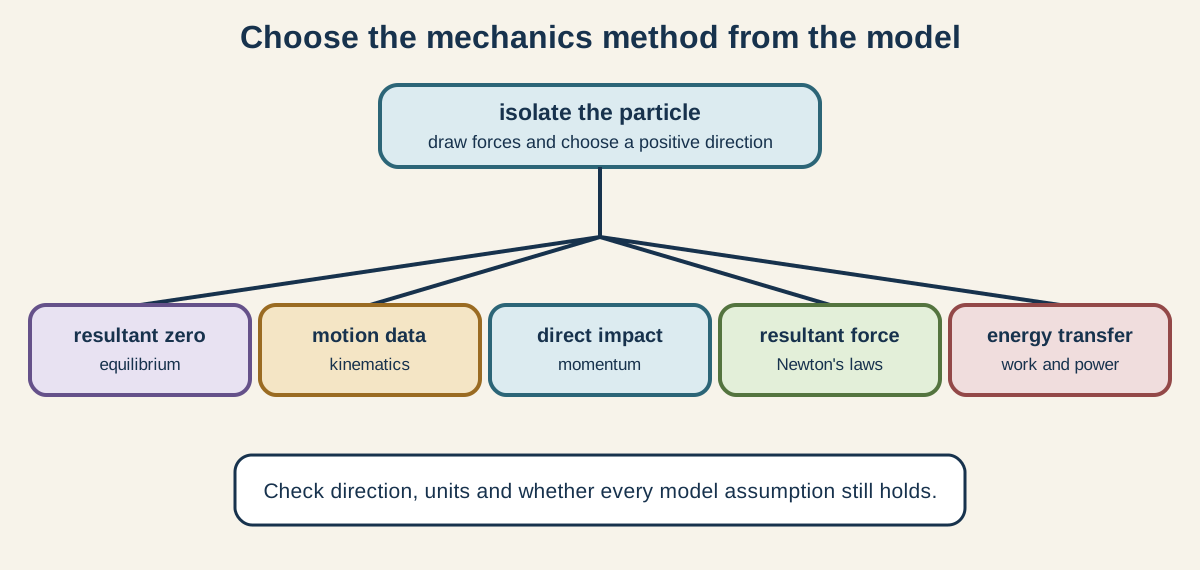
1. The particle model and force diagrams
A particle has mass but no relevant size or rotation. A realistic extended body may appear in a question, but every force is modelled as acting at one point. Vector notation is not used in Paper 4 questions, although force, displacement, velocity, acceleration and momentum still have direction.
Begin by isolating the particle and drawing every force acting on it. Common forces are weight mg vertically downward, normal contact perpendicular to a surface, friction along a contact surface, tension along a string, thrust along a rod, and any stated resistance. Use the approximate value g = 10 m s^-2 unless the question directs otherwise.
2. Forces and equilibrium
Resolve a force into perpendicular components. On a plane inclined at angle theta to the horizontal, weight has components mg sin theta down the plane and mg cos theta perpendicular to it. Calculations are required, not approximate scale drawings.
For equilibrium, the resultant force is zero. Resolve in two useful perpendicular directions and set each component sum to zero. A triangle of forces or Lami's theorem may also work, but neither is required knowledge.
A contact force can be separated into normal reaction R and friction F. A smooth contact has no friction. Its usefulness is mathematical simplicity, but it is an idealised model. Friction opposes actual or impending relative motion. At limiting equilibrium, F = mu R. Before the limiting state, F is no greater than mu R and should not automatically be set equal to it.
Newton's third law pairs forces of the same type acting on different bodies. The force of a particle on the ground and the force of the ground on the particle are equal in magnitude and opposite in direction. They do not cancel on one particle's force diagram.
3. Straight-line kinematics
Distance and speed are scalars. Displacement, velocity and acceleration carry a sign in one-dimensional motion. Choose a positive direction and keep it throughout.
On a displacement-time graph, gradient is velocity. On a velocity-time graph, gradient is acceleration and signed area is displacement. Total distance requires positive travel, so split at times when velocity changes sign.
With calculus, v = ds/dt and a = dv/dt. Paper 4 calculus is restricted to Paper 1 techniques. Integration introduces constants that must be found from initial conditions.
Check this topic from memory
Attempt the matching topic bank before reopening the notes. Use each missed idea to decide what to review next.
Start the topic quiz