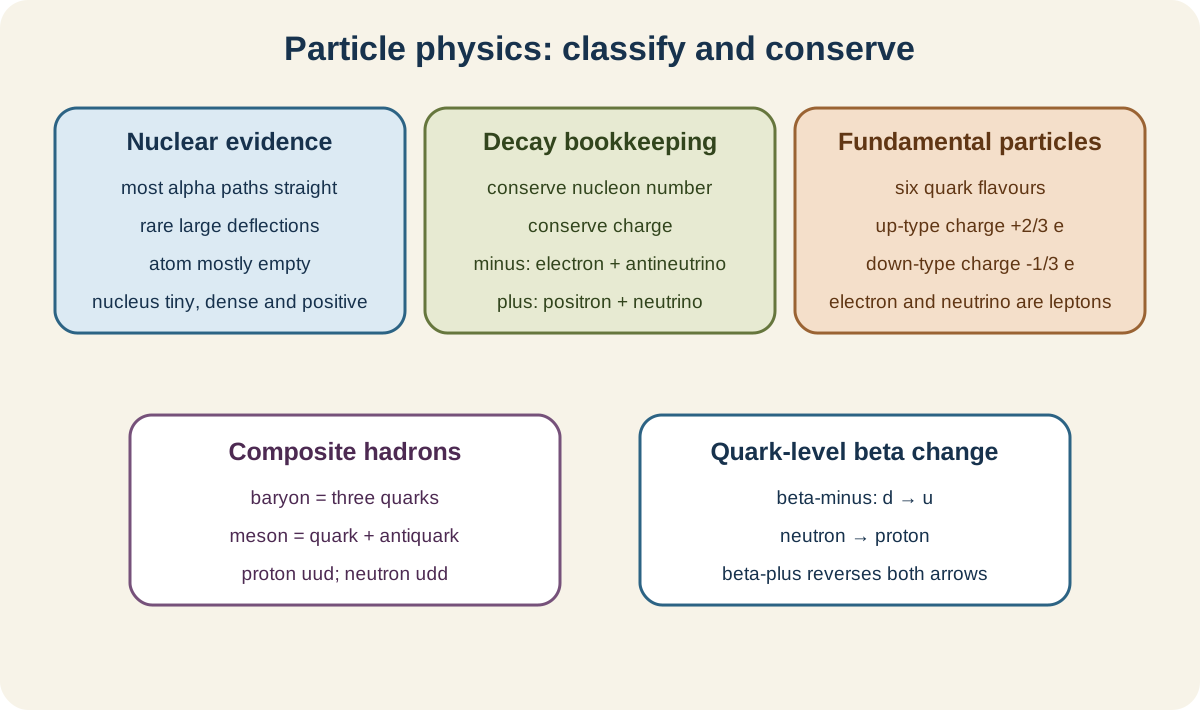
Particle physics is Topic 11 of the Cambridge International AS and A Level Physics 9702 AS Level syllabus. The official boundary covers nuclear evidence, nuclide notation and radiation in section 11.1, then quark, hadron and lepton classification in section 11.2. Conservation of charge and nucleon number links the two scales.
11.1 Atoms, nuclei and radiation
Alpha-particle scattering evidence
In the alpha-scattering experiment, a narrow beam of alpha particles was directed at thin metal foil and detected after passing through or scattering.
Most alpha particles passed through with little or no deflection. Therefore, most of an atom is empty space.
Some were deflected through small angles. Their positive charge experienced repulsion from a concentrated positive region.
A very small fraction were deflected through large angles or backscattered. Such a large momentum change requires a strong force produced when an alpha particle approaches a very small, dense, positively charged nucleus.
The rarity of large deflections implies that the nucleus occupies a tiny fraction of atomic volume. The experiment does not show electrons inside the nucleus.
Use each observation to support one inference rather than listing conclusions without evidence.
Simple nuclear atom
The nucleus contains protons and neutrons, collectively called nucleons. Orbital electrons occupy the surrounding atomic region.
A proton has charge +e, a neutron has zero charge and an electron has charge −e. Proton and neutron masses are each approximately 1u
Check this topic from memory
Attempt the matching topic bank before reopening the notes. Use each missed idea to decide what to review next.
Almost all atomic mass is concentrated in the nucleus. A neutral atom has equal numbers of protons and electrons.
Ion formation changes electron number, not proton number. Changing proton number changes the element.
This is a simple model. Detailed electron orbitals and nuclear structure beyond the stated particle content are not required here.
Proton number, nucleon number and isotopes
Proton number Z is the number of protons and identifies the element.
Nucleon number A is the total number of protons and neutrons:
A=Z+N,
where N is neutron number.
Isotopes are nuclei of the same element with the same proton number but different neutron numbers. They therefore have different nucleon numbers.
Neutral isotopes of one element have the same electron number and similar chemical behaviour but different nuclear masses.
Do not define isotopes by different numbers of protons; that would describe different elements.
Nuclide notation
A nuclide is written
ZAX,
where X is the element symbol, A is nucleon number at upper left and Z is proton number at lower left.
Neutron number is A−Z. Ion charge, if shown, appears separately at upper right and changes electron count.
Nuclear equations must conserve total nucleon number and total charge or proton-number equivalent on both sides.
These conservation checks identify missing particles or incorrect daughter nuclides.
Alpha radiation
An alpha particle is a helium nucleus:
24αor24He.
It contains two protons and two neutrons, has charge +2e and mass approximately 4u.
In alpha decay, parent nucleon number falls by four and proton number falls by two:
92238U→90234Th+24α.
Alpha particles from a specified transition have discrete energies because the nuclear initial and final states have defined energy differences, shared mainly between two products.
Beta-minus radiation
Beta-minus radiation consists of fast electrons:
−10eorβ−.
The electron has charge −e and mass approximately 0.00055u, negligible on the nucleon-number scale.
At nucleon level, a neutron changes into a proton:
n→p+e−+νˉe.
An electron antineutrino is emitted. Nucleon number stays constant and proton number of the daughter rises by one:
ZAX→Z+1AY+−10e+νˉe.
The emitted electron is created in the decay; it is not an orbital electron expelled from the atom.
Beta-plus radiation
Beta-plus radiation consists of positrons:
+10eorβ+.
A positron has the electron's mass and opposite charge +e. It is the electron's antiparticle.
At nucleon level, a proton changes into a neutron:
p→n+e++νe.
An electron neutrino is emitted. Nucleon number stays constant and daughter proton number falls by one:
ZAX→Z−1AY++10e+νe.
Gamma radiation and antiparticles
Gamma radiation consists of high-energy electromagnetic photons. A gamma photon has zero rest mass and zero charge.
Gamma emission changes nuclear energy state but not proton or nucleon number:
ZAX∗→ZAX+γ.
An antiparticle has the same mass as its corresponding particle and opposite charge. For neutral particles, opposite quantum properties distinguish particle and antiparticle even when charge alone does not.
The explicit required example is the positron as electron antiparticle.
Continuous beta energies
Beta particles from one decay have a continuous range of kinetic energies. Energy and momentum are shared variably among the daughter nucleus, beta particle and emitted neutrino or antineutrino.
The neutrino explains how conservation laws hold across the continuous beta spectrum.
Do not say alpha energy is continuous for the same reason. Alpha decay produces discrete alpha energies for specified transitions.
Unified atomic mass unit
The unified atomic mass unit is defined from carbon-12:
1u=121 of the mass of a carbon-12 atom≈1.66⋅10−27kg.
Use u for atomic and nuclear masses, converting to kilograms only when the equation requires SI mass.
Do not call u a unit of energy. Mass-energy may later be expressed using electronvolt-based units, but that is not the definition of u.
11.2 Fundamental particles
Six quark flavours and charges
Quarks are fundamental particles. The six flavours are up, down, strange, charm, top and bottom.
Up-type quarks have charge +32e:
up, u
charm, c
top, t
Down-type quarks have charge −31e:
down, d
strange, s
bottom, b
Each antiquark has the opposite charge. An anti-up has −32e; an anti-down has +31e.
No other quark properties are required by this syllabus outcome.
Protons and neutrons
Protons and neutrons are not fundamental. They are baryons made from three quarks.
A proton is
p=uud,
with total charge 32+32−31=+1.
A neutron is
n=udd,
with total charge 32−31−31=0.
Quark charges explain the nucleon charges. Do not assign three up quarks to a proton.
Hadrons, baryons and mesons
A hadron is a particle made from quarks and affected by the strong interaction.
A baryon consists of three quarks. An antibaryon consists of three antiquarks.
A meson consists of one quark and one antiquark.
Protons and neutrons are baryons and therefore hadrons. Electrons and neutrinos are not hadrons.
The syllabus requires the composition classification, not a catalogue of named mesons or baryon multiplets.
Quark changes in beta decay
In beta-minus decay, a down quark changes to an up quark:
Only one quark changes flavour in each nucleon conversion. Charge is conserved when the beta particle charge is included.
Leptons
Electrons and neutrinos are fundamental particles called leptons. They are not made from quarks.
The emitted electron or positron and neutrino or antineutrino in beta decay belong to the lepton family.
Do not classify leptons as hadrons or baryons. The categories distinguish fundamental leptons from composite quark-containing hadrons.
Worked application: checking nuclear and quark conservation
In beta-minus decay of 614C, nucleon number stays 14 and proton number rises to 7, so the daughter is 714N. The full products include −10e and νˉe. Charge check gives 6=7+(−1)+0. At quark level, one neutron udd changes to a proton uud because one d becomes u. The quark charge rises by +e, balanced by the electron's −e; the antineutrino carries no charge but shares energy and momentum. Nucleon number remains unchanged because the quark flavour conversion reorganises one existing nucleon rather than removing it.
Common misconceptions and corrections
Saying most alpha particles were strongly deflected. Most passed nearly straight.
Inferring that most atomic volume is nucleus. Most is empty space.
Placing electrons in the nucleus. They occupy the surrounding atomic region.
Calling all nuclear particles protons. Nuclei also contain neutrons.
Using proton number as total nucleons. Nucleon number is protons plus neutrons.
Defining isotopes by different proton numbers. Their proton number is the same.
Using ion charge to change the element. Element identity follows proton number.
Reversing A and Z in nuclide notation.A is upper left.
Balancing nuclear equations by mass alone. Conserve nucleon number and charge.
Calling an alpha particle a neutral helium atom. It has no electrons and charge +2e.
Reducing nucleon number by two in alpha decay. It falls by four.
Calling beta-minus radiation positrons. It consists of electrons.
Calling beta-plus radiation electrons. It consists of positrons.
Saying beta electrons come from atomic orbitals. They are created in nuclear decay.
Omitting the antineutrino from beta-minus decay. It is required.
Omitting the neutrino from beta-plus decay. It is required.
Reversing neutrino and antineutrino ownership. Minus emits antineutrino; plus emits neutrino.
Changing nucleon number in beta decay. It remains constant.
Giving gamma radiation mass or charge. Photons have neither rest mass nor charge.
Changing element during gamma emission.A and Z stay fixed.
Saying antiparticles have opposite mass. They have the same mass.
Calling every neutral particle its own antiparticle from charge alone. Other quantum properties matter.
Explaining continuous beta energy as detector error. Energy is shared with a neutrino.
Saying alpha particles from a defined transition have the same continuous spectrum. Their energies are discrete.
Calling u an energy unit. It is a mass unit.
Saying protons and neutrons are fundamental. They contain quarks.
Recalling only up and down as the six flavours. Include strange, charm, top and bottom.
Assigning integer charge to one quark. Quark charges are fractional multiples of e.
Giving an antiquark the same charge as its quark. Its charge is opposite.
Writing proton as uuu. It is uud.
Writing neutron as ddd. It is udd.
Calling every hadron a baryon. Mesons are also hadrons.
Calling a meson three quarks. It is quark plus antiquark.
Classifying electrons as hadrons. They are leptons.
Changing all three quarks in beta decay. One flavour changes.
Using u→d for beta-minus decay. Minus uses d→u.
Assessment guidance
Structure scattering answers as observation followed by inference: most straight implies mostly empty space; rare large deflections imply a tiny dense positive nucleus. In nuclear bookkeeping, write A and Z columns and conserve both before naming the daughter. Include the correct electron neutrino or antineutrino and use it to explain continuous beta energy. State radiation composition, approximate mass and charge separately. For quarks, group charges into up-type and down-type families, sum fractional charges to verify nucleons and classify hadrons by constituent count. In beta-decay quark questions, change exactly one d to u or one u to d, then check the emitted lepton charge.
Retrieval practice
Reconstruct the alpha-scattering evidence chain, label a nuclear atom and interpret ten nuclide symbols. Complete alpha, beta-minus, beta-plus and gamma equations with charge and nucleon checks and explain their energy spectra. Recall all six quark flavours and charges, derive proton and neutron charge from composition, sort particles into baryons, mesons, hadrons and leptons, then translate both beta processes between nuclear and quark levels.