Cambridge International AS and A Level Physics Practical 5: Planning Physics Investigations
Cambridge International AS and A Level Physics Practical 5: Planning Physics Investigations
Study guide/
Cambridge Physics 9702 Paper 5 planning notes on variables, workable apparatus, data collection, graph analysis, calibration, controls and risk reduction.
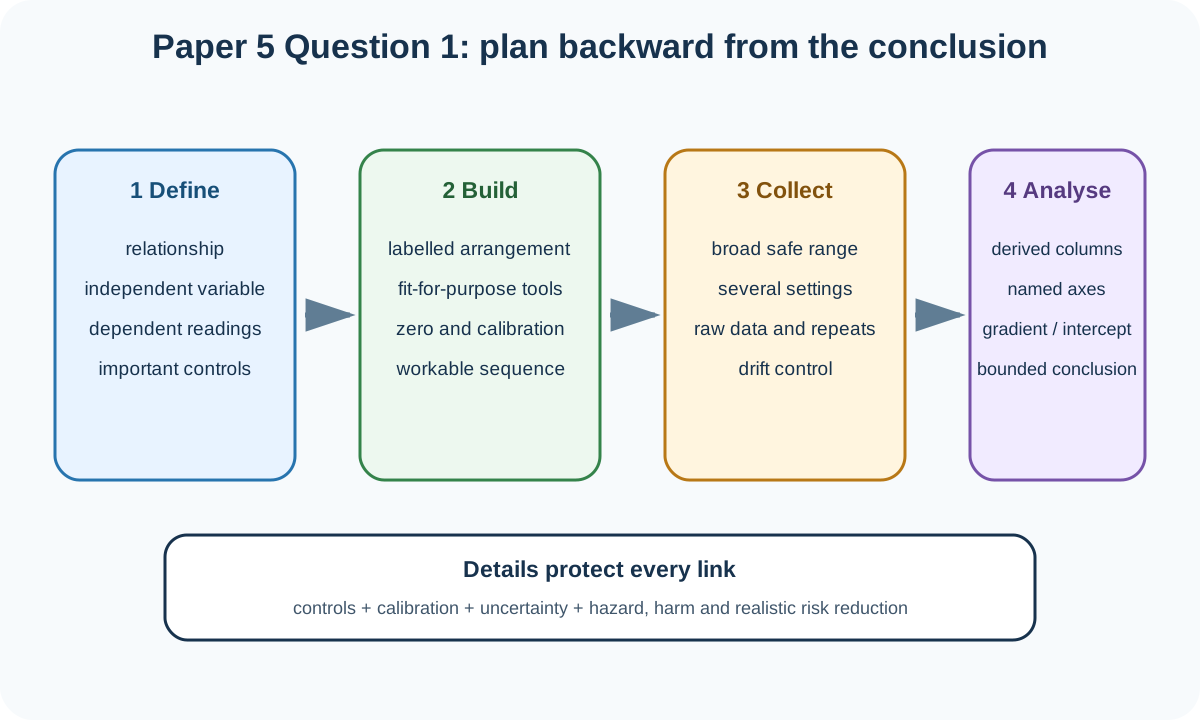
Planning Physics Investigations covers the Cambridge International AS and A Level Physics 9702 Paper 5 Question 1 planning contract. A strong plan is not a generic laboratory checklist. It is a connected design in which a stated independent variable produces measurable dependent data, controls protect the comparison, a workable apparatus creates the readings, and a preselected analysis answers the question.
Official Paper 5 boundary
Paper 5 is a written examination of higher-order experimental skills and does not require laboratory facilities during the paper. Question 1 is a 15-mark planning task answered with a diagram and extended writing. The official skill groups are defining the problem, methods of data collection, method of analysis, and additional relevant detail including safety.
Candidates must identify independent, dependent and controlled variables; explain how variables are changed, measured and kept constant; give a clear labelled apparatus arrangement; and describe how the data lead to a conclusion. The overall design must be workable in practice and measuring instruments must be fit for purpose.
The context may be experimentally unfamiliar or difficult to reproduce in a school laboratory. Necessary information is supplied. Use it rather than rejecting the task because a named apparatus or theory is unfamiliar.
Turn the question into a testable relationship
Write the proposed relationship symbolically before choosing equipment. Identify the quantity deliberately changed as the independent variable and the resulting measured quantity as the dependent variable. A calculated quantity is not automatically the dependent measurement; preserve the raw observations from which it is derived.
List controlled variables that could change the comparison. Give each a physical reason and a method, not merely the word "constant". For example, maintain temperature with a water bath and thermometer, keep geometry fixed with clamps and marked positions, or use the same specimen when material properties must not change.
Choose a useful range and at least several distinct values. The range must be wide enough to expose a trend, yet remain within apparatus, model and safety limits. State how the independent variable is varied in measured steps rather than saying only "change x".
Take repeat readings at each setting when random variation is plausible. State how repeats are used, usually through a mean and an uncertainty estimate. Do not add repeats mechanically when the main problem is a systematic offset or a slow drift.
Design a workable apparatus arrangement
Draw the arrangement as a functional diagram. Label the components that determine how variables are changed or measured, show important connections and place measuring instruments where they act. A circuit needs standard symbols and junctions. A mechanical plan needs supports, measured distances and force directions. An optical plan needs source, aperture, detector and alignment.
Check this topic from memory
Attempt the matching topic bank before reopening the notes. Use each missed idea to decide what to review next.
The written method should allow another learner to assemble and operate the design without inventing missing steps. State the initial setup, how one data row is obtained, how the next setting is produced and when readings are repeated or the apparatus is reset.
Choose instruments by quantity, range and suitable precision. Name a micrometer for small diameter, a balance for mass, an electrical meter in its correct connection, or a sensor with a stated logger role. "Use accurate equipment" is not a method.
Include zero checks and calibration where they matter. A calibration curve requires known reference inputs spanning the experimental range and recorded sensor outputs. Explain how an unknown response is converted through interpolation. A zero check alone does not establish the response scale.
Describe advanced measurement tools
The official boundary includes describing an oscilloscope or storage oscilloscope to measure voltage, current, time and frequency. State the input connection, probe or resistor used for current inference, vertical sensitivity, time base, trigger and how divisions become the requested quantity.
Light gates connected to a data logger can determine time, velocity and acceleration. State what interrupts the beam, what length or separation is measured and which recorded interval enters the calculation. A motion sensor can provide position-time data, but its alignment, sampling rate and valid range remain part of the plan.
Other sensors require the same discipline: identify the physical input, sensor output, calibration, sampling method and environmental controls. Naming a data logger without explaining the measurement chain does not make the design complete.
Plan the analysis before collecting data
Rearrange the supplied model into a graph form. For
y=mx+c,
plot y against x, then relate gradient and intercept to the required constants.
For a power relationship y=axn, use
logy=loga+nlogx.
Plot a dimensionless logarithmic quantity such as log(y/unit) against log(x/unit). The gradient is n and the intercept determines a in the chosen units.
For y=aekx, use
lny=lna+kx.
State the raw columns, derived columns, axes, gradient or intercept expression and how that quantity answers the question. A plan that says "plot a graph" without naming axes and conclusion is unfinished.
If the question asks whether a relationship is supported, state the expected graph behavior, such as a straight line through the origin or a constant gradient within uncertainty. Avoid promising an exact origin when offsets may exist and the model does not require one.
Protect measurement quality
Span the widest feasible range, take enough values to show a trend and avoid clustering points near one setting. Use pilot readings to verify that the response is measurable and the instruments are not overloaded.
Control drift by randomising or alternating the order of settings when appropriate, allowing thermal equilibrium, switching off between electrical readings, or rechecking a reference value. State which drift the procedure addresses.
Reduce parallax with normal viewing, improve a length endpoint with a fiducial marker and set square, time multiple cycles for periodic motion, or measure multiple repeated spacings for a wave pattern. Each detail must attach to a named measurement.
Assess risk and state precautions
Identify the hazard, possible harm and control. For a laser, use a low-power beam below eye level, terminate it and remove reflective objects. For hot equipment, use insulation, allow cooling and monitor temperature. For falling masses, use a tray or padding and keep feet clear. For high current, include current limitation and disconnect between readings.
Do not invent hazards unrelated to the proposed arrangement. "Wear goggles" earns little without a credible eye hazard and an explanation of what the goggles mitigate. Risk controls must preserve the measurement method while reducing likelihood or severity.
Worked application: plan a cooling investigation
To test whether cooling rate is proportional to temperature excess, vary the initial water temperature and measure temperature against time with a calibrated sensor in the same insulated container. Keep water mass, exposed surface area, container, sensor depth and room conditions controlled. Stir gently before each reading, then log temperature at fixed intervals until a common lower limit. For each run, calculate temperature excess θ=T−Troom and determine the initial gradient from a temperature-time graph. Plot cooling-rate magnitude against initial θ; proportionality predicts a straight line through the origin within uncertainty. Repeat runs, alternate starting temperatures to expose room drift, shield hot glass, and place the container on a heatproof mat.
Common misconceptions and corrections
Writing a memorised checklist before identifying the relationship. Let the model determine measurements and analysis.
Calling a calculated value the only raw dependent reading. Preserve the direct observations too.
Naming every other quantity as controlled. Select variables that can materially affect the comparison.
Writing "keep temperature constant" without a method. Name the bath, monitor or equilibration procedure.
Saying "change x" without range or mechanism. State measured settings and how they are produced.
Using only two values because a line needs two points. Collect enough values to reveal scatter and trend.
Repeating readings without saying how they are used. State mean and uncertainty treatment.
Using repeats to correct drift. Change order or recheck a reference to diagnose time-dependent bias.
Drawing apparatus decoratively. Show the functional geometry, connections and measuring positions.
Omitting labels because the prose names equipment. The official response expects a clear labelled diagram.
Writing "use a ruler" for a tiny dimension. Choose fit-for-purpose range and resolution.
Naming a sensor without calibration. Explain reference inputs and output conversion.
Saying "use a data logger" without a measurement chain. State sensor, sampling and calculation.
Using a light gate without defining the interrupting length. Name the card or gate separation used.
Using an oscilloscope without time base or vertical scale. State settings and division conversion.
Plotting before rearranging the equation. Derive axes, gradient and intercept first.
Taking logarithms of dimensional numbers without normalisation. Show the quantity divided by its unit.
Giving logarithms physical units. The logarithm itself is dimensionless.
Saying only "plot a suitable graph". Name both axes and the conclusion route.
Assuming every expected line crosses the origin. Follow the supplied model and account for offsets.
Giving a generic safety phrase. Link hazard, harm and control to the apparatus.
Replacing the proposed experiment as an improvement. Modify the stated investigation realistically.
Claiming a plan proves the relationship. It defines how evidence would test it over a bounded range.
Assessment guidance
Start with the symbolic relationship, then state independent, dependent and controlled variables. Describe a broad safe range, several settings, repeats and exactly how each raw measurement is made. Draw and label the functional apparatus, including circuit connections, sensor position or measured geometry. Specify zero checks, calibration and control procedures where relevant. Rearrange the model to name graph axes, derived columns, gradient and intercept meaning before discussing results. Finish with additional measurement-quality detail and specific risk controls. Every procedural sentence should help another person collect the intended evidence without inventing a missing step.
Retrieval practice
Given one linear, one power-law and one exponential relationship, design three compact Paper 5 plans. For each, identify variables and controls, sketch a workable labelled arrangement, choose instruments and calibration, define range and repeats, list raw and derived table columns, derive graph axes and constant extraction, and state two matched risk or quality controls.
Theory and practical ownership
Theory notes explain the physical relationships supplied or recalled within their syllabus topics. This note covers the general Paper 5 Question 1 planning architecture. Practicals 1 to 4 supply measurement and apparatus patterns, while Practical 6 covers the distinct Paper 5 Question 2 analysis, conclusion and uncertainty workflow.
Cambridge International, AS and A Level Physics 9702 syllabus for examinations in 2025, 2026 and 2027, Paper 5 Planning, Analysis and Evaluation, Question 1 mark allocation and planning expectations for defining the problem, methods of data collection, method of analysis, and additional detail including safety considerations.