If your private school, private education institution (PEI), tuition centre or homeschool co-op teaches science without a laboratory, Eclat can help you arrange supervised practical sessions for your students. Your centre can continue teaching theory while the cohort practises with apparatus under science-tutor supervision.
If you are searching for science lab rental in Singapore, start by explaining what your students need to do in the lab. A room booking alone does not settle the apparatus, preparation or supervision needed for a practical lesson. Eclat's cohort sessions include apparatus setup and clearing by the team; dedicated dates and any recurring schedule need to be agreed for your group.
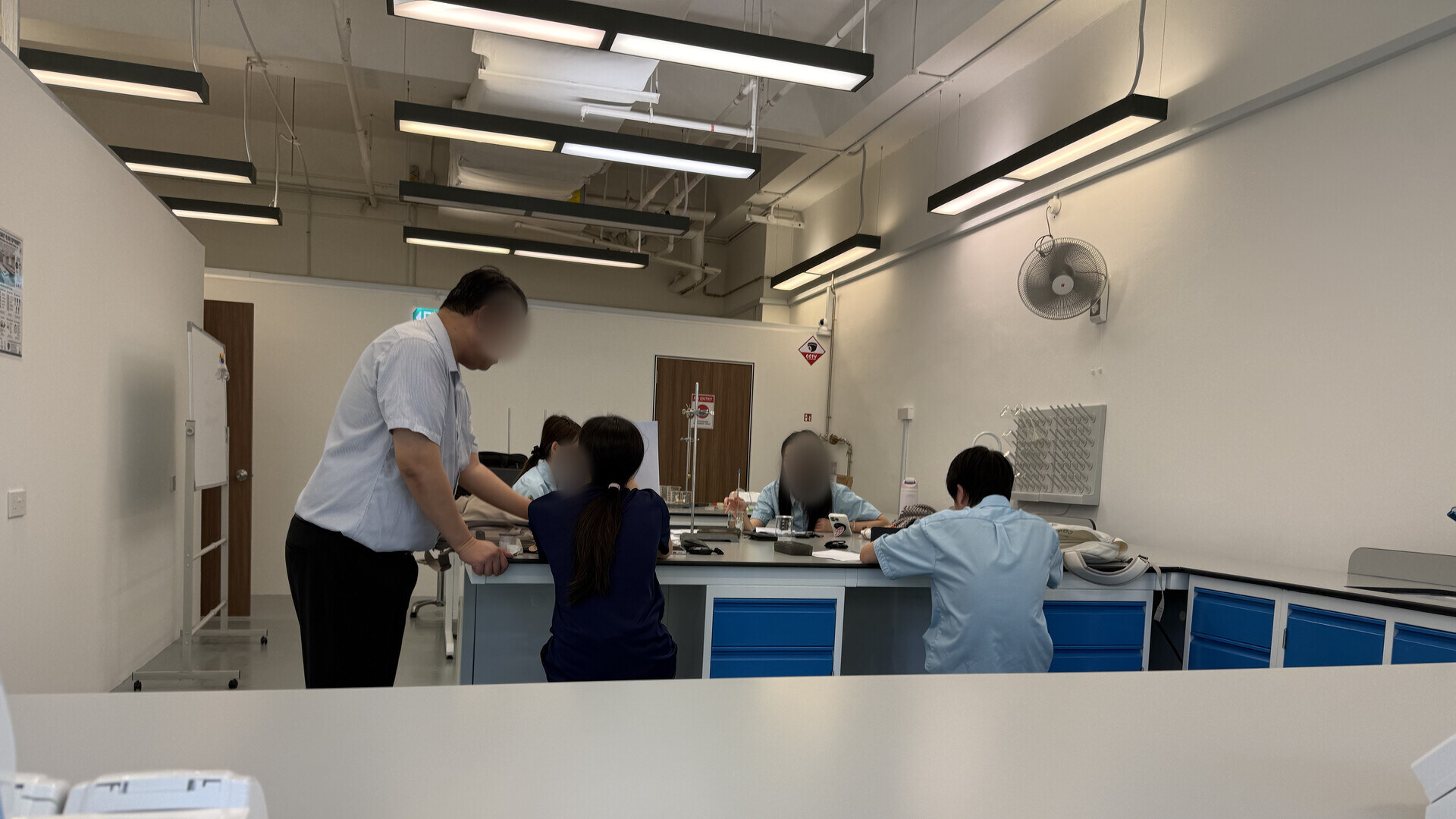
Guided practical work at Henderson Road, photographed on 20 August 2026. Faces have been anonymised.
Quick operator checklist
Question
Why it matters
Which exam and syllabus are students taking?
Practical duration and skills differ by level and subject
How many students need lab access?
Cohort size affects scheduling and supervision
Are they private candidates?
Registration declarations may require practical training plans
When is the practical paper?
Lab blocks need to finish before the exam
What records are needed?
Attendance records support later verification if requested
Science lab access for your school cohort
Eclat provides supervised practical sessions for individual students and cohorts referred by partner centres. For a school booking, agree the teaching brief, apparatus and dates together so that the practical work fits what students are learning in class.
Cohort bookings and dedicated dates
Cohort size is agreed around the subject, planned experiments, apparatus and supervision required. Send your student count and identify any groups taking different subjects or syllabuses so we can propose a suitable session arrangement. Dedicated dates are subject to availability; confirm the venue and booking before adding sessions to your school timetable.
School lab bookings can be arranged in two-hour sessions. Tell us whether the group needs guided practice with unfamiliar apparatus, revision of particular experimental skills or timed practical preparation. Agree the work to be covered within the booked time; extensions depend on availability and may carry an additional charge.
Apparatus, preparation and supervision
Choose the arrangement that fits your school's teaching plan:
Booking arrangement
Preparation and supervision
Your teacher leads
Eclat provides lab preparation, venue use and normal clean-up. Your school provides teaching and supervision.
Eclat trainer support
The booking includes lab preparation, venue use and normal clean-up, with one or two Eclat trainers as agreed for practical facilitation.
Your school remains responsible for student attendance, discipline and overall conduct unless otherwise agreed in writing. Confirm the selected arrangement before the session.
Share your syllabus, topics and any proposed experiment or worksheet before booking. Agree the apparatus quantities and whether students will work individually or share a setup. Special chemicals, consumables, customised worksheets, extra preparation or additional staff may be quoted separately.
For example, a chemistry brief might focus on titration technique, a physics brief on taking measurements in circuits, or a biology brief on microscopy. These are examples to discuss when planning the cohort's work, rather than a guarantee that every requested experiment can be accommodated.
Confirm what students should bring and the approved activities when the session is agreed. If you need equipment-only hire, describe that request separately so Eclat can assess it.
A closer look at the apparatus
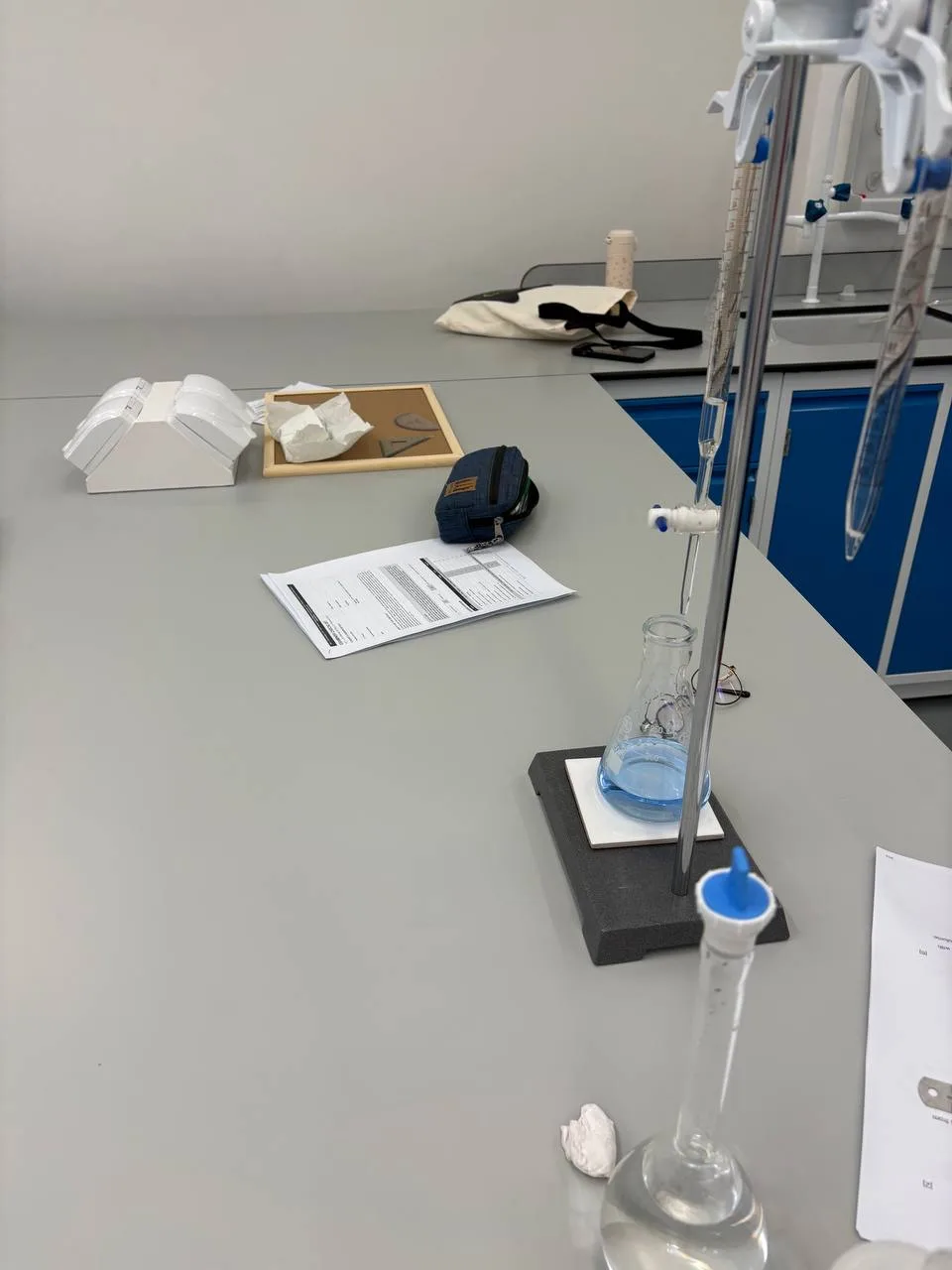
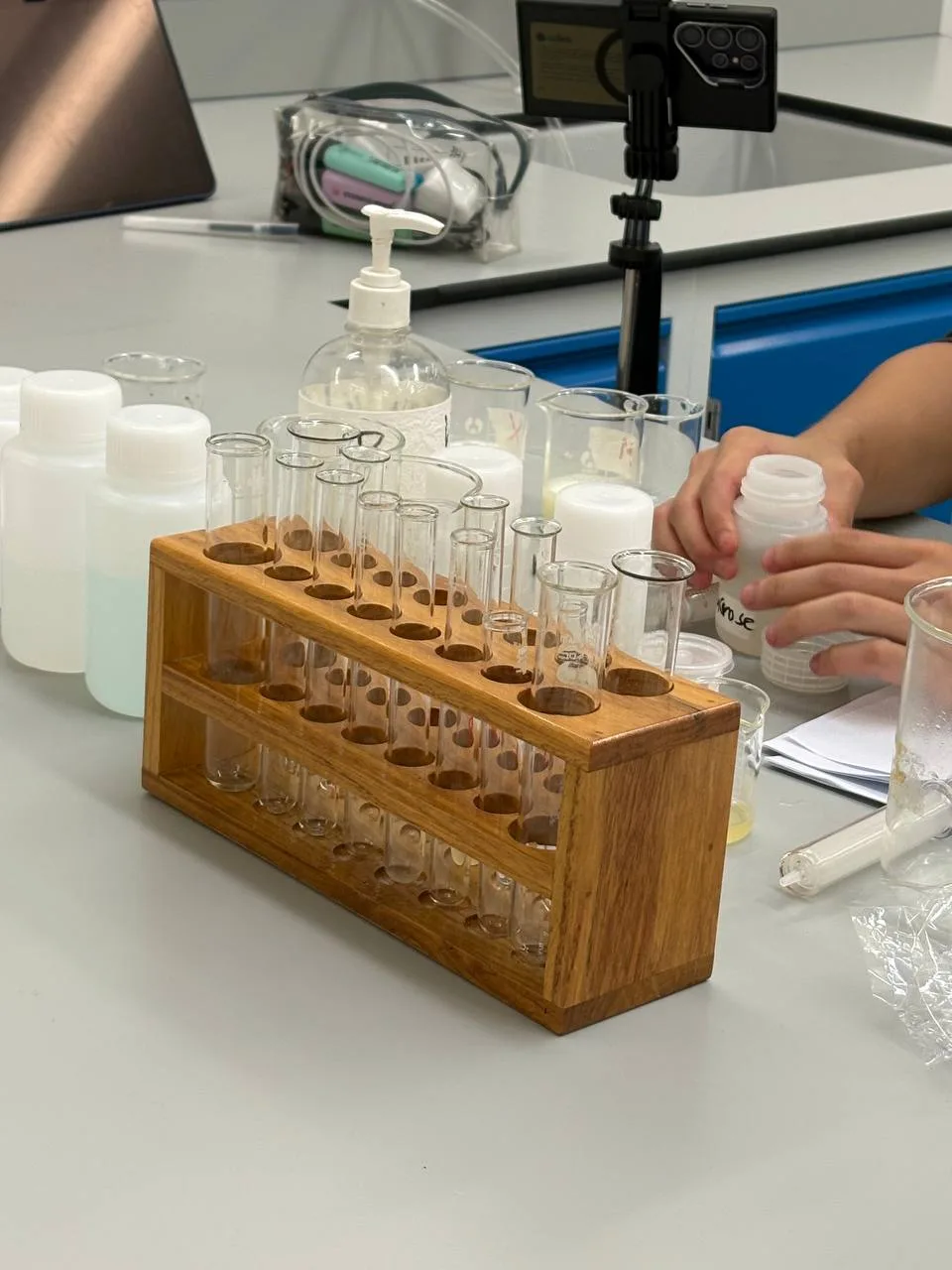
These photographs from Eclat's August 2026 practical sessions show the bench setups students work with. Share the experiment you have in mind so we can confirm the complete apparatus set and quantities for your cohort.
Practical work
Apparatus visible in the photographs
What to confirm for your booking
Titration
Burette held on a stand, pipette, conical flask and white tile
Glassware sizes, solutions, number of workstations and whether students share apparatus
Test-tube investigations
Test tubes, wooden test-tube rack and beakers
The planned tests, reagents, preparation and equipment needed for each group
Titration apparatus photographed during an Eclat chemistry practical on 26 August 2026.
Test tubes, racks and beakers photographed during an Eclat biology practical on 26 August 2026.
Recurring practical sessions across a term
If your school needs regular lab access, send your proposed frequency, start and end dates, and the topics students will cover in theory lessons. Ask about a recurring series before committing your timetable; availability for one session does not reserve the same slot for the rest of the term.
A planning example is to begin with apparatus handling, follow with subject-specific experiments, then use later sessions for timed practice and feedback. Agree the actual sequence around the cohort's starting skills and target examination. Include school holidays and any dates to avoid in your request.
For a recurring series, agree the dates, session duration, cohort size, apparatus scope, supervision and fees in writing. Include payment deadlines and arrangements for absences, cancellations or date changes. A booking is confirmed after payment or written confirmation from Eclat; recurring dates must be included in the agreed schedule.
Attendance records for your students
Eclat maintains attendance records per student. Tell the team what records your centre needs and agree how to request them. Keep those records alongside your own cohort timetable; the existing private-candidate guidance below explains the practical-training context.
Physics, Chemistry, Biology practical skills aligned to school WA requirements
Concrete example: the common PEI situation
A private centre teaches O-Level Chemistry theory to six private candidates but has no burettes, fume cupboard, or supervised wet-lab space. Instead of asking each student to find their own lab practice, the centre can arrange cohort practical sessions with a lab provider, keep attendance records, and align the training blocks to Paper 3 skills.
The lab access problem for PEIs and homeschool centres
Running a private education institution or homeschool programme in Singapore comes with a practical constraint that theory-only centres hit sooner or later: your students need supervised lab access to sit national examinations.
For O-Level science candidates (pure or combined), Paper 3 or Paper 5 is compulsory. For A-Level H2 science candidates, Paper 4 is compulsory and carries 20 % of the grade. For IGCSE candidates, a practical component is required by Cambridge International. For SEAB private candidates who have not sat the same subject before, the registration rule is that they must already be attending, or will be attending, supervised practical training and complete it before the practical paper.
Most PEIs and homeschool programmes are housed in commercial shophouses or HDB units. There is no fume cupboard, no burettes, no microscopes, no circuit-building equipment. The options are:
Refer students to find their own practical training (high dropout risk, inconsistent quality)
Build a lab from scratch (high capital cost, regulatory complexity, ongoing maintenance)
Partner with an established practical centre that already has the equipment, supervision, and SEAB familiarity
Most operators who have thought this through choose option 3.
What SEAB requires at each level
O-Level (pure sciences: 6091, 6092, 6093)
Paper 3 (Practical) is 1 h 50 min, 40 marks, 20 % of the grade. Candidates need practical training aligned to the syllabus's practical skills list. At registration, private candidates who have not sat the same subject before must declare that they are attending, or will attend, practical training that will be completed before the practical paper.
O-Level (Combined Science: 5086, 5087, 5088)
Paper 5 (Practical) is 1 h 30 min, 30 marks, 15 % of the grade. The same registration requirement applies.
Paper 4 (Practical) is 2 h 30 min, 50 marks, 20 % of the grade. In practice, centres usually front-load a baseline cycle before the April registration window so private candidates can make the declaration at registration and still complete the course before the October/November paper.
IGCSE (Cambridge International)
The practical component varies by subject (Paper 3 or Paper 6 Alternative to Practical). Students sitting Paper 3 require supervised lab access. Students sitting Paper 6 (written alternative) do not need a physical lab but must have studied practical methods from the syllabus.
Who typically enquires
Homeschool co-ops and parent groups: Families homeschooling through the private-candidate O-Level or A-Level route who pool resources to arrange group practical sessions for their children.
Registered PEIs without lab facilities: Institutions offering academic enrichment or full curriculum delivery that have science subjects on their timetable but no physical lab space.
Tuition centres adding science to their offering: A tuition centre strong in mathematics that wants to offer H2 Physics or H2 Chemistry support without building a lab.
International school students sitting GCE exams: Students at international schools preparing for GCE O-Level or A-Level alongside their school curriculum, where the school lab is not available for private-candidate training.
Request a cohort booking or recurring lab schedule
Send one enquiry for your cohort with:
Number of students and their current year / level
Subjects (Physics, Chemistry, Biology, or combined science)
Target examination (O-Level, A-Level, IGCSE) and year (e.g., October/November 2026)
Preferred dates and frequency - a single block or a recurring series, proposed start and end dates, and dates to avoid
Practical topics and apparatus needs - include any worksheet or experiment your centre wants to use
Teaching and supervision needs - guided lessons, timed practice, or a request involving your own teacher
Records needed - attendance details your centre would like to retain
Whether students are private candidates or school candidates supplementing school lab time
Get in touch
Email hello@eclatinstitute.sg with the details above to discuss availability and fees. A useful starting message is: "We are a private school looking for supervised science lab access for [number] students taking [subject and syllabus]. We would like [one session / a recurring series] between [dates], focusing on [practical topics]. Please advise on availability, apparatus, supervision and fees."
For context on what individual private candidates need to prepare for practicals, share these resources with your students: