

IGCSE Biology Practical Skills 1: Measurement, Tables and Graphs
Cambridge IGCSE Biology 0610 and 0970 practical notes on readings, units, tables, graphs, gradients, interpolation, extrapolation and anomalies.
Cambridge IGCSE Biology Papers 5 and 6 assess the same AO3 skills and experimental contexts. This practical note develops quantitative measurement, systematic recording, data processing and graphical presentation across both 0610 and 0970. Paper 5 performs laboratory work; Paper 6 reasons from equivalent experimental evidence.
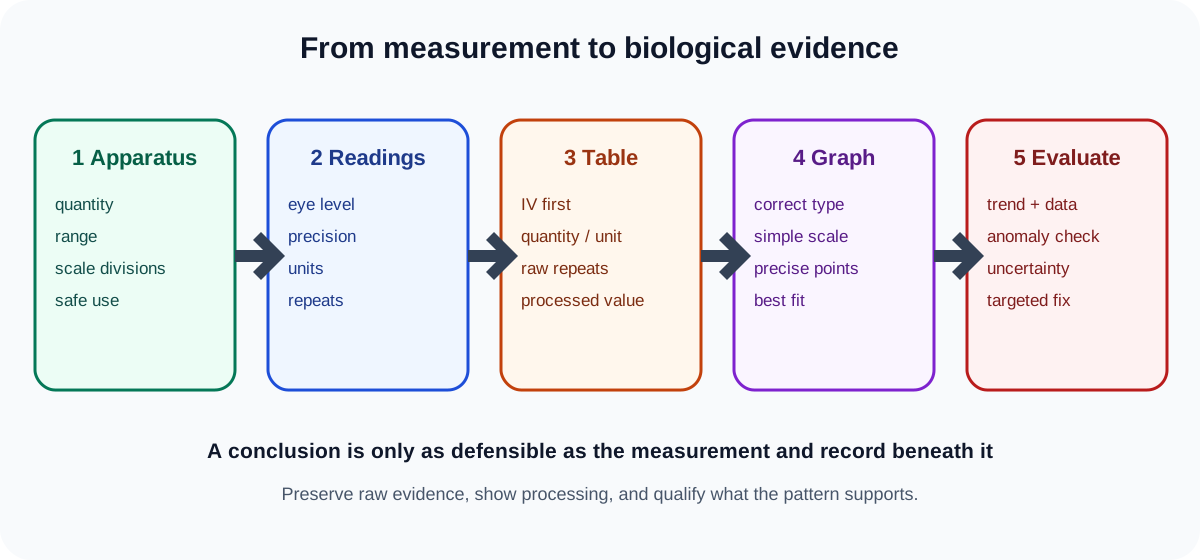
Select measurement apparatus
Match apparatus to the quantity, range and precision required. A measuring cylinder measures liquid volume more appropriately than a beaker scale. A small cylinder or syringe usually resolves a small volume better than a large cylinder. A balance measures mass, a thermometer measures temperature, a stop-clock measures time and a millimetre ruler measures length.
Cambridge lists balances precise to at least 0.1 g, stop-clocks reading to 1 s or better, thermometers with 1 °C graduations and rulers graduated in millimetres among familiar apparatus. A question may supply different instruments, so read the shown scale rather than assume a standard precision.
Justify a choice through its fitness for the measurement. Saying that a syringe is "more accurate" is incomplete. Explain that its smaller scale divisions allow the required small volume to be read with greater precision.
Read scales defensibly
Read a liquid scale with the line of sight level with the relevant meniscus to reduce parallax error. Identify the value between two labelled marks, count the intervals and calculate the value of each smallest division before reading.
For digital apparatus, record the displayed precision. For analogue apparatus, record only the precision supported by the scale and task. Do not add meaningless decimal places.
Biological measurements may require estimates. A ruler image, field of view or irregular specimen can still be measured using a defined start and end point. Apply the same rule to every specimen.
Volumes may be measured in cm³, masses in g, temperatures in °C, times in s and lengths in suitable units. Convert units only when the calculation requires consistent quantities.
Build a results table before collecting data
Place the independent variable in the first column. Put raw dependent-variable readings next, followed by processed values such as a mean, percentage change or rate.
Each heading states the quantity and unit separated by a solidus, for example time / s or mass / g. Units belong in headings, not beside every value in the body.
Use one cell per value and do not combine several measurements with prose. Record qualitative observations precisely, such as "blue to brick-red precipitate", rather than writing only "positive".
Check this topic from memory
Attempt the matching topic bank before reopening the notes. Use each missed idea to decide what to review next.
Start the topic quizSources
Want supervised lab practice?
Explore practical lessons, with timings, fees, and locations on the programme page.
View Cambridge IGCSE Biology Practical Skills Practicals