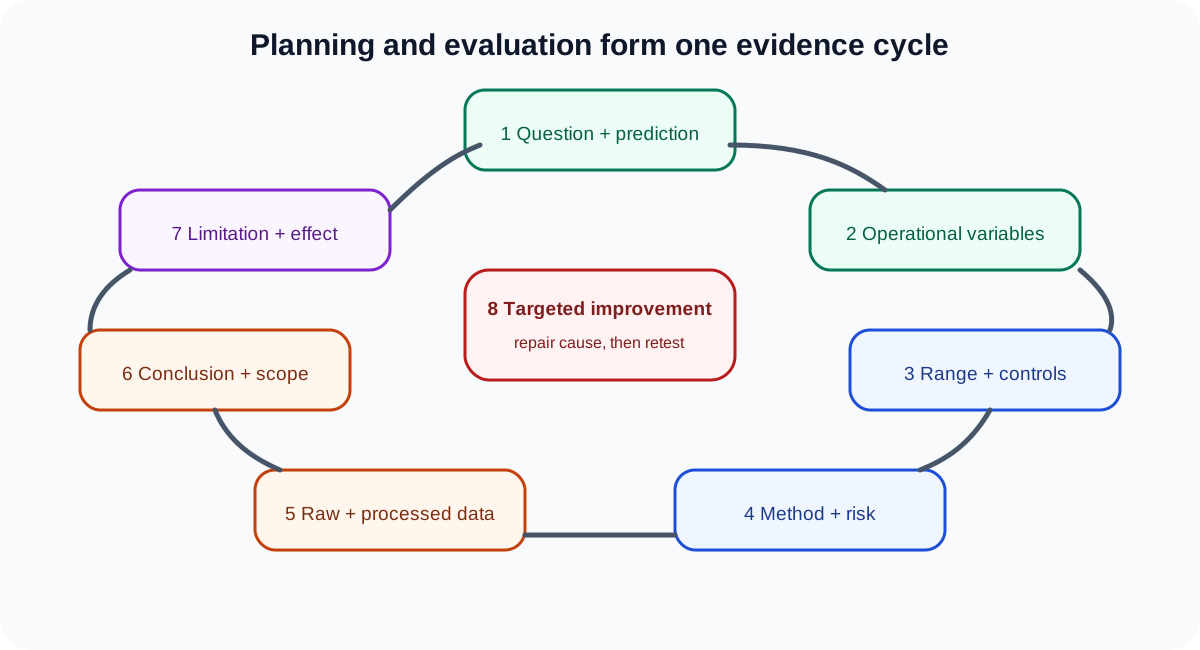
Cambridge IGCSE Biology Papers 5 and 6 use the same AO3 planning and evaluation skills. A defensible plan changes one defined factor, measures a relevant response, controls alternatives, manages risk and states how evidence will answer the question. Evaluation then diagnoses what the evidence can and cannot support.
Turn a question into testable variables
The independent variable is deliberately changed. The dependent variable is observed or measured in response. Control variables are factors that could affect the dependent variable and are kept constant to make the comparison valid.
Name variables operationally. "Temperature" is incomplete as a method; state the selected temperatures, how they are produced and how actual reaction temperature is checked. "Enzyme activity" needs a measurable endpoint such as time for starch to disappear or gas volume produced per minute.
A hypothesis predicts a relationship and may include biological reasoning. A prediction describes the expected result in the proposed setup. Do not write a conclusion before evidence exists.
Choose a useful range and intervals
Use enough independent-variable values to reveal a relationship, curve or optimum. Five values are often stronger than a treated and untreated pair, although the context determines what is feasible.
The range should be safe and biologically informative. A pilot study can identify a useful range, suitable intervals and an endpoint that is neither instantaneous nor too slow.
Intervals need not always be equal, but closer values can be placed near a suspected transition or optimum. Avoid claiming the true optimum when only a narrow or widely spaced range was tested.
Control alternative explanations
For every important control variable, state how it is held constant and why. In an enzyme-temperature investigation, control enzyme and substrate concentrations, their volumes, pH and endpoint method because each could change measured time.
Standardise biological material by species, source, age, initial size or surface area where relevant. Biological specimens are not identical, so independent replicates may be needed even when dimensions are controlled.
A control experiment removes the proposed causal factor while keeping other conditions similar. Boiled seeds can provide a non-living comparison for respiration, and distilled water may provide a negative food-test control. A control variable and a control experiment are different ideas.
Write a reproducible method
Specify apparatus, quantities, concentrations, sequence, timing and endpoint. Another student should be able to perform the investigation without inventing missing decisions.
Check this topic from memory
Attempt the matching topic bank before reopening the notes. Use each missed idea to decide what to review next.
State how the independent variable is set and checked, how the dependent variable is measured, when the timer starts and stops, and how the apparatus is reset between trials. Include a suitable table plan and processing method.
Select apparatus for range and precision. Justify choices through smaller divisions, capacity, safer operation or direct measurement rather than calling equipment vaguely "better".
Repeats, replicates and sample size
Repeats under one condition expose random variation and permit a mean. Replicates using independent organisms or tissue samples capture biological variation more effectively than repeatedly reading the same specimen.
Use sufficient observations for the expected variation. A larger sample generally reduces the influence of unusual individuals, but it does not correct a biased method.
If a result appears anomalous, check the record and apparatus and repeat that condition. Keep raw evidence and justify any exclusion from a calculation.
Plan data recording and processing
Prepare a results table with quantity and unit headings. Preserve raw readings before means, rates or percentage changes. State which graph will display the relationship and which calculation supports comparison.
Make a reasoned prediction of the expected pattern. For an enzyme-temperature plan, predict increasing rate to an optimum and decreasing rate beyond it, with low-temperature kinetic reasoning and high-temperature denaturation reasoning.
Processing must fit the measurement. Reciprocal time is suitable only when the same fixed endpoint is reached. Percentage change helps compare specimens with different initial values.
Identify hazards, risks and precautions
A hazard is a source of harm. Risk describes how harm could occur. A precaution reduces that named risk.
For a sharp scalpel, the risk is a cut; use a cutting tile, cut away from fingers and follow supervised handling. For hot water, the risk is a burn; use a controlled water bath, suitable holders and temperatures within instructions. Eye protection reduces injury risk from splashes.
Avoid generic statements such as "be careful". Do not invent extreme hazards for ordinary materials, and follow centre instructions for chemical disposal and biological material.
Human investigations require consent, appropriate intensity, standardised rest and a stop rule if a participant feels unwell. Ecological work should minimise trampling and disturbance.
Form an evidence-based conclusion
Describe the relationship, quote relevant processed data and explain it with appropriate biology. A conclusion about increasing temperature should identify the tested range and any optimum or decline actually observed.
State whether evidence supports the prediction, not whether the prediction was "correct" in an absolute sense. Do not generalise beyond the organisms, range and conditions tested.
Correlation alone does not prove causation when uncontrolled variables could explain the pattern.
Evaluate data and method separately
Data evaluation considers scatter, repeats, anomalies, sample size and whether the range reveals the pattern. Method evaluation considers variable control, apparatus resolution, endpoint judgement, contamination, leaks and biological standardisation.
Accuracy concerns closeness to an accepted or true value. Precision concerns resolution or closeness of repeated measurements. Reliability concerns whether repeated evidence is consistent. Validity asks whether the design tests the intended relationship.
Random error produces unpredictable spread and can often be reduced through repeats and means. Systematic error shifts readings consistently, such as a balance that is not zeroed; repetition alone will not remove the bias.
Suggest targeted improvements
Link limitation, effect and correction. If visual endpoint judgement varies, the measured time may differ between trials; use a colorimeter or fixed colour standard. If temperature changes after mixing, the intended independent variable is not maintained; use a thermostatically controlled bath and check the reaction mixture.
"Use better equipment" is too vague. Name the instrument and explain how it addresses the identified problem. More repeats improve reliability but do not repair a confounded variable, unsafe method or systematic calibration error.
Worked application: plan an osmosis investigation
To test solution concentration against potato mass change, prepare at least five concentrations across a pilot-tested range. Cut cylinders with the same cork borer and length, record initial mass, use equal solution volumes, and keep immersion time and temperature constant. Use at least three independent cylinders per concentration, blot each with the same method, record final mass and calculate percentage change. Plot concentration against mean percentage change. Handle the cutting tool on a tile and away from fingers. If cylinder length varies, surface area changes and may alter water exchange; use a measured cutting guide rather than merely adding repeats.
Common misconceptions and corrections
Calling the measured outcome the independent variable. It is the dependent variable.
Listing controls without saying how. Give the constant value or method.
Giving no reason for a control. Link it to the dependent variable.
Calling a control experiment a control variable. One removes a causal factor; the other is held constant.
Changing concentration by changing both solute and total volume. Prepare defined concentrations consistently.
Testing only two values for an optimum. Use a useful range and several values.
Assuming the highest tested rate is the true optimum. The real optimum may lie between or beyond values.
Using unsafe temperatures to enlarge a range. Safety constrains design.
Writing "same plant" when independent replicates are needed. Separate specimens capture biological variation.
Saying a larger sample removes bias. Biased selection remains biased.
Replacing raw results with means. Preserve the measurements.
Repeating only until values agree. Predefine repeats and report anomalies.
Starting a timer before the defined reaction begins. Tie timing to mixing or another explicit event.
Calling every unexpected result human error. Identify a mechanism.
Treating accuracy and reliability as synonyms. They answer different questions.
Saying repeats remove systematic error. Calibration or method correction is required.
Using "be careful" as a precaution. State a concrete action.
Naming a hazard without its risk. Explain the possible harm.
Giving goggles for every limitation. Safety does not improve measurement precision.
Writing a conclusion without data. Quote representative values or the processed pattern.
Claiming causation from uncontrolled correlation. Qualify the inference.
Generalising from one organism to all organisms. State the tested scope.
Suggesting more repeats for a confounded design. Control the variable first.
Saying use better apparatus. Name it and its benefit.
Proposing a colorimeter without explaining why. It reduces subjective colour judgement.
Changing the research question in the improvement. Repair the original test.
Assessment guidance
Planning answers should specify operational variables, a safe and informative range, repeat structure, control method and reason, apparatus with quantities, a measurable endpoint, results recording and processing. Include a control experiment only when it isolates the proposed cause. Risk answers need hazard, possible harm and matched precaution. Conclusions must state a relationship and quote data within the tested scope. Evaluations score through specific limitation-effect-improvement chains. Separate random spread from systematic bias and do not offer repeated trials as a universal solution. A justified instrument or procedure is stronger than vague claims about accuracy.
Retrieval practice
Take unfamiliar questions on enzymes, osmosis, germination and exercise and write an operational independent variable, dependent variable and three control-variable reason pairs for each. Design a five-value range, control experiment, risk statement, raw table and processing plan. Then diagnose sample evaluations as random error, systematic error, weak validity or limited reliability and write one targeted correction.
Theory and practical ownership
This practical note owns transferable planning, risk, conclusion and evaluation logic. The context practical notes own their apparatus and procedural details. Theory hubs own the biological mechanisms used to predict and explain patterns.