

IGCSE Biology Practical Skills 4: Food Tests
Cambridge IGCSE Biology 0610 and 0970 practical notes on iodine, Benedict's, biuret, ethanol-emulsion and DCPIP tests, controls, comparison and safety.
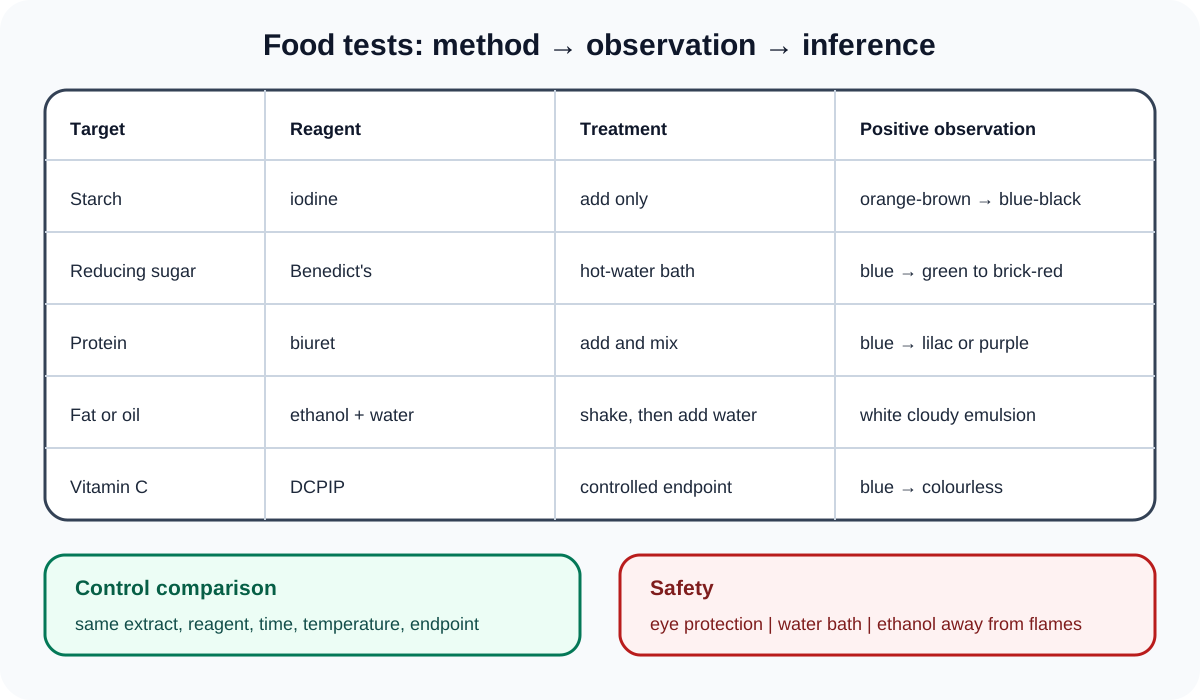
Cambridge IGCSE Biology 0610 and 0970 require five food-test procedures: iodine solution for starch, Benedict's solution for reducing sugars, biuret for proteins, ethanol emulsion for fats and oils, and DCPIP for vitamin C. Practical answers must separate method, observation and inference while controlling comparison and risk.
Prepare a test solution
Liquids may be tested directly in measured volumes. For a solid food, crush or grind a measured mass with a measured volume of distilled or deionised water, then filter or decant when a clearer extract is needed.
Use clean apparatus for every sample. Cross-contamination can create a false positive. Label tubes before adding extracts and use separate pipettes or rinse them thoroughly as instructed.
When comparing foods, standardise sample mass, extraction-water volume, extract volume and reagent quantity. Otherwise a stronger result might reflect more material rather than a higher concentration.
Iodine solution test for starch
Place the sample or extract in a clean tube or spotting tile and add iodine solution. A positive result changes from orange-brown to blue-black. If starch is absent, iodine remains orange-brown.
Heating is not required. Record initial and final colours rather than writing only "positive". Very dark or naturally coloured samples may obscure the endpoint, so use suitable controls and a consistent dilution where comparison is intended.
Benedict's solution test for reducing sugars
Add Benedict's solution to the sample and heat the tube in a hot-water bath for a controlled time. A positive result changes from blue towards green, yellow, orange or brick-red, often with a precipitate. A negative result remains blue.
The colour sequence can support a semi-quantitative comparison only when sample and Benedict's volumes, bath temperature and heating time are the same. A colorimeter or calibrated colour standards can reduce subjective judgement.
Use a water bath rather than direct flame. Point tubes away from people, use a holder when required and wear eye protection.
This test detects reducing sugars such as glucose. A negative result does not prove that every carbohydrate is absent. Sucrose, for example, is not identified directly by the standard Benedict's procedure.
Biuret test for protein
Add biuret reagent to the sample as instructed and mix. A positive result changes from blue to lilac or purple. A negative result remains blue.
Do not heat the test. Compare colour under similar lighting and against a white background. State protein as the inference, not "biuret is present".
If separate alkali and copper sulfate solutions are supplied instead of prepared reagent, follow the provided sequence and quantities. Do not invent a different method when the exam specifies materials.
Check this topic from memory
Attempt the matching topic bank before reopening the notes. Use each missed idea to decide what to review next.
Start the topic quizSources
Want supervised lab practice?
Explore practical lessons, with timings, fees, and locations on the programme page.
View Cambridge IGCSE Biology Practical Skills Practicals