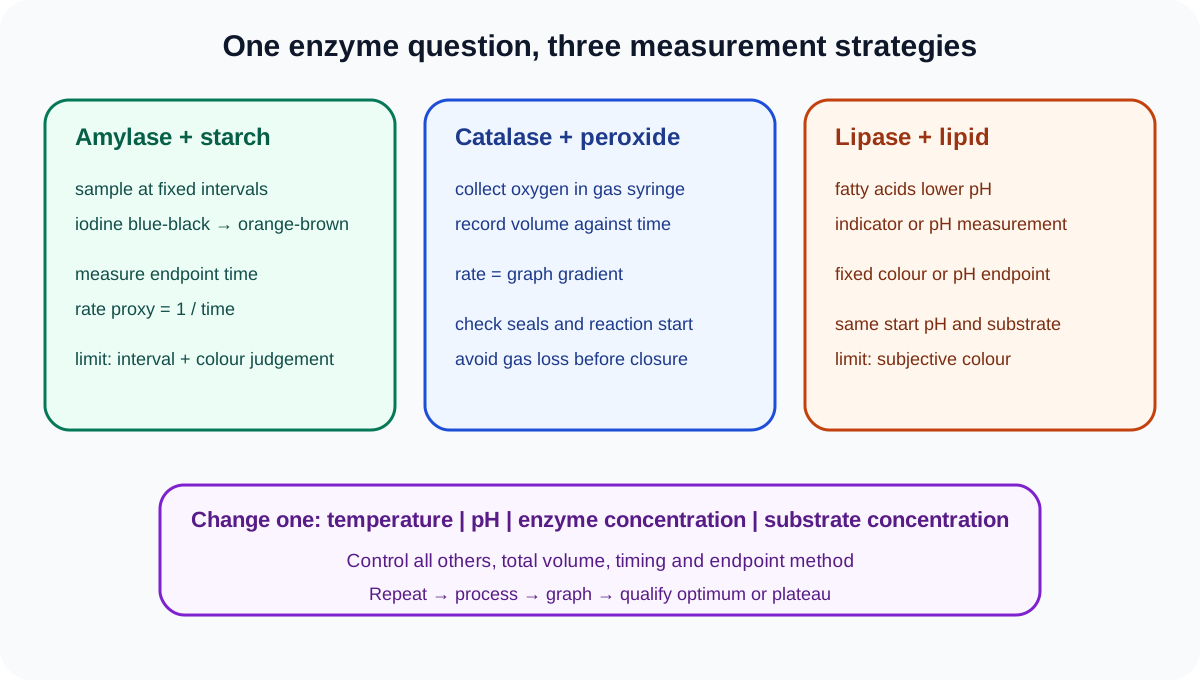
Rates of enzyme-catalysed reactions, including judged colour endpoints, are an explicit Cambridge IGCSE Biology practical context. Papers 5 and 6 can vary temperature, pH, enzyme concentration or substrate concentration and require a valid rate measure, controlled method, graph and evidence-based evaluation.
Define what rate means in the method
Rate is change in a measured quantity per unit time. A continuous method measures product formation or substrate loss repeatedly, such as oxygen volume over time. An endpoint method measures the time required to reach the same defined state.
When every trial reaches the same endpoint from the same starting amounts, comparative rate = 1 / endpoint time. If time is measured in seconds, the unit is s⁻¹.
Reciprocal time compares rates but is not automatically an exact concentration change per second. State what was measured and avoid claiming a stronger unit than the evidence supports.
Amylase and starch endpoint
Place iodine solution in separate wells of a spotting tile. Equilibrate amylase, starch and any buffer at the selected condition. Mix amylase and starch and start the timer immediately.
At fixed intervals, use a clean pipette to transfer one drop of reaction mixture to a fresh iodine well. Early samples turn blue-black while starch remains. The endpoint is the first sample for which iodine stays orange-brown, indicating that starch is no longer detected.
Use separate pipettes for iodine and reaction mixture to prevent contamination. Keep drop size, sampling interval, volumes, concentrations and endpoint rule constant.
The true endpoint lies between the last positive and first negative sample. Shorter sampling intervals reduce this timing uncertainty but require faster, consistent handling.
Investigate temperature
Prepare water baths across a safe, useful range. Place enzyme and substrate tubes separately in the selected bath long enough to reach that temperature before mixing.
Keep pH, enzyme concentration and volume, substrate concentration and volume, total volume and measurement method constant. Monitor actual mixture temperature rather than relying only on a bath label.
Rate commonly rises with temperature initially because particles move faster and successful collisions occur more often. Above an optimum, denaturation changes the active site and rate falls.
Low temperature slows molecular movement; it does not normally denature the enzyme. Do not infer an exact optimum if tested intervals are wide.
Investigate pH
Use buffer solutions to set a range of pH values. Keep buffer volume and total reaction volume constant. Equilibrate all solutions at the same temperature.
Check this topic from memory
Attempt the matching topic bank before reopening the notes. Use each missed idea to decide what to review next.
Measure the same endpoint or product for every pH. Different enzymes may have different optimum pH values, so use results rather than a universal assumed value.
Extreme pH can alter ionic interactions and active-site shape. The practical conclusion should first describe the observed rate-pH pattern and then use theory to explain it.
Investigate enzyme concentration
Prepare known enzyme concentrations while keeping substrate concentration and volume constant. Maintain total volume, often by replacing reduced enzyme solution with distilled water where the method specifies.
At low enzyme concentrations with excess substrate, more enzyme provides more active sites and can increase rate. Eventually another factor may limit the response.
Changing enzyme volume without controlling total volume can also change dilution and collision conditions, weakening validity.
Investigate substrate concentration
Vary substrate concentration while keeping enzyme amount, pH, temperature and total volume constant. At low substrate concentration, more substrate increases collision frequency. At high concentration, active sites may be occupied most of the time and rate can level off.
The tested range must extend far enough to reveal whether a plateau occurs. Do not call the final point a maximum merely because no higher value was tested.
Catalase and hydrogen peroxide
Catalase breaks down hydrogen peroxide and releases oxygen. Add a controlled enzyme source to a measured hydrogen peroxide volume, seal the apparatus promptly and collect gas in a gas syringe or by an instructed method.
Record oxygen volume at regular times, or measure volume in a fixed time. A gas-volume-time graph can provide initial rate from the early gradient.
Check airtight connections. Gas lost before sealing makes early readings too low. Foam height is a weaker proxy because bubble size and stability vary.
Hydrogen peroxide is a hazard at relevant concentrations. Wear eye protection, avoid skin and eye contact and follow the supplied handling instructions.
Lipase and pH indicators
Lipase breaks down lipid to fatty acids and glycerol. Fatty-acid formation lowers pH. An indicator or pH measurement can therefore provide an endpoint or continuous proxy.
Start every trial at the same pH, use the same milk or lipid substrate, lipase amount, indicator amount and temperature, and define the endpoint colour using a reference.
A colour endpoint is semi-quantitative and observer-dependent. A pH probe or colorimeter can improve measurement when available and appropriate.
Measure rate and graph results
For fixed endpoint data, calculate reciprocal time and plot independent variable on the x-axis against rate on the y-axis. For gas data, plot volume against time and calculate a gradient using a large triangle on the fitted line.
Initial rate is often more comparable because substrate depletion, product accumulation or enzyme change can alter later rate. State which graph region is used.
Use repeats at every condition and calculate a mean. Preserve raw times or volumes. Identify anomalies from the replicate pattern and repeat the condition rather than deleting inconvenient values.
Improve endpoint quality
Visual colour judgement varies with lighting, sample colour and the observer. Use a white background, defined colour standard, same observer or an instrument.
Fixed sampling intervals create interval uncertainty. Reduce the interval while retaining workable technique. Automated sensors can record continuous data, but an improvement must remain realistic for the stated apparatus.
If mixing and sampling times vary, use a consistent sequence and practise the method. Randomising trial order can reduce drift where the enzyme or room conditions change over time.
Control contamination and condition drift
Use clean apparatus and separate pipettes. Residual enzyme, substrate, acid, alkali or iodine can start reactions early or alter pH.
A water bath controls temperature only if solutions equilibrate and remain immersed appropriately. A thermometer checks actual conditions.
Buffer controls pH more effectively than assuming it remains constant. Record prepared concentrations and use calibrated volume apparatus suitable for the quantities.
Evaluate conclusions within scope
A trend supports a conclusion for the tested enzyme, substrate, range and method. It does not establish one optimum for all enzymes.
If every tested temperature shows increasing rate, conclude that rate increased across that range. Do not claim denaturation without observed decline or other evidence.
If a plateau is not reached, the tested substrate range cannot show active-site saturation. Extend the range safely rather than inventing the missing pattern.
Worked application: compare an amylase temperature series
Mean starch-disappearance times are 180 s at 20 °C, 96 s at 30 °C, 62 s at 40 °C and 150 s at 60 °C. Reciprocal times are approximately 0.0056, 0.0104, 0.0161 and 0.0067 s⁻¹. Rate rises to the fastest tested condition at 40 °C, then falls at 60 °C. The data support an optimum somewhere around the tested peak, not exactly 40 °C. Testing 35, 40 and 45 °C with equilibrated solutions, shorter sampling intervals and repeats would refine the estimate. Raw endpoint times should remain recorded.
Common misconceptions and corrections
Calling endpoint time the rate. Shorter time means faster rate; calculate reciprocal time when appropriate.
Giving reciprocal time a concentration unit. Use s⁻¹ unless concentration change was measured.
Starting the timer before mixing. Start at the defined reaction start.
Adding iodine directly to the reaction tube. Sample into separate iodine wells.
Reusing the iodine pipette for enzyme mixture. Prevent contamination.
Calling blue-black the completed endpoint. It shows starch remains.
Calling orange-brown proof that no starch ever existed. It shows none is detected in that sample.
Taking samples at irregular intervals. Use a fixed schedule.
Ignoring interval uncertainty. The endpoint lies between samples.
Mixing cold reactants in a warm bath immediately. Equilibrate first.
Using bath setting as actual reaction temperature. Check with a thermometer.
Changing temperature and pH together. Control all other variables.
Saying low temperature denatures enzyme. It slows molecular movement.
Saying high temperature kills an enzyme. Enzymes are molecules; they denature.
Assuming every enzyme has the same optimum. Use the supplied evidence.
Changing pH without a buffer. Reaction products may alter pH.
Changing enzyme volume without total-volume control. Dilution also changes.
Calling the last substrate point saturation. A plateau must be evidenced.
Measuring catalase by foam height as exact oxygen volume. Foam is a variable proxy.
Leaving a gas apparatus unsealed. Escaped gas lowers results.
Reading only final gas volume to infer initial rate. Use early gradient or defined fixed time.
Calling lipase colour change direct fat measurement. It is a pH proxy from fatty acids.
Using an undefined colour endpoint. Provide a reference rule.
Deleting an anomalous repeat silently. Preserve and investigate it.
Claiming causation after two values. Use a suitable range.
Claiming an exact optimum from wide intervals. Test closer values.
Using repeats to correct systematic temperature drift. Control the condition.
Generalising one enzyme's pattern to all enzymes. Qualify the scope.
Assessment guidance
Define the independent variable, controlled enzyme-substrate quantities and a valid rate measure before writing procedural detail. Endpoint methods need a fixed start, regular sampling, a precise colour rule and reciprocal-time interpretation. Continuous gas methods need airtight apparatus, timed readings and an appropriate gradient. Explain water-bath equilibration, buffer use and total-volume control rather than merely listing them. Conclusions must quote the tested pattern and qualify any optimum or plateau. Evaluations score through a named weakness, its effect on rate evidence and a targeted correction such as shorter sampling intervals, temperature monitoring or instrumental endpoint measurement.
Retrieval practice
Plan temperature, pH, enzyme-concentration and substrate-concentration investigations using the same enzyme context, changing only the appropriate variables. Reconstruct the amylase-iodine sequence and a catalase gas setup. Convert endpoint times to reciprocal rates, calculate a gas-graph gradient, identify whether an optimum or plateau is actually supported and write targeted fixes for contamination, leaks, drift and subjective endpoints.
Theory and practical ownership
This practical note owns enzyme investigation design, endpoints, rate processing, apparatus, controls, hazards and evaluation. The enzyme theory note owns active-site, collision, denaturation and saturation mechanisms. The food-test note owns reagent identification procedures outside rate investigations.